
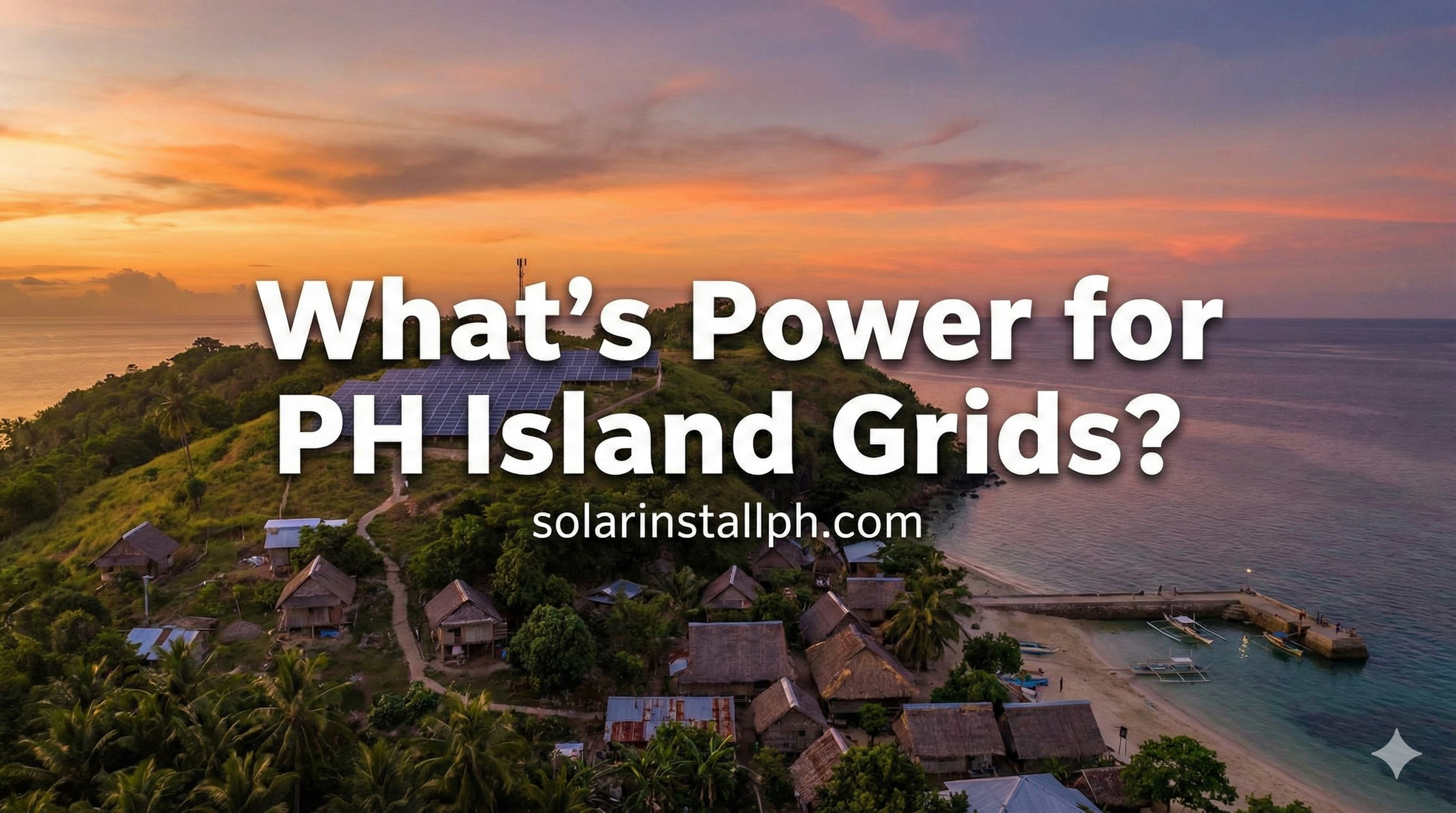
What's Power for PH Island Grids?
In the Philippines, an archipelago of over 7,600 islands, "the grid" isn't a single, unified entity. While major transmission backbones like the Mindanao-Visayas Interconnection Project (MVIP), energized in January 2024, have finally linked our three main island groups into one national system, thousands of remote communities remain physically isolated. For these "off-grid" areas, power is not a guarantee—it is a daily logistical feat.
Understanding what powers these island grids in 2025 and 2026 reveals a landscape in transition, moving from expensive, polluting diesel toward decentralized, indigenous energy.
The Diesel Dilemma: The Traditional Powerhouse
For decades, the backbone of missionary electrification has been the Small Power Utilities Group (SPUG), managed by the National Power Corporation (NPC). Most SPUG plants are diesel-powered. While reliable in the sense that they can generate power as long as there is fuel, they face three massive hurdles in the Philippine setting:
Prohibitive Costs: Generating electricity from diesel in remote areas can be up to six times more expensive than on the main grid.
Logistical Fragility: Transporting fuel to a remote island in the Visayas or Mindanao can add 20% or more to the cost per liter. During typhoon season, fuel barges often cannot dock, leading to "rotational brownouts" simply because the tank is empty.
Subsidy Dependence: Because residents cannot afford the "true cost" of diesel power, the government uses the Universal Charge for Missionary Electrification (UCME) to bridge the gap. As of 2023, the NPC was reportedly losing roughly ₱1 billion a month due to high fuel prices, highlighting the unsustainability of this model.
The Rise of Solar-Diesel Hybridization
The most significant shift currently underway is hybridization. Instead of relying solely on diesel, island grids are being upgraded with solar PV arrays and Battery Energy Storage Systems (BESS).
In this setup, solar panels provide the bulk of the power during the day, allowing diesel engines to be throttled down or turned off entirely. The batteries store excess sunlit energy to smooth out fluctuations from cloud cover. Research on Philippine island grids shows that shifting to a solar photovoltaics-battery-diesel hybrid system can reduce the levelized cost of electricity by an average of 20%.
For those looking to understand how these systems work on a smaller scale, exploring a DIY solar guide can provide insight into the basic components used in decentralized setups.
The Policy Drivers: Microgrid Systems Act
To accelerate this transition, the government enacted Republic Act 11646, or the Microgrid Systems Act. This law allows private "New Power Providers" (NPPs) and "Qualified Third Parties" (QTPs) to enter unserved or underserved areas without the need for a traditional franchise.
Key impacts of this policy in 2025 include:
Total Electrification Goal: The government is pushing for 100% electrification by 2028.
Competitive Selection: Private companies now compete to provide the most cost-effective hybrid power solutions for islands, often outperforming traditional diesel-only cooperatives.
Energy Storage Mandates: Recent legislative progress, such as the Energy Storage Systems (ESS) Act passed by the House in early 2026, aims to stabilize these island grids further by incentivizing large-scale battery deployments.
Challenges to Island Integration
Despite the abundance of sun, powering an island isn't without technical "friction." Integrating variable solar energy into a small, standalone grid is a complex task.
1. Technical Stability
On a large grid like Luzon's, if one solar farm's output drops due to a cloud, other plants compensate. On a small island grid, that same cloud can cause a "voltage swing" that triggers a blackout. This is why advanced solar monitoring apps and smart inverters are critical for local grid operators to maintain balance.
2. Environmental Hazards
Island grids face the harshest of Philippine conditions. Salt air corrosion can eat through low-grade mounting systems in months, and typhoons can rip panels off roofs if they aren't engineered for high wind loads. For island residents, choosing premium solar brands isn't about luxury; it's about survival.
3. The 24/7 Energy Gap
Without sufficient battery capacity, solar-powered islands still go dark at night or revert to expensive diesel. Sizing a system correctly to meet "night-time peaks" (when everyone turns on lights and fans) is the most common engineering challenge. Homeowners in these areas can learn from solar battery capacity guides to understand how to size their own backup needs.
The Future: Micro-Nuclear and Beyond
While solar and batteries are the immediate solution, the Philippine government is also exploring "emerging technologies" for the 2030s. In late 2025, the Department of Energy (DOE) reaffirmed its commitment to exploring Small Modular Reactors (SMRs) or "micro-nuclear" plants as a potential carbon-free baseload for island grids that cannot support massive solar farms.
For now, the most practical step for most island-based businesses and households is to leverage existing incentives. Many are finding that their solar payback factors are actually better on islands than in Manila because they are displacing much more expensive diesel power rather than just grid-priced electricity.
FAQ
Why can't we just connect all islands with underwater cables?
While the NGCP is working on this, underwater cables are incredibly expensive and technically difficult to lay across deep trenches or through areas with strong currents. Interconnecting every tiny island isn't always "economically viable," which is why localized off-grid solar is often the more immediate solution.
Is solar power reliable enough for a hospital on an island?
On its own, no. But when integrated into a hybrid system with batteries and a backup generator, it can be more reliable than a central grid that is prone to transmission line failures during storms.
Can I sell my solar power to my neighbors on an island?
Under the Microgrid Systems Act, specific "QTP" entities can distribute power to a community. For individual households, peer-to-peer energy trading is still in the pilot and regulatory discussion phase in the Philippines.
Powering our islands is no longer about waiting for a cable to arrive from the mainland. It is about using the sunlight that hits our roofs today to build a more resilient, localized energy future.
Would you like me to help you compare the costs of a hybrid solar system versus a standard diesel generator for your island property?