
Grants for Philippine Residences: 7 Ways
Let’s rip the bandage off immediately: if you are a middle-class homeowner in Metro Manila, Cebu, or Davao looking for a government website where you click "Apply" and receive a free check to buy solar panels, stop looking. That website does not exist.
In the Philippines, the term "grant" is often misunderstood. Unlike the US or Australia, where direct cash rebates (STCs or Federal Tax Credits) are handed out to individual homeowners, our government’s support mechanism under Republic Act 9513 (The Renewable Energy Act of 2008) operates differently.
Instead of handing you cash, the Philippine system offers subsidies, exemptions, and specialized financing that effectively function as grants by reducing your upfront cost or accelerating your payback period.
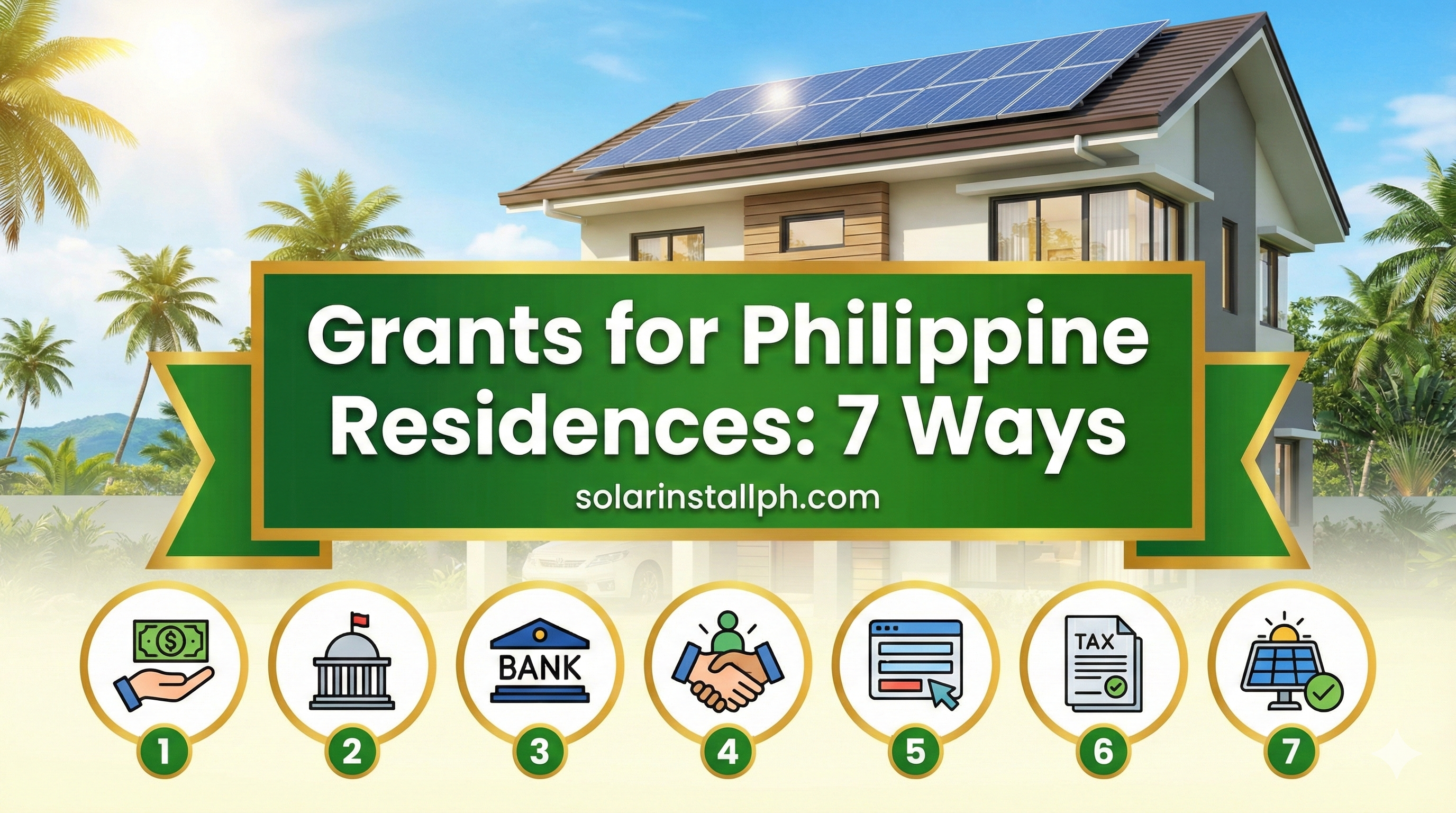
If you want to fund your solar system without paying 100% cash upfront, these are the 7 reliable financial pathways available to Filipino residences in 2025.
1. The "Hidden Grant": Net Metering Credits
While not a cash handout, this is the single most powerful financial subsidy available to Filipino homeowners. Think of it as a recurring monthly grant from your Distribution Utility (DU).
Without Net Metering, any solar energy you produce but don’t use immediately is wasted—it flows into the grid for free. Under the Net Metering program, the law mandates that Meralco (or your local electric coop) must "buy" that excess power from you.
How it functions as a grant
The utility pays you in bill credits.
The Math: If you export 200kWh of power, your bill is credited based on the "generation charge" (roughly ₱7–₱8 per kWh).
The Result: This can lower your bill to zero or even negative values. These credits roll over. We have seen homeowners accumulate enough credits in January and February to completely offset their bills in the expensive summer months of April and May.
To navigate the application process specifically for the country's largest utility, read our practitioner’s guide to Meralco Net Metering.
2. Pag-IBIG Home Improvement Loan
This is the closest thing to a "public fund" accessible to the average Filipino employee. The Pag-IBIG Fund (HDMF) explicitly recognizes solar panel installation as a valid purpose for their Home Improvement Loan.
Why it beats a bank loan
Interest Rates: Pag-IBIG rates are significantly lower than standard personal loans from commercial banks.
Terms: You can spread the payments over 20 or even 30 years. This drastically lowers your monthly amortization, often making the monthly loan payment lower than the electricity savings the system generates.
Cash Flow Positive: If your solar system saves you ₱5,000 a month and your Pag-IBIG amortization is ₱3,500, you are cash-flow positive from Day 1.
The paperwork can be tedious, but the financial logic is undeniable. For a breakdown of requirements and steps, consult our Pag-IBIG solar loan guide.
3. The 12% VAT Exemption (Zero-Rating)
This is a fiscal incentive that many homeowners miss because their installer pockets it instead of passing it on.
Under recent clarifications of the Renewable Energy Act and BIR Revenue Regulations, sales of renewable energy components and services by accredited suppliers can be VAT Zero-Rated. This effectively acts as a 12% discount on your system.
How to claim it
You cannot just demand this from any fly-by-night installer. The supplier must be registered with the Board of Investments (BOI) and the DOE.
The Trap: Many "colorum" installers will quote you a price that includes VAT, buy the panels VAT-free themselves, and keep the difference.
The Fix: Ask your installer explicitly: "Is this quote VAT-zero rated? Are you BOI registered?"
For the technical details on who qualifies for this tax break, review our article on VAT zero-rating for RE.
4. Green Financing Programs (BPI, BDO, Security Bank)
Recognizing the lack of direct government handouts, private banks have stepped up with "Green Energy" loan products. These are not standard personal loans; they are collateral-heavy products designed specifically for green home upgrades.
BPI Solar Mortgage: Allows you to top up your existing housing loan to cover solar panels. Since it’s tied to the mortgage, the interest rate is much lower than a credit card or salary loan.
Security Bank: Has offered specialized home improvement loans for energy efficiency.
The advantage here is speed. unlike Pag-IBIG, which can take months, a bank approval (especially if you are an existing client) can happen in weeks.
Compare the current offers from major Philippine banks in our solar bank loan comparison.
5. Socialized Housing Grants (The "Ning Ning" Model)
If you live in a socialized housing development, actual free grants are starting to appear.
In late 2024 and 2025, we saw the launch of projects like the Ning Ning Solar Rooftop Project in Naic, Cavite. Funded by international bodies like the UN Green Climate Fund and implemented by private developers, these programs install solar panels on low-income housing units at zero upfront cost to the resident.
The Mechanism: The resident usually pays a discounted rate for the power, or the system helps power common areas to lower association dues.
Eligibility: These are currently location-specific and developer-driven. You usually cannot apply individually; your housing community must be part of the program.
6. Landbank & DBP "Energy" Lending
For those running a home-based business, a sari-sari store, or a small piggery in the province, the government banks (Landbank and DBP) offer lending programs that blur the line between residential and commercial.
Landbank’s REAL Energy+ Program: While mostly for bigger players, it supports RE projects that promote energy efficiency.
The "Agri-Home" Angle: If your home is on agricultural land or part of an agribusiness, you may qualify for loans intended to modernize farm operations—which includes installing solar for pumps or lighting.
7. Installer In-House Financing (Deferred Payment)
Finally, there is the "Vendor Grant"—essentially 0% interest financing offered directly by large solar installation companies.
In the fierce competition of the 2025 market, many Tier 1 installers have stopped waiting for banks. They now offer:
30/70 Splits: Pay 30% down, and pay the rest over 12 months with post-dated checks (PDCs).
Credit Card Installments: 12 to 24 months at 0% interest using major credit cards.
While this isn't "free money," it prevents capital depletion. You keep your savings in the bank while the solar system "pays for itself" through monthly savings.
Before signing a deferred payment contract, ensure the math works in your favor by reading about installer in-house financing options.
Conclusion
Stop waiting for a government check in the mail. In the Philippine context, "grants" are found in the margins—in the 12% tax you don't pay, the bill credits you earn from Meralco, and the low-interest capital you borrow from Pag-IBIG.
The money is there, but it favors the proactive. Do your paperwork, claim your tax breaks, and lock in your net metering. That is how you get the system to pay for you.