
Home ROI: Power Savings Financing Options
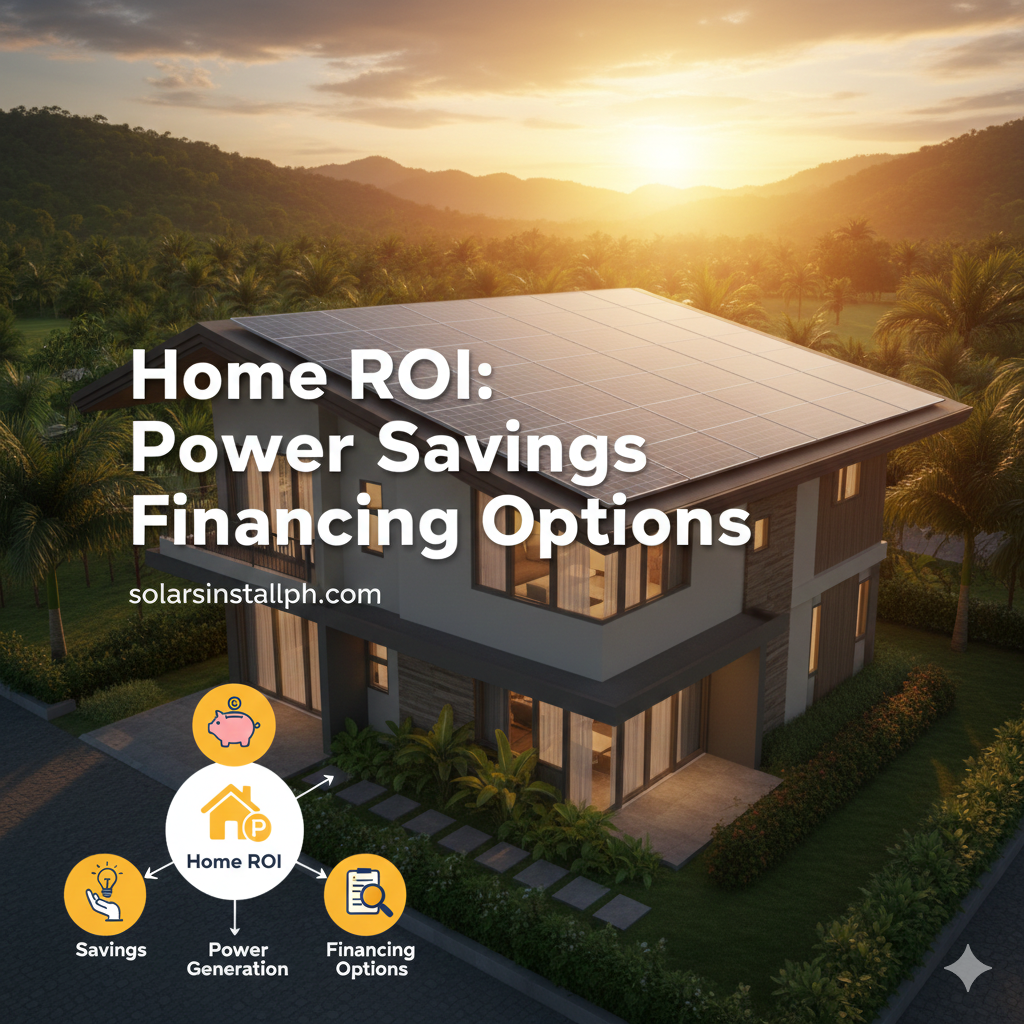
There is a fundamental misunderstanding about solar power in the Philippines. Most people treat it like buying a car—a depreciating expense you have to "save up for."
But a car consumes money. A solar system produces it.
In 2025, the smartest way to look at solar isn't just about the "Payback Period" (how many years to recover your cash). It’s about "Cash Flow" (how much money stays in your pocket this month).
If you finance your system correctly, you can achieve a "Bill Swap" where your monthly loan payment is lower than your old Meralco bill. You stop bleeding cash to the utility company and start building equity in your own power plant—often with zero money down.
Here is how to structure your solar financing to maximize your Return on Investment (ROI).
The New ROI Equation: Cash vs. OPM
Traditionally, Solar ROI is calculated on a cash basis.
Cost: ₱250,000
Savings: ₱8,000/month
Payback: ~3.5 years.
This is a great return. But it requires you to have ₱250,000 sitting in the bank doing nothing.
When you use Other People’s Money (OPM)—like a bank loan—the math changes. You keep your cash for emergencies or other investments. Instead, you use the bank's money to buy an asset that pays for itself.
If the monthly savings are ₱8,000 and the monthly loan amortization is ₱6,500, your ROI is technically infinite in the first month because you put zero cash out and gained ₱1,500 in positive cash flow.
For a deeper dive into running these numbers yourself, use our guide to calculating solar ROI and payback periods.
Option 1: Commercial Bank "Solar Mortgages" (The Sweet Spot)
As of 2025, major Philippine banks have realized that solar panels are low-risk assets. They now offer specialized "Green Loans" or "Solar Mortgages" that are far cheaper than personal loans.
Top Contenders
BPI Green Solutions: Offers rates around 7% to 9% per annum with terms up to 7 years. They also have a partnership with integrators like Helios to streamline the process.
RCBC Solar Mortgage: Offers specialized rates hovering between 7.75% and 8.50% depending on the fixing period, with loan terms up to 5–7 years.
Security Bank: Allows "Top-Up" loans on existing mortgages specifically for solar panel acquisition.
The ROI Impact
Because these loans have longer terms (5 to 7 years) compared to credit cards (2 years), the monthly amortization is lower. This makes it easier to achieve Positive Cash Flow immediately.
Scenario:
System Cost: ₱300,000
Loan Term: 7 Years @ 8% interest
Monthly Amortization: ~₱4,600
Monthly Solar Savings: ~₱9,000
Net Gain: +₱4,400 per month
You are immediately richer by ₱4,400 every month, without spending a single peso upfront.
Check our comparison of current solar bank loan offers to see which bank fits your profile.
Option 2: Pag-IBIG Home Improvement Loan (The Long Game)
If you want the absolute lowest cost of money, Pag-IBIG is the king.
The Pag-IBIG Home Improvement Loan covers solar installation. The interest rates are unbeatable:
5.75% per annum (1-year fixing).
6.25% per annum (3-year fixing).
The Pros & Cons
Pro: Lowest interest means you pay the least amount to the bank over time.
Con: It is a Real Estate Mortgage. You must surrender your land title (TCT) as collateral.
Con: Processing is slow (1–3 months).
The ROI Impact
Because Pag-IBIG allows terms up to 30 years, you can make your monthly payments tiny. However, do not stretch a solar loan to 30 years. The equipment warranty is usually 25 years, and inverters last 10–12 years. We recommend capping your term at 5 years to match the equipment lifecycle.
Read our step-by-step Pag-IBIG solar application guide to navigate the paperwork.
Option 3: Credit Card "0% Interest" (The Convenience Trap)
Many installers offer "0% Interest for 12/24 Months" via Metrobank, BDO, or BPI credit cards.
The Hidden ROI Killer
"0% Interest" is a marketing term. In reality, there is almost always a Cash Price vs. Installment Price difference.
Cash Price: ₱240,000
Installment Price: ₱265,000
That ₱25,000 difference is the interest. On a 2-year term, that is effectively ~5% interest flat per year.
When to Use It
This option kills your immediate cash flow because the term is short (12–24 months). A ₱265,000 system over 24 months is ₱11,000/month. If your savings are only ₱8,000, you are negative ₱3,000 per month for two years.
However, once paid off in Year 2, you own the system free and clear. This is best for people who want to be debt-free quickly and don't mind a temporary cash flow dip.
See our analysis of installer in-house financing vs. bank loans for more on these hidden markups.
The "Hidden" Costs That Affect ROI
When calculating your financing ROI, you must include the "invisible" costs that banks and installers don't headline.
Bank Fees: Processing fees, appraisal fees, and mortgage registration fees can total ₱15,000 to ₱30,000 upfront. This extends your ROI payback by a few months.
Net Metering Costs: Financing rarely covers the Meralco application fees (Bill Deposit adjustment, Yellow Card, etc.), which can run ₱15,000+.
Insurance: Banks often require "Fire and Allied Perils" insurance on the equipment, costing ~₱2,000/year.
If you don't factor these in, your "Bill Swap" might turn negative in the first year. For a full breakdown of total project costs, refer to our residential solar cost guide.
How to Calculate Your Personal ROI
To decide which financing option is right for you, follow this simple logic:
Determine your "Grid Cost": Average Monthly Bill ÷ kWh rate. (e.g., ₱10,000 ÷ ₱12 = 833 kWh).
Get a Quote: Ask an installer for a system that offsets 70–80% of that usage (never 100%, as Net Metering rates are lower).
Compare Monthly Outflows:
Scenario A (Cash): ₱250k out now. ₱0 monthly payment. ₱8k monthly savings.
Scenario B (Bank Loan): ₱0 out now. ₱5k monthly payment. ₱8k monthly savings. Net gain: ₱3k/month.
Pick Your Priority: Do you want to save maximum pesos over 20 years (Cash)? Or do you want extra cash in your pocket today (Loan)?
Conclusion
Financing your solar system is no longer a sign that you "can't afford it." It is a strategic move to leverage low-interest green funds to defeat high-interest utility inflation.
If you can get a loan at 7% (Bank/Pag-IBIG) and electricity prices are rising at 5–10% per year, borrowing money to go solar is one of the safest financial hedges you can make in the Philippines today.
Don't wait to save up the cash. Every month you wait is another month you pay a bill you will never get back.