
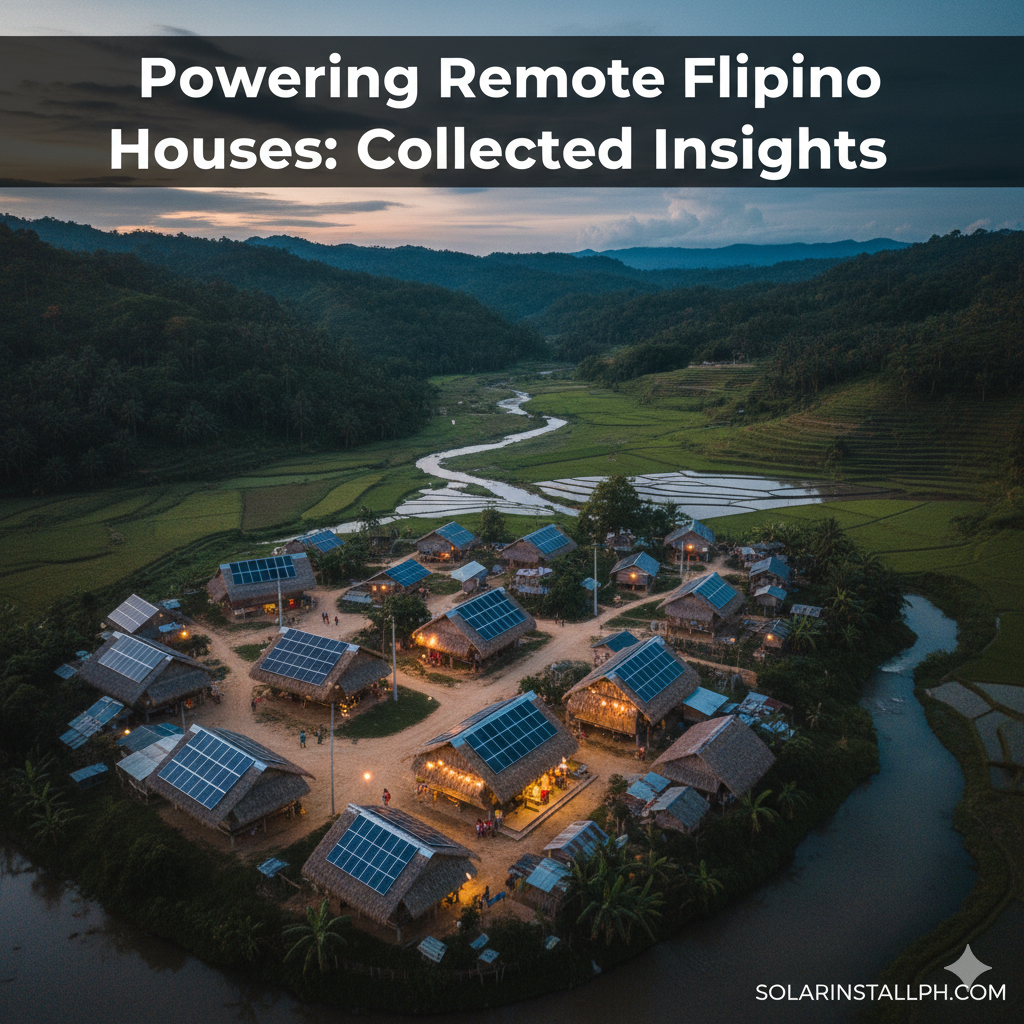
Powering Remote Filipino Houses: Collected Insights
For a homeowner in a remote province or a secluded island in the Philippines, electricity is often a luxury defined by instability. Whether you are dealing with a weak "end-of-the-line" connection from a local electric cooperative or you are completely off the grid, the reliance on expensive diesel generators or kerosene lamps is no longer the only option. In 2025, the maturation of solar technology and storage has made independent power a practical reality for Filipino households that the traditional grid has left behind.
The Reality of Remote Electrification in the Philippines
Living far from the urban centers of Luzon, Cebu, or Davao comes with a specific set of energy challenges. Most remote houses are served by Small Power Utilities Groups (SPUG) or missionary electrification projects that often limit power to only 4 to 8 hours a day. Even where a grid exists, the "brownout" is a weekly or even daily occurrence caused by aging distribution lines and the constant threat of weather-related damage.
The economic cost is also higher. While a resident in Manila might complain about Meralco rates, a remote household using a small diesel generator can easily spend over 50 pesos per kWh when fuel transport and maintenance are factored in. This makes the transition to off-grid solar systems an investment in energy security rather than just a way to save on monthly bills.
Choosing Between Off-Grid and Hybrid Systems
For a remote house, the choice of system architecture is the most critical decision. It defines how much freedom you have from the local utility and how much you will need to invest upfront.
Pure Off-Grid Systems
In a pure off-grid setup, your house is a self-contained power plant. There is no connection to a utility company. This requires a significant battery bank to ensure that you have power during the night and throughout consecutive rainy days. In the Philippines, we typically design for at least two to three days of "autonomy," meaning the batteries can carry the load even if there is zero sun.
Hybrid Systems for Weak Grids
If you have a grid connection but it is unreliable, a hybrid system is often the smarter choice. These systems stay connected to the cooperative but prioritize solar and battery power. When the grid fails, the system switches to "island mode" instantly. This is the primary solution for families seeking dependable solar brownout backup in areas where the local cooperative is prone to frequent line faults.
Battery Technology: The Heart of Remote Power
In a remote setting, your batteries are more important than your panels. If a panel fails, you lose a fraction of your charging capacity. If your battery bank fails, your house goes dark.
As of 2025, the industry has moved decisively away from lead-acid (deep cycle) batteries toward Lithium Iron Phosphate (LiFePO4 or LFP). While the initial cost of LFP is higher, the "cost per cycle" is significantly lower. A standard lead-acid battery might last 2 to 3 years in a hot Philippine climate, whereas a well-managed LFP battery can last 10 years or more.
Understanding your solar battery capacity needs is vital. For a typical remote house running a refrigerator, several LED lights, fans, and a laptop, a 5kWh to 10kWh battery bank is usually the minimum starting point. Undersizing the battery leads to deep discharges that shorten the equipment's life, especially during the monsoon season when charging is limited.
Structural Resilience in the Typhoon Belt
A remote house is often more exposed to the elements. Whether it is a coastal home facing salt-air corrosion or a mountain hut facing high-altitude winds, your mounting system must be over-engineered.
The Philippines experiences roughly 20 typhoons a year. A common mistake in remote DIY installations is using flimsy aluminum brackets or improper roof attachments. For a solar array to survive a Signal No. 4 typhoon, it must be secured with stainless steel hardware and rails rated for at least 250kph wind loads. We often emphasize solar typhoon resistance because in a remote area, help for repairs is days or weeks away. If your panels fly off during a storm, you aren't just losing money; you are losing your only source of light and communication.
Key Structural Considerations:
Wind Load: Use specialized mounting kits that account for the specific pitch and material of your roof.
Corrosion Resistance: In coastal areas like Siargao or Palawan, only use anodized aluminum and 304 or 316-grade stainless steel.
Roof Integrity: Ensure the rafters (C-purlins) can handle the added weight and the "uplift" force created during high winds.
Practical Maintenance for Isolated Sites
One of the biggest hurdles for remote solar is the lack of nearby technical support. If your inverter throws an error code in a remote part of Bukidnon, you cannot simply call a technician to arrive within the hour.
This makes regular solar panel maintenance and upkeep a mandatory skill for the homeowner. Simple tasks like cleaning dust or bird droppings from the panels can improve efficiency by 10% to 15%. Checking terminal connections for tightness and signs of heat (discoloration) prevents the most common cause of system fires: loose electrical contacts.
The Spare Parts Strategy
For truly isolated homes, we recommend keeping a small "critical spares" kit. This includes:
Spare DC and AC breakers.
Extra fuses for the battery and PV strings.
A basic digital multimeter to troubleshoot voltages.
Standard MC4 connectors and a crimping tool.
The Economics of Going Remote Solar
The upfront cost of a robust off-grid system in the Philippines ranges from 150,000 to 500,000 pesos for a typical residential load. While this seems high, you must compare it against the alternatives.
If a household spends 4,000 pesos a month on electricity plus another 2,000 pesos on fuel for a backup generator, they are looking at an annual energy cost of 72,000 pesos. A well-designed solar system can pay for itself in 4 to 6 years. Given that the panels are warranted for 25 years and modern LFP batteries for 10 years, the "free" energy generated after the payback period is pure profit.
For many Filipinos, the barrier remains the initial capital. There are now more options available than in previous years, including the Pag-IBIG solar loan program which allows members to include solar installation as part of a home improvement loan. This has been a game-changer for middle-income families building retirement homes in the provinces.
Common Mistakes in Remote Installations
Overselling the Capability: Homeowners often expect a small 1kW system to run an air conditioner all night. In an off-grid setup, air conditioning is a massive drain that requires a very large battery bank and a high-wattage inverter.
Poor Shading Analysis: A single leaf or a nearby coconut tree casting a shadow on one corner of a panel can drop the output of the entire string by 30% or more. In the tropics, vegetation grows fast; what is clear today might be a shade problem in six months.
Using Low-Quality Inverters: In remote sites, the "budget" inverters often fail due to heat or dust. A failed inverter is a total system blackout. It is better to buy a mid-range, reputable brand with a local service center in the Philippines than a generic one with no warranty support.
Incorrect Wiring Sizing: Using undersized wires leads to voltage drops. If your panels are 20 meters away from your batteries, you need thick DC cables to ensure the energy actually reaches the storage.
Conclusion
Powering a remote Filipino house with solar is no longer a "green" experiment; it is a strategic necessity for quality of life. By focusing on high-quality lithium storage, typhoon-rated mounting, and realistic load management, homeowners can bypass the failures of the national grid. The independence gained from a well-installed system provides more than just light; it provides the security to live and work anywhere in the archipelago without being tethered to a failing power line.
FAQ
Can I run a refrigerator 24/7 on a remote solar system?
Yes, but it requires careful sizing. An inverter-type refrigerator is highly recommended as it avoids the massive "surge" current of traditional compressors. You will typically need at least 1.5kW of panels and 5kWh of lithium storage to reliably run a fridge through the night and cloudy days.
What happens if it rains for a whole week?
This is why we include "days of autonomy" in the design. If your battery bank is sized correctly, it will carry your essential loads (lights, fans, phones) for 2 to 3 days without sun. For extended rainy weeks, a small backup gasoline generator can be used for a few hours to "top up" the batteries via the inverter's built-in charger.
Is it legal to go off-grid in the Philippines?
Yes. There are no laws requiring a private residential property to be connected to the distribution utility. However, if you are building a new house, you still need to comply with the Philippine Electrical Code and secure the necessary LGU permits for the structure and the electrical installation.