
Philippines Solar Loans: 7 Tips
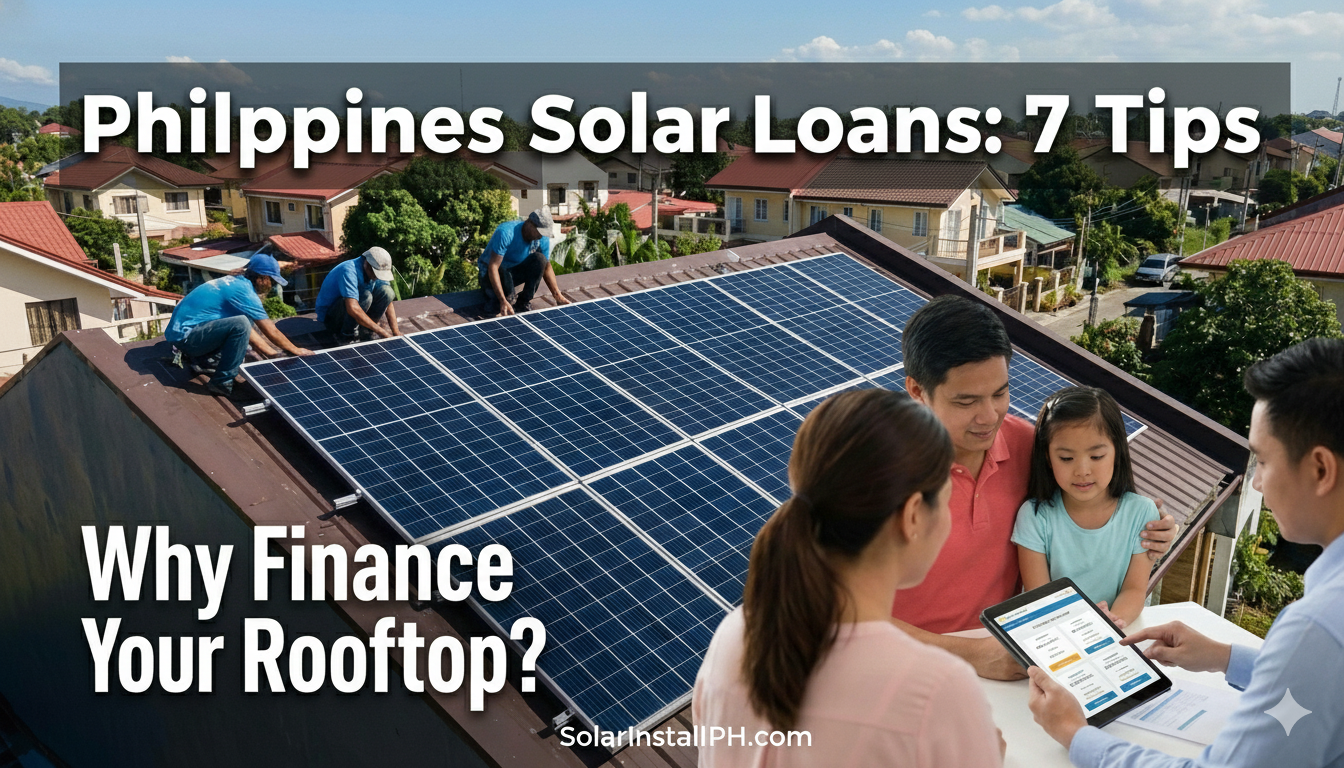
Let’s be real: The biggest hurdle to going solar in the Philippines isn’t the technology—it’s the price tag.
You see a quote for a 5kW hybrid system. It’s ₱350,000.
Your brain immediately does the math: "That’s a down payment on a car." Or, "I could renovate my kitchen with that."
So you hesitate. You tell yourself you’ll "save up" for it.
Here is the problem with saving up for solar: While you wait, you are still paying Meralco.
If your bill is ₱10,000 a month and you wait two years to buy in cash, you have just burned ₱240,000 in electricity payments that you will never see again. That is money that could have paid off 70% of your system.
In 2025, financing solar is often smarter than paying cash. Banks like BPI, RCBC, and Security Bank have woken up to the fact that solar panels are a low-risk asset. They want to lend to you.
Here are 7 professional tips to navigate the confusing world of solar loans in the Philippines so you can stop renting power and start owning it.
1. The "Bill Swap" Strategy is the Only Math That Matters
When you take out a car loan, it’s a pure expense. You pay the bank, and the car depreciates.
A solar loan is different. It is a Bill Swap.
You are taking the money you already pay to the utility company (a variable, rising expense) and shifting it to a bank loan (a fixed, temporary expense).
The Golden Rule: Your monthly loan amortization should be roughly equal to (or lower than) your current average electric bill.
Scenario A (Status Quo): You pay Meralco ₱12,000/month. In 5 years, you have paid ₱720,000+ (accounting for rate hikes), and you own nothing.
Scenario B (Financed Solar): You pay the bank ₱11,000/month for a 3-year loan. Your Meralco bill drops to ₱500. After 3 years, the loan is gone. You pay ₱500/month for the next 20 years.
If you can achieve a "Cash Flow Positive" swap from Day 1, financing is a no-brainer. To see if the numbers work for your roof, check our guide on calculating your solar ROI.
2. Match the Loan Term to the Hardware
One common mistake I see: taking a 20-year loan for a solar system.
While longer terms lower your monthly payment, they can trap you in debt longer than the lifespan of some components.
Solar Panels: Last 25+ years.
Inverters: Last 10–15 years.
Batteries: Last 5–10 years (depending on chemistry).
Do not finance a battery-heavy system for 20 years. You will be paying for the battery long after it has died and been recycled.
Ideal Term: 3 to 5 years. This aligns perfectly with the typical payback period of a grid-tied system.
3. Know Your "Green Loan" Options (They Are Cheaper)
In the past, you had to take a generic "Personal Loan" with high interest rates (12–24% per annum). Today, Philippine banks offer specific Green Energy Loans with preferential rates.
BPI Green Solutions: Offers "Solar Mortgage" options where you can top up your existing housing loan.
Security Bank: Has a dedicated "Solar Mortgage" product that allows loan terms up to 20 years for solar retrofits.
Pag-IBIG: Yes, the Home Improvement Loan explicitly covers solar panel installation.
Pro Tip: Always ask for the "Green" or "Home Improvement" rate. Never settle for the standard Personal Loan rate without asking. The difference in interest can save you ₱50,000 over the life of the loan.
4. Pag-IBIG is Cheap but Slow
Using your Pag-IBIG Fund is the most affordable route on paper. Interest rates can be as low as 5.75% per annum (subject to repricing).
However, treat this like a house construction loan. It is not quick cash.
Requirements: Bill of materials, building plans, tax declarations, and potentially a mortgage annotation on your property title.
Timeline: Expect 1 to 3 months of processing.
The Catch: You usually need to pay the installer first (or find an installer willing to wait), as Pag-IBIG releases checks in tranches based on project completion.
If you have the patience, it’s the cheapest money in town. Read our detailed walkthrough on applying for a Pag-IBIG solar loan.
5. "0% Interest" Credit Card Installments Have Limits
For smaller systems (3kW to 5kW), many installers now offer 0% interest for 12 or 24 months via credit cards (BPI, Metrobank, BDO). BPI, for instance, runs specific promos with solar merchants for up to 24 months Real 0% SIP.
The Hidden Trap:
Many installers have two prices: a "Cash Price" and a "Regular/Installment Price."
The Installment Price is often 5% to 10% higher to cover the bank fees. So, while the bank calls it "0% interest," you are effectively paying an upfront interest fee disguised as a higher price.
Always ask: "What is the cash discount?"
If the cash discount is ₱25,000, and you choose to swipe for 0% installment, you are essentially paying ₱25,000 interest. Calculate if a bank loan would be cheaper.
6. Installer In-House Financing: The "Easy" Button
If you don't want to deal with bank paperwork, some larger solar companies offer in-house financing.
Pros: Fast approval, less documentation, integrated with the installation contract.
Cons: Higher effective interest rates, large down payments (usually 30–50%).
This is best for business owners who want to keep their bank credit lines open for their operations. Before signing, review the terms carefully using our guide on installer in-house financing.
7. The Bank Needs a "Legit" Quote
You cannot get a bank loan for a DIY project where you buy panels on Shopee and hire a neighborhood electrician.
Banks require:
A formal quotation from a reputable company.
Ideally, a PCAB-licensed contractor.
Sometimes, a projected savings analysis (ROI).
The bank needs to know the asset they are financing is real and safe. A quote from a "fly-by-night" installer with no office address will likely get your loan rejected. Ensure your quote includes all the necessary warranties and technical specs. (See: What should be in your solar quote).
Conclusion
Financing your solar system changes the conversation from "Can I afford this?" to "Why am I still paying Meralco?"
If you are paying more than ₱5,000 a month in electricity, you are already making the monthly payments for a solar system—you just don't have the panels to show for it.
Your Next Step:
Gather your last 3 electricity bills and get a formal quote from a vetted installer. Then, bring that quote to your bank (start with the one where you have your payroll or savings) and ask for their Green Loan officer.
Stop saving up to save money. In the Philippine energy market, speed is your biggest asset.