
Grid Metering Woes: What Others Say
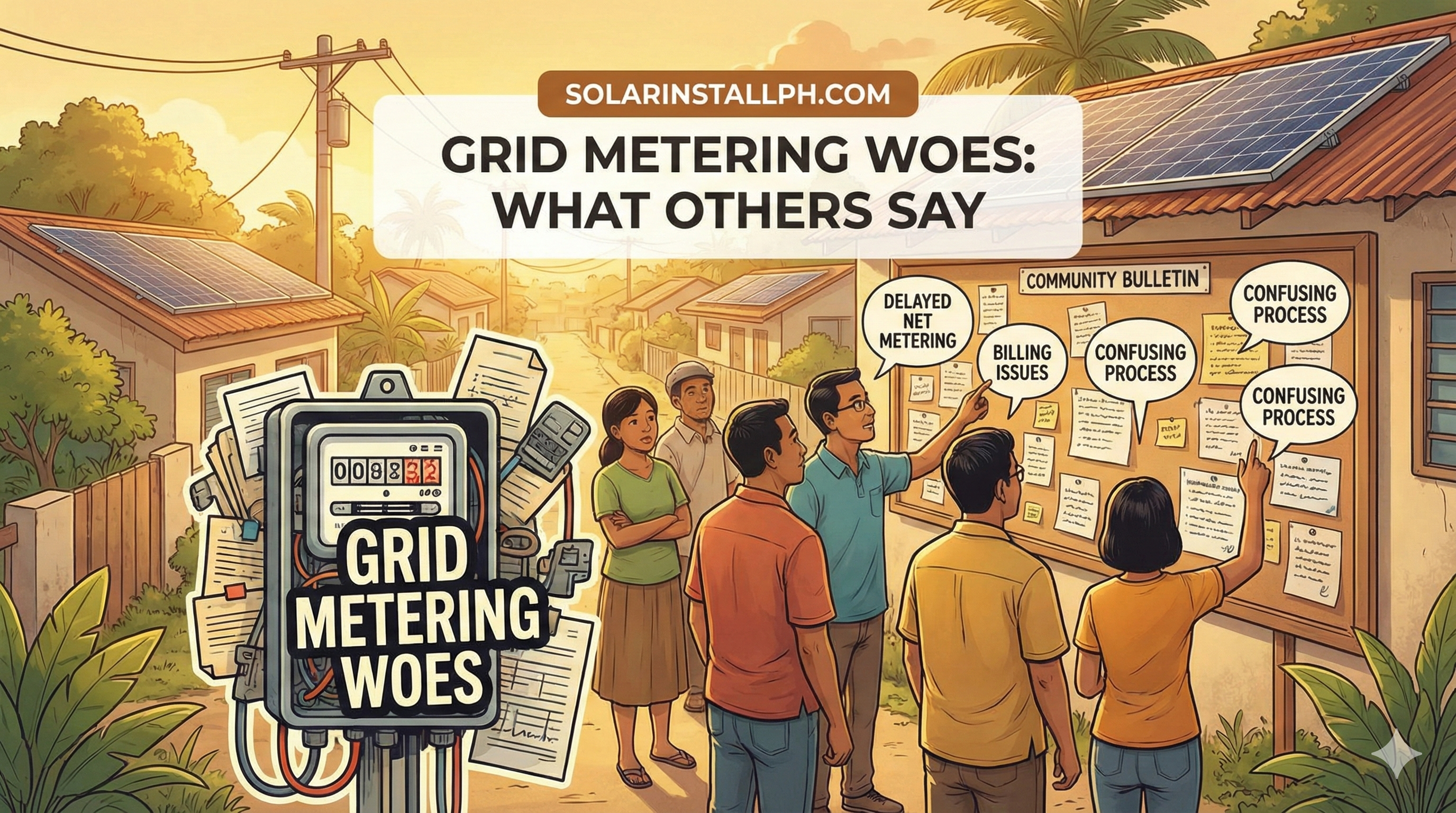
If you hang around Philippine solar Facebook groups or forums long enough, you will notice a pattern. There is the "Honeymoon Phase" (posting photos of the newly installed panels), followed swiftly by the "Bureaucracy Phase" (posting angry rants about Meralco, electric coops, or City Hall).
While solar technology itself is fantastic, the process of connecting it to the grid—officially known as Net Metering—is often where the dream hits a speed bump.
If you are currently waiting for your bidirectional meter or staring at a confusing bill, you are not alone. Here is a compilation of the most common "grid metering woes" Filipino homeowners face in 2024-2025, and the reality behind the complaints.
Woe #1: "It’s Been 6 Months and I’m Still Waiting"
This is the number one complaint. You paid for the system in cash. The installer finished the roof work in two days. But five months later, you are still not officially connected.
The Reality:
The Net Metering application process in the Philippines is a relay race involving three distinct entities:
The Distribution Utility (DU): Meralco, VECO, or your local Electric Coop (EC).
The Local Government Unit (LGU): Your City Hall’s Office of the Building Official (OBO).
The Energy Regulatory Commission (ERC): The national regulator.
A delay in one office stops the whole chain. For example, some homeowners report that their LGU requires "as-built" plans signed by five different engineers before issuing the Certificate of Final Electrical Inspection (CFEI). Others get stuck at the utility level, waiting weeks just for a "yellow card" or a meter socket inspection.
While the Department of Energy (DOE) has pushed for faster processing, the reality on the ground is that 3 to 6 months is a standard wait time.
What you can do:
Be proactive. Ask your installer for the "tracker" number of your application. Follow up with your LGU personally. If you are a Meralco customer, familiarize yourself with Meralco's specific process so you know exactly which document is missing.
Woe #2: "My Bill Went UP After Installing Solar!"
This is the stuff of nightmares. A homeowner installs a 5kW system, turns it on without waiting for the new meter, and expects their bill to drop. Instead, their next bill is higher than before.
The Reality:
This happens when you export power through an old unidirectional digital meter. These meters are "dumb"—they cannot tell the difference between power coming in (consumption) and power going out (export). They simply count the flow of electrons.
If you send 200kWh of excess solar power to the grid, the old meter reads it as 200kWh of consumption and charges you for it. You are literally paying the utility for the privilege of giving them free electricity.
The Fix:
Never turn off your "Zero Export" limiter until the utility installs the Bi-Directional Meter. This is a non-negotiable rule.
Woe #3: "Why Is My Export Rate So Low?"
"I buy electricity at ₱12, but Meralco only buys it from me at ₱5. This is a scam!"
We hear this sentiment daily. Homeowners expect a 1-for-1 exchange (Net Metering), but what they get is technically Net Billing.
The Reality:
Under the Renewable Energy Act of 2008 (RA 9513), the utility is required to pay you the "Blended Generation Rate" for your exports.
Retail Rate (₱12/kWh): Includes generation, transmission, distribution, system loss, taxes, and subsidies.
Export Rate (₱5-7/kWh): Only covers the generation cost. Since you aren't using the transmission or distribution lines to deliver power to yourself, you don't get paid for those components.
While it feels unfair, it is still money in your pocket. That ₱5/kWh is better than ₱0/kWh (which is what you get if you don't export). To understand the math better, read our deep dive on the rules behind the system.
Woe #4: "The 'Hidden' Costs of Applying"
Many homeowners budget for the solar panels but forget to budget for the paperwork. Then the "surprise" fees start rolling in.
The Reality:
The application isn't free.
Distribution Impact Study (DIS): The utility charges a fee (ranging from ₱1,500 to over ₱5,000) to simulate how your system affects the grid.
Permit Fees: LGUs charge for Electrical Permits and CFEIs. This can range from ₱2,000 to ₱10,000 depending on your city.
Check Meters: Some Electric Coops require you to buy a specific brand of REC meter, which can cost another ₱5,000+.
The most painful "hidden cost"? Transformer Upgrades. If the DIS reveals that your local transformer is already "saturated" (too many neighbors have solar), the utility might require you to pay for a transformer upgrade to handle your export. This can cost ₱50,000 or more, killing the ROI for smaller systems.
Woe #5: "The LGU Paper Chase"
"My installer said they handle the permits, but now they are asking me to go to City Hall."
The Reality:
Installers can do the technical legwork, but they cannot fix your tax problems.
To get a CFEI, the LGU often requires:
Updated Real Property Tax (Amilyar) payments.
The original Building Permit of your house (which many people lost 20 years ago).
Proof of ownership (Title/Deed of Sale).
If your house has illegal extensions or unpaid taxes, the solar application will expose them. This is why many people try skipping LGU permits, but that path leads to even bigger risks (voided insurance, inability to net meter).
Woe #6: "My Coop Doesn't Know How to Process This"
If you are a Meralco customer, the process is slow but defined. If you are with a small Electric Cooperative in the province, you might be the first person to ever apply.
The Reality:
Some smaller coops are unfamiliar with the ERC resolutions regarding Net Metering. They might demand requirements that don't exist, or claim they "don't allow" solar (which is illegal under the RE Act).
The Fix:
You (or your installer) may need to educate the coop. Print out the ERC regulations and politely show them the law. Patience is key here.
Woe #7: "The Bill is Confusing"
Finally, the meter is installed! You get your first bill... and you can't read it.
The Reality:
Your bill now has new line items: "Export Energy," "Generation Charge Adjustment," "Previous Reading," "Current Reading" for two different registers.
It is not intuitive. Often, the credit is not subtracted from the total amount but is applied to specific components.
If you don't know how to audit it, you might think you are being underpaid. We recommend learning how to read your new bill immediately so you can catch errors early.
Conclusion: Manage Your Expectations
The challenges of net metering are real, but they are temporary. The "woes" usually last for the first 4-6 months.
Once the system is active, the meter is swapped, and the credits start rolling in, the frustration fades. You stop worrying about the paperwork and start enjoying the fact that your electric bill is now ₱200 instead of ₱8,000.
The Takeaway:
Don't let the horror stories scare you off. Just go in with your eyes open. Budget for the delays, expect some bureaucratic friction, and hire an installer who has a dedicated "Liaison Officer" to fight these battles for you.
Next Step: Ask your neighbors who have solar: "Who handled your permits?" Their answer will tell you which installer knows how to navigate your specific City Hall and Utility.