
Why Net Metering Saves Electric Bills?
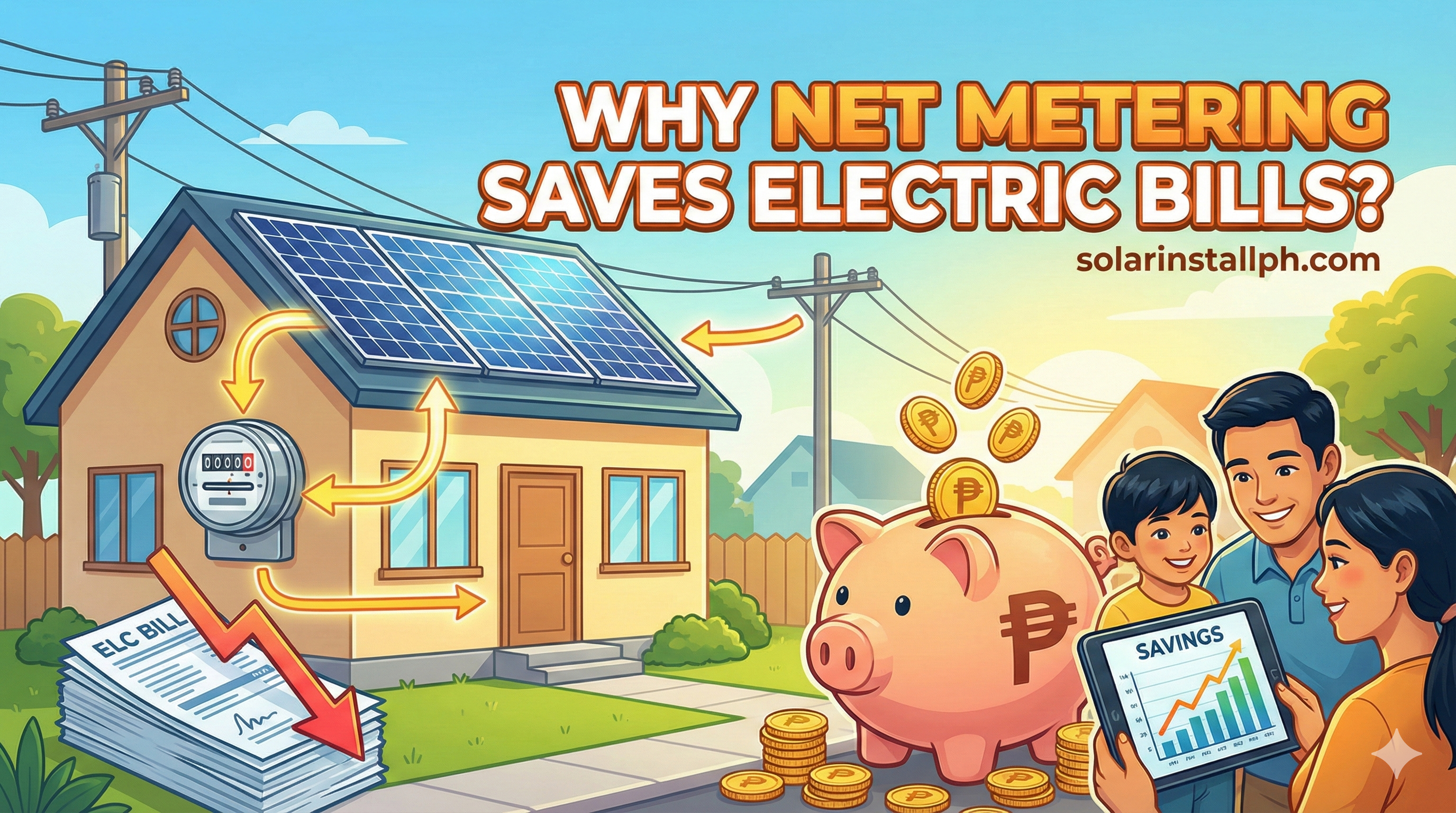
If you have solar panels—or are planning to get them—you have likely heard the term "Net Metering" thrown around as the holy grail of zero electric bills.
But in the Philippines, there is a lot of confusion about how it actually works. Some people think it’s a battery. Others think it’s a 1:1 trade where you give Meralco 1 kWh and get 1 kWh back later.
The reality is strictly financial. Net Metering is not a battery; it is an accounting mechanism. And understanding the specific math of the Philippine "Peso Credit" system is the difference between an electric bill that drops to ₱100 and one that stays stubbornly high.
Here is the practitioner’s guide to how Net Metering saves you money in 2025, and why it is the single most important policy for Filipino solar owners.
The Basic Concept: Your Grid as a Virtual Battery
Solar panels have a fundamental flaw: they produce the most power at noon when your house is often empty, and zero power at night when you are running the aircon.
Without Net Metering, any solar energy you don't use the millisecond it is generated flows out to the electric grid and is lost. You give it to the utility for free. Then, at night, you buy power from them at full price. This is a bad deal.
Net Metering fixes this by measuring that outflow. Under the Renewable Energy Act of 2008 (RA 9513), distribution utilities (DUs) like Meralco, VECO, or your local coop are required to install a Bi-Directional Meter. This meter reads two numbers:
Import: What you buy from the grid (mostly at night).
Export: What you send to the grid (your excess solar during the day).
The Philippine Math: Peso Credits vs. kWh Credits
This is where 90% of homeowners get confused. In some countries, like parts of the US, Net Metering is a 1-for-1 volume trade. If you export 100 kWh, you get 100 kWh back for free.
In the Philippines, it is a monetary trade.
When you export power, the utility buys it from you. However, they do not buy it at the Retail Rate (what you pay). They buy it at the Blended Generation Rate.
The "Buy High, Sell Low" Dynamic
Retail Rate (What you pay): Approx. ₱12.00 – ₱14.00 per kWh. This includes generation, transmission, distribution, taxes, and system loss charges.
Export Rate (What they pay you): Approx. ₱5.00 – ₱7.00 per kWh. This is purely the "generation cost" of electricity.
Because the utility is not charging you for distribution or taxes on power you sell to them, the export credit is roughly 50% of the retail price.
How This Affects Your Bill
To offset 1 kWh of night-time aircon use (worth ₱12), you need to export about 2 kWh of daytime solar (worth ₱6 each).
This "exchange rate" means you cannot just size a system to match your monthly average usage exactly. You usually need to produce more in the day to cover the cost difference at night.
For a deeper explanation on how these credits appear on your actual bill, you can read our breakdown of net metering savings and bill analysis.
The 2025 "Game Changer": Indefinite Credit Rollover
For years, a major frustration was that in some areas, if you had too many credits at the end of the year, they might expire or be hard to cash out.
However, recent updates to the ERC Net Metering Rules (Resolution No. 15, Series of 2025) have significantly improved the landscape for homeowners:
Non-Expiration: Net Metering credits now roll over indefinitely. You don't lose them at the end of the calendar year.
Transferability: If you sell your house, you can transfer those accumulated credits to the new owner.
Simplified Metering: The requirement for a separate REC (Renewable Energy Certificate) meter has been made optional, potentially lowering installation costs by using a calculation formula instead.
This makes Net Metering far more valuable. You can "bank" credits during the sunny summer months (March–May) and use them to offset higher bills during the rainy season when solar production drops.
How the Savings Actually Happen
Reducing your bill with Net Metering happens in two distinct stages.
Stage 1: Self-Consumption (The 100% Saving)
The best way to save money is not to sell power to Meralco, but to use it yourself.
When your solar panels are active and you turn on a washing machine, the power flows directly from the roof to the appliance. It never touches the meter.
Value: You avoid paying the full retail rate (₱12+).
Strategy: Shift heavy loads (laundry, pool pumps, cooking) to 10:00 AM – 2:00 PM.
Stage 2: The Export Offset (The 50% Saving)
Any power you don't use flows through the bi-directional meter to the grid. At the end of the month, Meralco calculates your total exports, multiplies them by the current generation rate, and subtracts that Peso amount from your total bill.
If your bill is ₱5,000 and you have ₱4,500 worth of export credits, you only pay ₱500 (plus the fixed metering charge).
For more details on the application workflow, check out our guide to the Meralco net metering application process.
The Trap: Why You Shouldn't Oversize
Since the export rate is lower than the import rate, you might think, "I'll just install a massive system to overpower the price difference."
This is risky. If you install a 10kW system for a house that only needs 3kW, you will generate massive amounts of cheap export credits. You might hit "Zero Bill," but your ROI (Return on Investment) will suffer.
You paid for extra panels and inverters.
You are selling the output of those extra panels at a 50% discount.
It would have been smarter to install a smaller system that covers your daytime load and just part of your night load.
Balancing your system size is critical. You can learn more about avoiding these errors in our article on solar sizing factors.
The Hidden "Lifeline" Rate Benefits
There is a secondary, often overlooked benefit to Net Metering. In the Philippines, residential electricity rates are tiered. The more you consume, the higher your rate often goes (due to the "lifeline" subsidy removal for high users).
By using solar and Net Metering:
You lower your billed consumption volume.
This might drop you into a lower consumption bracket, slightly reducing the per-kWh rate on the remaining power you do buy.
Is It Worth the Hassle?
Applying for Net Metering involves paperwork: the Distribution Impact Study (DIS), obtaining a Certificate of Final Electrical Inspection (CFEI) from your LGU, and paying for the meter upgrade.
Many homeowners ask if they can just skip it and go "Zero Export."
Zero Export: You install a device that chokes your solar production if you aren't using it. You waste potential power.
Net Metering: You monetize every watt you produce.
For 95% of grid-tied homes, Net Metering is mathematically superior. The cost of the permit application (usually ₱15,000–₱30,000 depending on your city and installer) is recovered within 1–2 years through the credits you earn. Without it, you are throwing away surplus energy every day.
For a clearer picture of the regulatory side, read our overview of the ERC Net Metering policies.
Conclusion: The Path to Zero
Net Metering is the mechanism that turns a solar system from a daytime appliance into a 24-hour bill reducer. It allows you to "store" your excess energy in the grid—not as electricity, but as cash credits.
While the "buy high, sell low" exchange rate in the Philippines requires smart system sizing, the ability to wipe out your bill is real. With the 2025 rules allowing indefinite credit rollover, the argument for Net Metering has never been stronger.
If you are ready to start the process, make sure you understand the requirements. Review the complete checklist for Net Metering applications to ensure your home is ready for the switch.