
Savings: Philippines Grid Benefits Explained
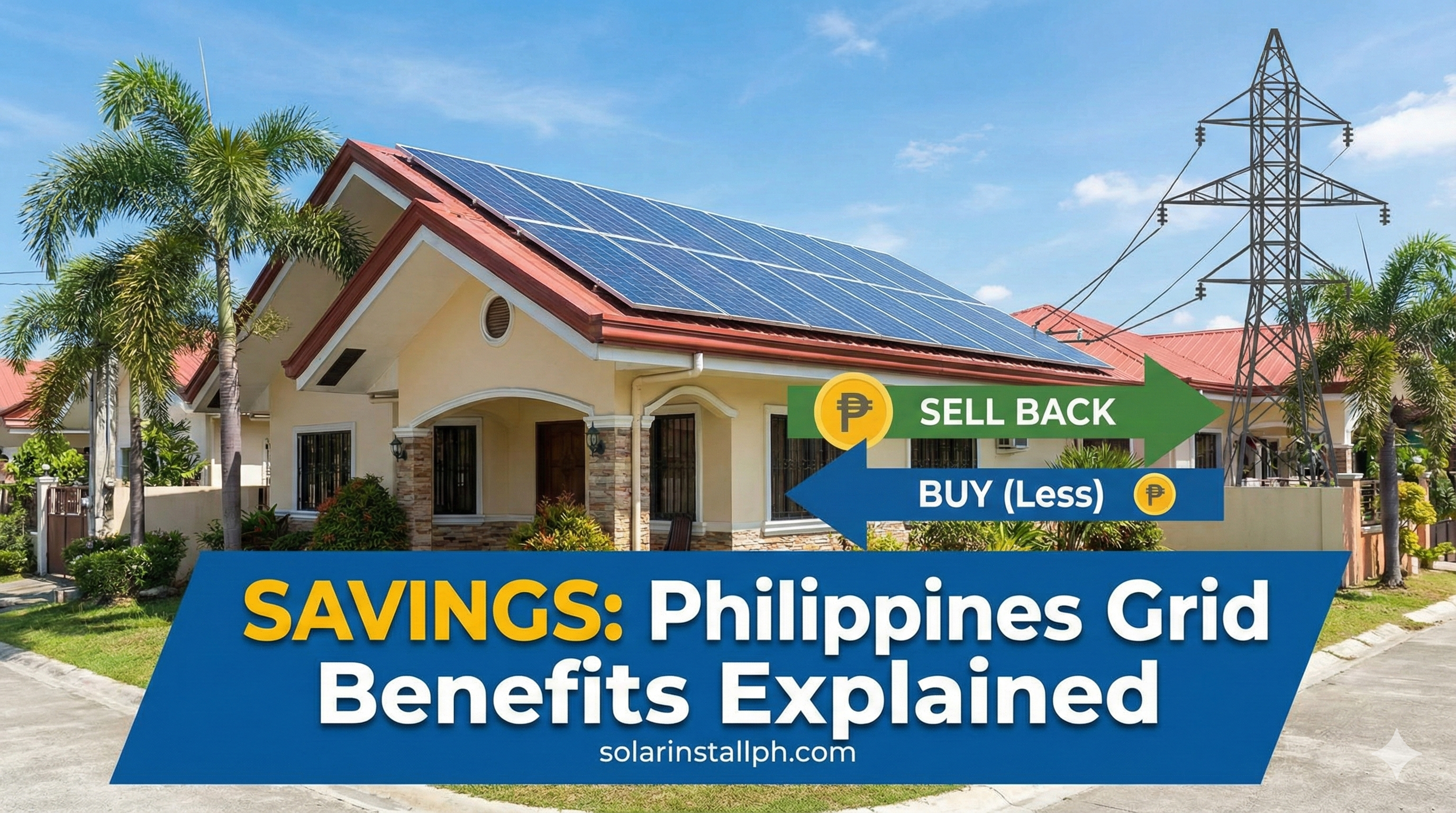
For most Filipinos, the power grid is a source of anxiety. It’s the bearer of the monthly Meralco or electric cooperative bill, a slip of paper that seems to only go up. We pay some of the highest rates in Southeast Asia, and our "grid reliability" often leaves us sweating in the dark during a yellow alert.
But if you are smart about it, the grid doesn't have to be just a drain on your wallet. Thanks to policies like Republic Act 9513 (The Renewable Energy Act of 2008), the grid can actually function as your bank.
If you are generating your own power—or even if you are just a strategic consumer—there are specific grid programs designed to lower your costs. Here is the practitioner’s guide to unlocking grid benefits in the Philippines.
Net Metering: The Crown Jewel
If you install solar panels and do not apply for Net Metering, you are leaving money on the table.
Net Metering is the only mechanism that allows residential homeowners (and businesses up to 100kWp capacity) to sell excess power back to the distribution utility (DU).
How The Savings Work
In a standard home, your solar panels produce the most power at noon. But your house might be empty because everyone is at work or school. Without Net Metering, that power disappears into the ether (or you have to throttle your inverter to stop producing).
With Net Metering, that excess energy flows out to the grid. The DU measures it and gives you a peso credit on your next bill.
The Exchange Rate: It is important to manage expectations. You do not get a 1:1 exchange. You buy power at the "Retail Rate" (approx. ₱12–₱13/kWh) but you sell it at the "Generation Charge" (approx. ₱7–₱8/kWh).
The Benefit: Even though it’s not 1:1, these credits accumulate. During cool months like January, you might export so much that your bill hits zero (or close to the lifeline rate). Those credits roll over to offset your bill during the hot, expensive summer months.
To understand the exact mechanics of how these pesos are calculated, read our breakdown of net metering credits.
The "Zero Export" Trap
We often hear homeowners say, "I don't want to deal with permits, I'll just go Zero Export."
This is a financial mistake. A "Zero Export" device clamps your solar production to match your house's consumption exactly. If you turn off an aircon, the panels stop producing, even if the sun is blazing. You are wasting potential energy that could have earned you credits.
While avoiding permits seems convenient, it significantly lengthens your return on investment (ROI). You are paying for 100% of the hardware but utilizing only 60–70% of its potential output.
For a deeper look at why this limits your savings, check our overview of zero export systems.
Meralco’s Peak / Off-Peak (POP) Program
You don't necessarily need solar panels to save money using grid programs. If you are a high-consumption household or business, Meralco offers a Peak / Off-Peak (POP) rate mechanism.
This relies on a "Time of Use" principle.
Peak Hours (Expensive): 8:00 AM to 9:00 PM (Mondays to Saturdays).
Off-Peak Hours (Cheap): 9:00 PM to 8:00 AM, and Sundays.
If you own an Electric Vehicle (EV) or run heavy machinery (like pool pumps or industrial laundry), switching to POP can slash your generation charge significantly—sometimes by nearly half during off-peak hours. The strategy is simple: run your heavy loads at night.
GEOP: For The Big Players
If your monthly electricity bill is roughly ₱190,000 or more (specifically, if your average peak demand is 100kW or higher), you have a powerful option called the Green Energy Option Program (GEOP).
GEOP breaks the monopoly of your local DU. Instead of being forced to buy power from Meralco or your local coop at their blended generation rate, you can sign a contract directly with a Renewable Energy Supplier.
The Benefit: You often get a cheaper, fixed rate per kWh.
The Perk: You are powered by 100% renewable energy, which is excellent for corporate sustainability goals and branding.
Tax Incentives: In many cases, the generation charge for RE supply is VAT-zero rated, providing an automatic 12% saving on that portion of the bill.
Is your business eligible? We detail the requirements in our guide to the GEOP program.
The Cost of Admission
Accessing these grid benefits requires legality. You cannot apply for Net Metering or GEOP with a "colorum" installation.
Distribution Impact Study (DIS): You pay a fee to the DU to ensure their transformer can handle your export.
C.F.E.I: You need a Certificate of Final Electrical Inspection from your City Hall.
Many homeowners balk at the initial cost of permits (often ₱15,000 to ₱30,000 depending on the city and installer fees). However, this is a one-time expense that unlocks 25 years of savings.
If you are navigating the Meralco territory specifically, we have a step-by-step Meralco Net Metering guide to help you prep your documents.
Conclusion
The Philippine grid is expensive, but it is not inflexible. The "savings" come from shifting your mindset: do not just be a passive payer.
Small Homes: Use Net Metering to bank your excess sun.
Big Homes/Biz: Use POP rates to shift consumption to cheap hours.
Large Facilities: Use GEOP to bypass the DU rates entirely.
The laws are there. The incentives are real. The only thing stopping you from lowering your rate is the paperwork—and a little bit of patience.
For a broader look at the regulatory landscape that makes this possible, review our summary of ERC Net Metering policies.