
What's The Grid Export Process?
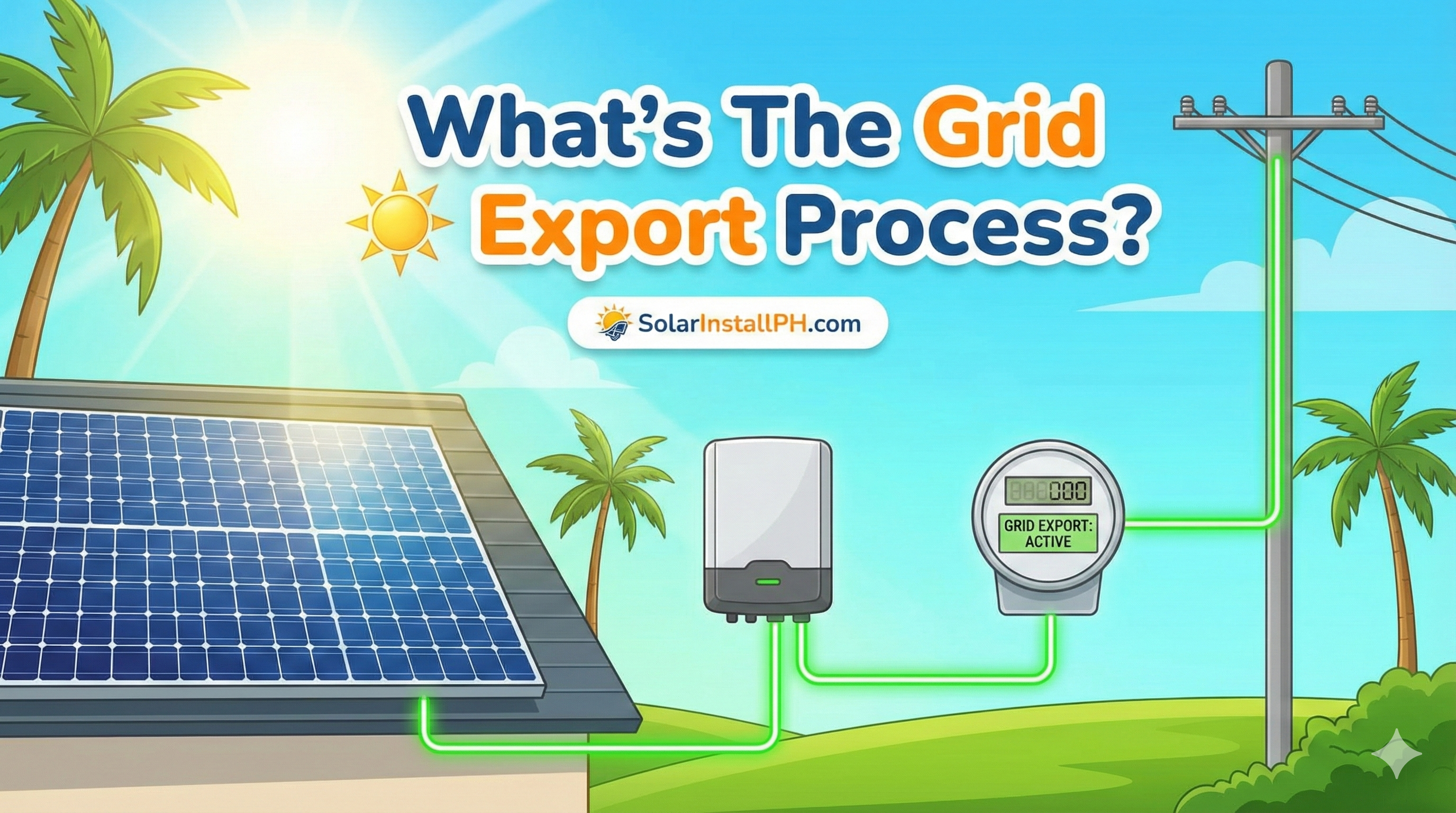
If you have installed solar panels in 2025, you have likely realized one painful truth: you are wasting power.
At 1:00 PM, when the Philippine sun is blasting your roof, your system might be generating 5 kilowatts (kW). But if your house is empty and you’re only running a fridge and a router (maybe 300 watts), that extra 4.7kW has nowhere to go.
Without "Grid Export" (officially known as Net Metering), that energy simply vanishes. Your inverter throttles down, and you lose the value of the electricity you produced.
The solution is to sell that power to the grid. But in the Philippines, this isn't as simple as flipping a switch. It involves Meralco (or your local coop), the ERC, your LGU, and a stack of paperwork that can take 3 to 6 months to process.
Here is the no-nonsense guide to the grid export process in the Philippines—how it works, what it costs, and why it is still worth the headache.
The "Net Metering" Mechanism: How It Works
First, let's clear up a common misconception. You are not "selling" electricity to Meralco like a power plant. You are banking credits.
Under Republic Act 9513 (The Renewable Energy Act of 2008), homeowners with systems up to 100kWp are allowed to export excess power.
Here is the simplified flow:
Production: Your panels generate power.
Self-Consumption: Your house uses what it needs first (this is where you save the most money).
Export: Any surplus flows out through a special Bi-Directional Meter to the grid.
Credit: Your utility measures this export and gives you a peso credit on your next bill.
The Catch: You buy electricity at the Retail Rate (approx. ₱12/kWh), but you are credited at the Blended Generation Rate (approx. ₱6-7/kWh). This is technically "Net Billing," not 1:1 Net Metering. It means you need to export roughly 2 kWh to offset the cost of buying 1 kWh at night.
For a deeper dive into the math of these credits, read our breakdown of how net metering credits are calculated.
Step 1: The Application & "DIS"
The process starts with your Distribution Utility (DU)—usually Meralco, VECO, or your local electric cooperative.
You cannot just apply yourself. You need a licensed Professional Electrical Engineer (PEE) to sign off on your electrical plans. This is why most homeowners pay their installer a "processing fee" (ranging from ₱15,000 to ₱30,000) to handle this legwork.
The Distribution Impact Study (DIS)
Once you submit your application, the utility performs a Distribution Impact Study.
What it is: The engineers simulate what happens if your solar system pushes power into their grid. They check if their transformers and lines can handle your extra voltage without blowing up.
The Cost: This used to be expensive, but recent guidelines have standardized fees. However, if the study shows your local transformer is already "full" (saturated with other solar homes), you might be asked to pay for a transformer upgrade—a nasty surprise that can cost upwards of ₱50,000.
Step 2: The LGU & The CFEI Nightmare
This is the bottleneck where 90% of applications get stuck.
Before Meralco changes your meter, they require a Certificate of Final Electrical Inspection (CFEI) from your City Hall.
To get a CFEI, you theoretically just need to show your electrical plan. In reality, many LGUs (Local Government Units) treat this as a chance to audit your entire house.
They may ask for your original Building Permit.
They may inspect unrelated electrical wirings.
They may require you to pay updated real estate taxes.
If you built your house 20 years ago and lost the blueprints, this can drag on for months. Some homeowners are tempted to bypass this, but operating without it is risky. See our article on the dangers of skipping LGU permits.
Step 3: ERC Certificate of Compliance (COC)
While you wrestle with City Hall, you also need to apply for a Certificate of Compliance (COC) from the Energy Regulatory Commission (ERC).
In the past, this was a manual process that took forever. As of late 2024/2025, the ERC has streamlined this significantly for systems under 100kW, but you still need to pay the COC application fee (around ₱1,500) and submit the technical forms.
Important: The ERC COC is your "license to operate" as a mini power plant. Without it, your utility legally cannot turn on your export meter.
Step 4: The Meter Replacement
Once you have the DIS results, the CFEI, and the COC (or at least proof of filing), you go back to the utility.
They will schedule a "meter change."
Bi-Directional Meter: Replaces your old meter. It has two registers: one for Import (what you buy) and one for Export (what you sell).
REC Meter: A second meter is often installed near your inverter to measure total generation for Renewable Energy Certificate tracking.
Timeline: From the day you submit complete documents, Meralco typically installs the meter within 2-3 weeks. The entire process from Day 1, however, usually takes 3 to 4 months.
For Meralco customers specifically, we have a detailed walkthrough of the Meralco net metering guidelines.
The "Zero Export" Purgatory
What happens during those 4 months of waiting?
You have two choices:
Leave the system off. (Painful).
Use "Zero Export" mode.
Most modern hybrid inverters (Deye, Growatt, Huawei) have a "Zero Export" or "Grid Limit" function. You install a CT sensor on your main wire. The inverter detects when you are about to send power to the grid and throttles itself down to match your house load exactly.
Warning: Do not export power before your bi-directional meter is installed. Old digital meters are "dumb"—they count exported power as consumption. If you export 500kWh without the new meter, Meralco will charge you for that 500kWh as if you used it!
If you are stuck in this phase, read our guide on maximizing zero export settings.
Is It Worth It?
If the process is this hard, why bother?
1. The "Peso" ROI
Even with the lower export rate (₱6 vs ₱12), the credits add up. A typical 5kW system might export 200kWh a month. That’s ~₱1,200 in savings on top of what you saved by self-consumption. Over 25 years, that is over ₱300,000.
2. The Law requires it for safety
"Guerrilla solar" (connecting without permission) is dangerous for linemen. If the grid goes down for maintenance and your inverter pushes power back into the line, you could electrocute a worker. Net metering ensures your system disconnects safely during brownouts.
3. Future-Proofing
Once you are in the system, you are eligible for future incentives. Plus, if you ever sell your house, a fully permitted, net-metered solar system increases property value significantly more than a "DIY" setup.
Summary of Costs (Estimates)
DIS Fee: ₱1,500 - ₱5,000 (varies by Utility)
ERC COC Fee: ~₱1,500
LGU Electrical Permit: ₱2,000 - ₱10,000 (highly variable)
Installer Processing Fee: ₱15,000 - ₱30,000 (optional but recommended)
Bi-Directional Meter: Usually covered by the utility, but some coops charge for the meter itself.
Conclusion
The grid export process in the Philippines is a bureaucratic marathon, not a sprint. It involves coordination between engineers, government officials, and utility inspectors.
However, it is the only way to unlock the full financial potential of your solar investment. Without it, you are throwing free energy—and money—off your roof every single day.
If you are just starting your journey and feeling overwhelmed by the paperwork, check out our comprehensive ERC net metering explainer to see the exact regulatory framework supporting your rights.
Next Step: Ask your prospective installer explicitly: "Does your quote include full net metering processing, or do I have to do it myself?" The answer will tell you a lot about the quality of service you are paying for.