
Pros and Cons for Your House Grid
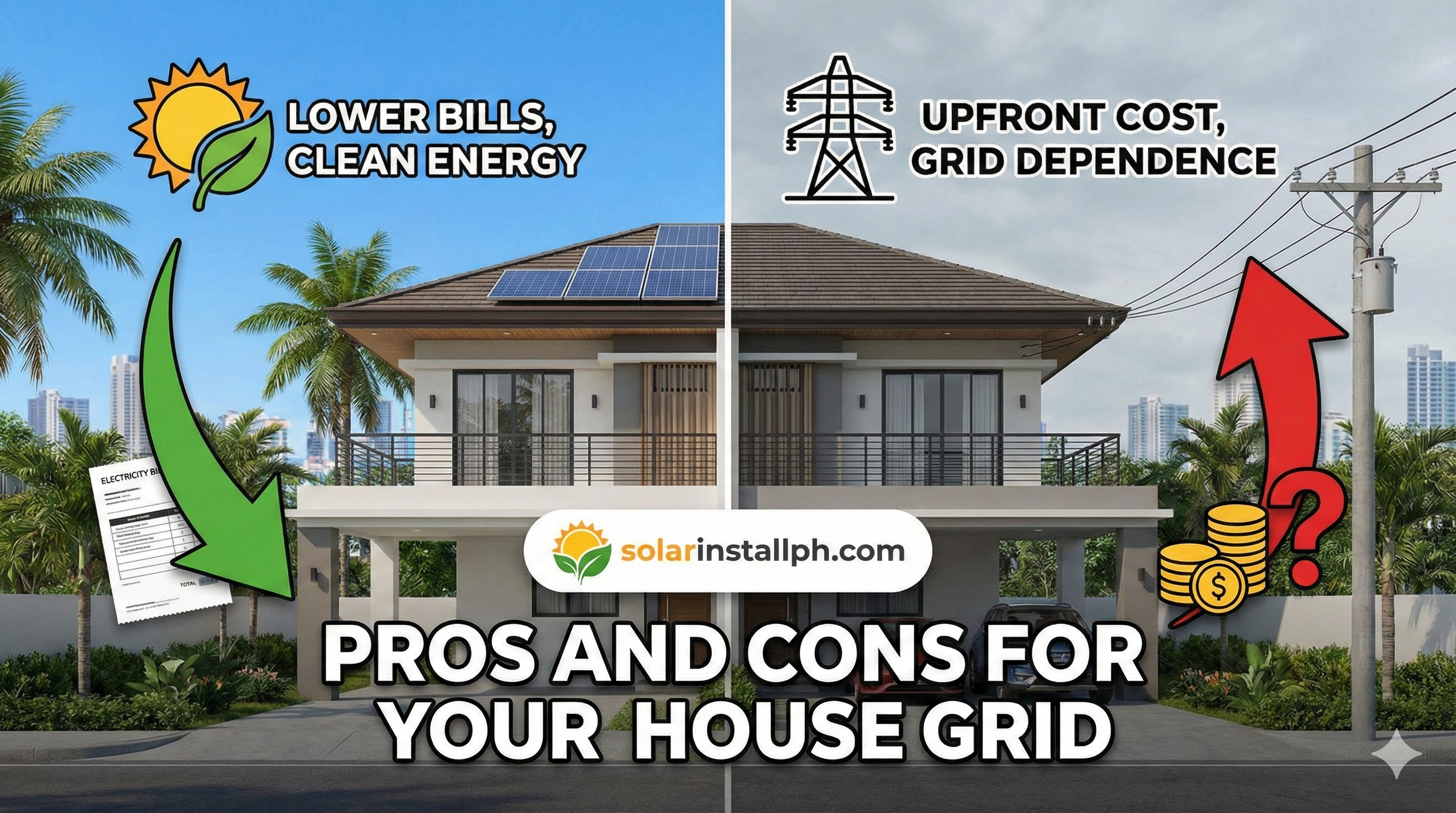
In the Philippine solar market, "Grid-Tied" is the most common buzzword you will hear. It is the entry-level drug for homeowners tired of Meralco’s ₱13.00/kWh rates.
But it is also the most misunderstood.
Newcomers often assume that bolting panels to the roof automatically means they have power during a brownout (spoiler: they don’t). Others assume they can just plug the system in like a refrigerator without telling the utility (spoiler: that’s illegal).
If you are considering connecting your house to the grid in 2025, you need to look past the sales brochure. Here is the practitioner’s breakdown of the pros and cons of a grid-tied system, grounded in the realities of Philippine regulations and infrastructure.
What is a "House Grid" Connection?
First, let’s define terms. A Grid-Tied Solar System has no batteries. It consists of panels on your roof and an inverter that syncs directly with the Meralco (or local coop) power lines.
Daytime: You use solar power first. If you need more, you pull from the grid.
Nighttime: You pull 100% from the grid.
Excess: You sell power back to the grid (Net Metering).
It is a partnership with the utility. And like any partnership, it has perks and dealbreakers.
The Pros: Why It’s the Smartest Financial Move
For 90% of middle-class households in Metro Manila and Luzon, this is the default choice for one reason: ROI.
1. The Lowest "Price of Entry"
Batteries are the most expensive part of a solar setup. By removing them, you slash the upfront cost by nearly 40%.
Grid-Tied Cost: A quality 5kW system might cost ₱250,000 – ₱300,000.
Hybrid (With Battery) Cost: That same capacity with reliable lithium storage pushes ₱450,000+.
Because the capital output is lower, the Return on Investment (ROI) is faster—typically 3.5 to 5 years. After that, your energy is effectively free for the remaining 20 years of the panel warranty. You can review current pricing in our breakdown of residential solar costs.
2. Net Metering 2.0: The "Indefinite Rollover"
This is the biggest win for 2025.
In the past, Net Metering credits (the money Meralco owes you for excess power) had an expiration date or were hard to cash out.
Under the new ERC Resolution No. 15, Series of 2025, the rules have shifted in favor of the prosumer:
No Expiration: Credits now roll over indefinitely. You can bank your massive summer harvest (March–May) and use the credits to wipe out your bill in December.
Transferability: If you sell your house, you can transfer those accumulated credits to the new owner, adding tangible value to your property.
For a deep dive on these rules, check our summary of the ERC Net Metering policies.
3. "Passive Cooling"
This is a hidden benefit. Philippine roofs are mostly uninsulated metal sheets that turn attics into ovens. Solar panels act as a "second roof," shading the metal and absorbing the UV.
Homeowners frequently report a 3°C to 5°C drop in indoor temperatures. Your house is cooler, so your aircon works less, saving you even more money.
The Cons: The Dealbreakers
Grid-tied systems are purely financial tools. They are not backup generators. This distinction causes the most frustration for Filipino homeowners.
1. No Grid, No Solar (The Brownout Issue)
This is the hardest pill to swallow.
When Meralco goes out, your solar goes out.
Even if it is high noon and the sun is blazing, your inverter will shut down immediately. This is a non-negotiable safety feature called Anti-Islanding. It prevents your system from feeding live electricity into the grid and electrocuting linemen who are fixing the transformer.
If you live in an area with frequent fluctuations or "Red Alerts," a standard grid-tied system will leave you sweating in the dark just like your neighbors. To fix this, you need to spend extra on batteries. You can read more about solar options during brownouts to see if the upgrade is worth it for you.
2. The "Red Tape" (Permitting)
You cannot just install grid-tied solar and turn it on. You must apply for Net Metering, which involves a bureaucratic gauntlet:
Distribution Impact Study (DIS): The utility checks if their transformer can handle your export.
LGU Permits: Electrical and building permits from City Hall.
Yellow Meter: Waiting for Meralco to replace your meter.
This process can take 3 to 6 months. During this time, your system is often sitting idle or set to "Zero Export" mode, wasting potential savings. Navigating this requires patience. We have a step-by-step guide to the Meralco Net Metering process to help you prepare the documents.
3. The "Buy High, Sell Low" Export Rate
Net Metering is not a 1-for-1 trade.
You Buy Power: At the Retail Rate (approx. ₱12–₱14/kWh), which includes distribution and transmission charges.
You Sell Power: At the Generation Rate (approx. ₱5–₱7/kWh), which is just the cost of energy.
Because you sell at a ~50% discount, you cannot simply oversize your system to hit "Zero Bill." You have to size it carefully to match your daytime consumption. If you export too much, you are losing potential value.
The Verdict: Is It For You?
The "House Grid" connection is the most practical choice for:
Homeowners with daytime usage: If you have a fridge, home office, or kids at home, you consume the solar power directly, saving the full ₱13/kWh.
Budget-conscious investors: You want the fastest ROI and lowest maintenance.
Areas with stable grids: If brownouts are rare (once a month or less), investing in batteries is often a waste of money.
However, if you are in a province with weekly blackouts, you might need to look at Hybrid systems instead.
Grid-tied solar is about financial defense. It protects you from inflation and slashes your monthly overhead. Just make sure you go into it knowing that when the grid fails, you are still at the mercy of the utility.
For a final comparison before you sign a contract, read our detailed analysis of the pros and cons of grid-tied systems.