
Why Philippine Grid Credits?
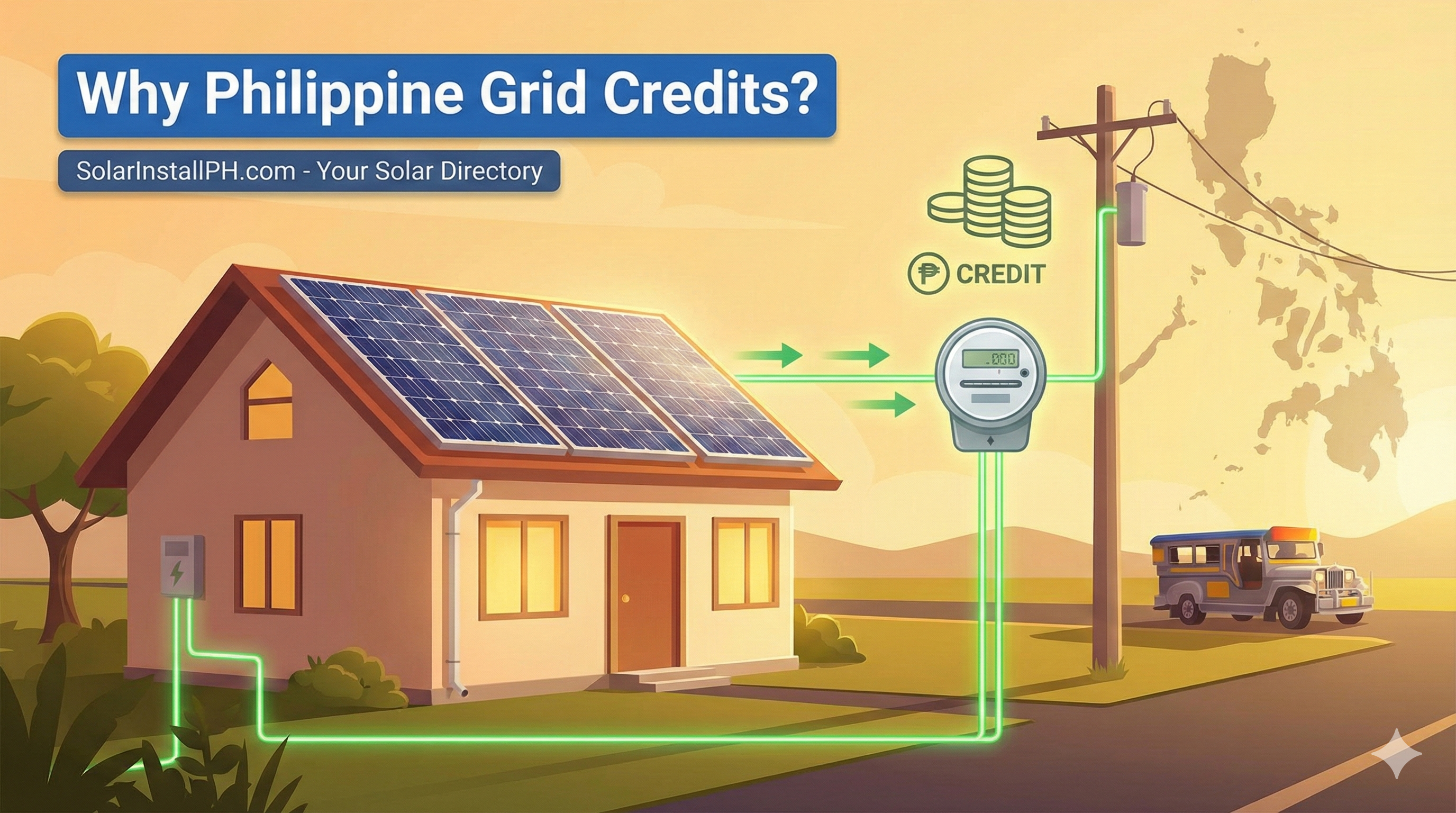
If you own a solar system in the Philippines—or are planning to buy one—you have likely heard the term "Net Metering" thrown around. But do you actually know why it matters for your wallet?
For years, many Filipino homeowners treated grid export as an afterthought. They focused on "daytime savings" (running the aircon for free) and ignored the excess energy their panels produced when they weren't home.
In late 2025, however, the game changed. With new rules from the Energy Regulatory Commission (ERC) allowing for indefinite banking and transferability of credits, grid credits have evolved from a "nice bonus" into a primary financial asset.
Here is why Philippine grid credits are now the smartest investment you can make, and why you should stop wasting your surplus power.
1. The "Indefinite Banking" Revolution (2025 Update)
For a long time, the biggest complaint about Philippine Net Metering was the fear of losing credits. Homeowners worried that if they didn't use their accumulated credits within a certain period, the utility would wipe the slate clean.
As of September 2025, the ERC has issued Resolution No. 15, which fundamentally upgrades the system.
No More Expiration: You can now "bank" your excess credits indefinitely. If you generate a massive surplus during the sunny months of March and April, you can keep those credits rolling over to offset your bill in December or January.
Transferable Assets: If you sell your house, you don't lose the value of your banked energy. The new rules allow you to transfer your accumulated credits to the new property owner, effectively increasing the resale value of your home.
This turns your electric bill into a savings account. You aren't just lowering your monthly expense; you are building a reserve fund of energy.
2. The "Net Billing" Mechanism: How You Actually Get Paid
There is a lot of confusion about how the credits are calculated. In the Philippines, we use a Net Billing scheme, not a 1:1 kilowatt exchange.
It works like this:
You Buy Power: When you pull from the grid at night, you pay the Retail Rate (e.g., ₱12/kWh).
You Sell Power: When you export to the grid, you are paid the Blended Generation Rate (e.g., ₱6–₱8/kWh).
You might think, "That's unfair! Why is my export worth less?"
The export rate only covers the cost of the energy itself. It excludes the distribution and transmission charges because you aren't using the grid to deliver power to anyone else—you are just dumping it into the nearest wire.
Despite the lower rate, these credits are powerful. They are deducted directly from your total bill amount (in Pesos), not just the generation charge. A 5kW system can easily generate ₱1,500+ worth of credits a month, which is often enough to wipe out the remaining bill for a standard household.
For a detailed breakdown of the math, read our guide on how net metering credits are calculated.
3. The Ultimate Inflation Hedge
We all hate seeing the "Generation Charge" go up on our Meralco bill. When coal prices spike or the Peso weakens, our electricity rates skyrocket.
But here is the secret perk of grid credits: They rise with inflation.
Since your export rate is tied to the Blended Generation Charge, when electricity gets more expensive, the value of your solar export increases.
If Meralco raises rates to ₱15/kWh, they likely have to pay you more for your solar power, too.
Your credits act as a natural hedge. While your neighbors are complaining about high prices, your system is quietly earning more pesos to offset that hike.
To see how this impacts your long-term returns, check our solar ROI guide for 2025.
4. The Grid is a "Free" Battery
Batteries are great for brownouts, but they are terrible for ROI. A decent lithium battery costs upwards of ₱80,000 and will eventually degrade.
The grid, on the other hand, is an "infinite battery" that costs you almost nothing to use.
Capacity: You can dump up to 100kW of power into it.
Maintenance: Zero. You don't have to check water levels or monitor temperatures.
Cost: Aside from the initial application fees, there is no monthly maintenance fee for the "storage" service.
By using Net Metering, you are effectively using Meralco or your local coop as your cloud storage for energy. You send them power at 10:00 AM and "withdraw" the value at 8:00 PM. This allows you to achieve massive savings without the heavy upfront cost of a physical battery bank.
5. Avoiding the "Zero Export" Trap
What happens if you don't apply for Net Metering? You are forced to use a Zero Export device.
This device throttles your solar panels to match your house load exactly.
Scenario: It’s 12:00 PM. Your panels could produce 5,000 watts.
Reality: Your house is only using 500 watts (fridge + router).
Result: The inverter throttles down to 500 watts. You throw away 4,500 watts of potential power.
That is wasted money. Over a year, "Zero Export" can cost you tens of thousands of pesos in lost opportunity. While it is a useful temporary setting during the permitting phase, it should never be your permanent strategy. Learn more about the limitations in our zero export overview.
6. Voluntary REC Meters (Lower Upfront Costs)
Another win for 2025 is the removal of the mandatory REC (Renewable Energy Certificate) meter for small users.
In the past, you had to pay for a second meter just to measure your gross generation. The new ERC rules make this voluntary for typical residential users.
Savings: This saves you roughly ₱5,000 to ₱8,000 in upfront installation costs.
Simplicity: Fewer meters mean less wiring and faster approvals.
Conclusion: Don't Leave Money on the Roof
Philippine grid credits are not just about being "green." They are a financial instrument that protects you from inflation, reduces your reliance on expensive batteries, and turns your roof into an income-generating asset.
The process to get there—the Distribution Impact Study, the CFEI, the ERC COC—can be a hassle. But with the 2025 rules allowing for indefinite banking, the reward has never been greater.
Next Step: If you are currently stuck in the application process or just starting out, ensure you follow the official procedures to avoid delays. Read our specific Meralco net metering guide to prepare your documents correctly the first time.
Also, verify that your system is compliant with the latest standards. Check our ERC net metering explainer to know your rights as a "prosumer."