
5 Best Budget Power Options Now
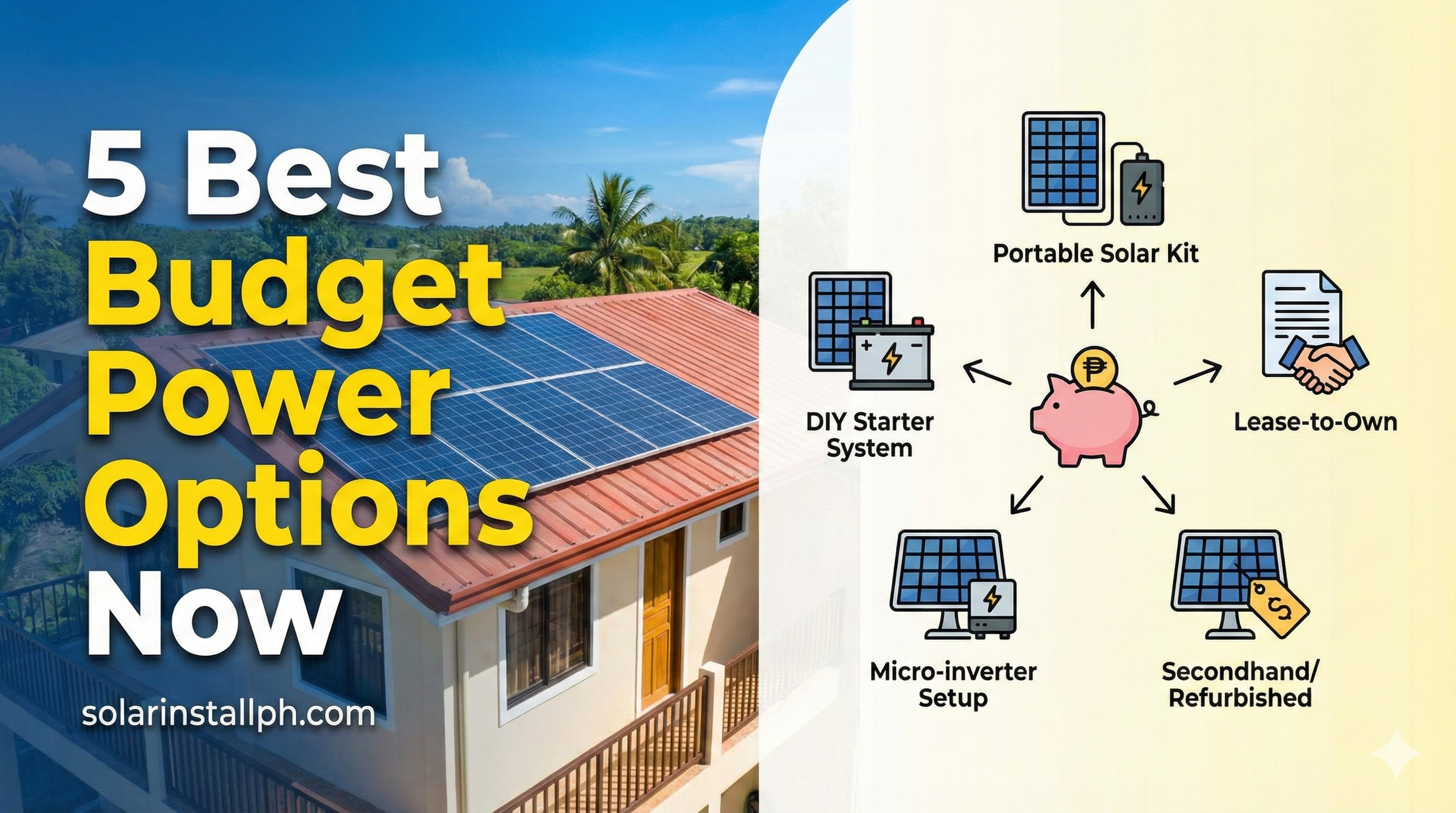
We all know the feeling. You open your Meralco bill, and your jaw drops. Then, two days later, a thunderstorm knocks out the grid, and you’re sweating in the dark.
In 2025, having backup power or solar isn’t just about being "green"—it’s about survival and sanity. But the misconception is that you need ₱300,000 to get started.
You don't.
If you aren't ready to mortgage your house for a full roof array, there are smaller, smarter ways to secure your energy. Here are the 5 best budget power options available in the Philippines right now that actually work.
1. Solar Electric Fans (The "Presko" Saver)
This is hands-down the most practical "gateway drug" to solar for Filipino households.
Air conditioning is the biggest driver of high electricity bills. While a solar fan won't replace your split-type AC, it will let you turn off the AC during the cooler hours or keep you ventilated during a brownout without draining a drop of grid power.
How it works:
These standalone units come with a dedicated 10W–25W solar panel and a built-in lithium battery. You leave the panel on the roof (or a sunny window), and it charges the fan all day.
Why it’s a winner:
Price: ₱1,500 to ₱3,500 per unit.
Zero Wiring: No need to touch your main breaker.
Brownout Proof: Most models run for 8–10 hours on low speed.
It’s simple, effective, and pays for itself in a few months by reducing your daytime fan usage.
2. Portable Power Stations (The "Giant Powerbank")
If you live in a condo or rent an apartment where you can’t install panels on the roof, this is your best option.
Think of a portable power station as a massive power bank with a 220V outlet. You charge it from the wall when Meralco is live, and when the brownout hits, you plug in your WiFi router, laptop, and electric fan.
The Budget Tier (₱3,000 – ₱6,000):
Brands like NSS or generic "Raon" units. Good for charging phones and running a small DC light. Don't expect to run a heater or heavy appliance.
The Premium Tier (₱12,000 – ₱30,000):
Brands like EcoFlow or Bluetti. These use safer LiFePO4 batteries that last 10 years and charge from 0 to 100% in an hour. Some even accept a portable solar panel input, turning them into a mini solar generator.
3. Micro-Inverter Grid-Tie (The "One-Panel" Start)
For homeowners who want real solar (to lower the bill) but have a tight budget, the traditional string inverter is a problem. String inverters usually require a minimum of 4–6 panels to wake up. That’s a ₱100k+ commitment.
Enter the Micro-inverter.
A micro-inverter sits under a single solar panel and converts its power directly to AC. This means you can start with just one panel and one micro-inverter.
Why it’s budget-friendly:
Scalability: Buy one panel now (₱6,000) and one micro-inverter (₱8,000). Add another pair next Christmas. You build your system piece by piece as your budget allows.
Safety: They use lower DC voltage, making them safer for DIY-adjacent installs (though we always recommend a pro).
Check our review of Enphase microinverters to see if this modular approach fits your cash flow.
4. Solar Perimeter Lights (The Security Basic)
If your goal is simply to light up your "sari-sari" store front, garage, or garden without adding to your bill, avoid wiring 220V floodlights.
Modern solar street lights are surprisingly bright and dirt cheap. The "Buy 1 Take 1" deals online are aggressive, often pricing 100W–200W equivalent LED floodlights at under ₱1,500.
The Trap to Avoid:
Don't believe the "1000 Watts" stickers. Look for the physical size of the battery and the solar panel. A tiny panel cannot charge a huge battery.
Good Rule of Thumb: Look for units with removable/replaceable LiFePO4 batteries. Cheap units use sealed lead-acid or low-grade lithium that dies in 6 months.
For more on choosing units that won't burn your house down, read our guide on solar light safety.
5. DIY "Raon" Off-Grid Kits
For the tinkerers and the brave, a trip to Raon (Quiapo) or a scroll through Lazada can yield a full "Solar Generator Kit" for under ₱5,000.
These usually include:
A 50W–100W flexible or rigid panel.
A cheap PWM charge controller.
A small 12V lead-acid battery (motorcycle battery size).
An inverter (modified sine wave).
Who this is for:
This is strictly for small DC loads—charging phones, running 12V LED bulbs, or a DC electric fan.
The Risk:
These kits often come with undersized wires and cheap controllers that can overheat. If you go this route, you need to educate yourself. Do not plug a rice cooker into a ₱2,000 solar kit—you will fry the inverter.
If you are handy and careful, this is the absolute cheapest way to generate power. Read our DIY solar guide before you start stripping wires.
Conclusion: Start Small, But Start
The biggest mistake people make is waiting until they can afford a "perfect" ₱500,000 system. By the time you save that much, you’ve already paid another ₱100,000 to the utility company.
Whether it’s a ₱2,000 solar fan or a financed grid-tie system, the best budget option is the one that stops the bleeding today. Pick one, install it, and enjoy the small victory of seeing your meter slow down—or your fan keep spinning when the rest of the barangay goes dark.