
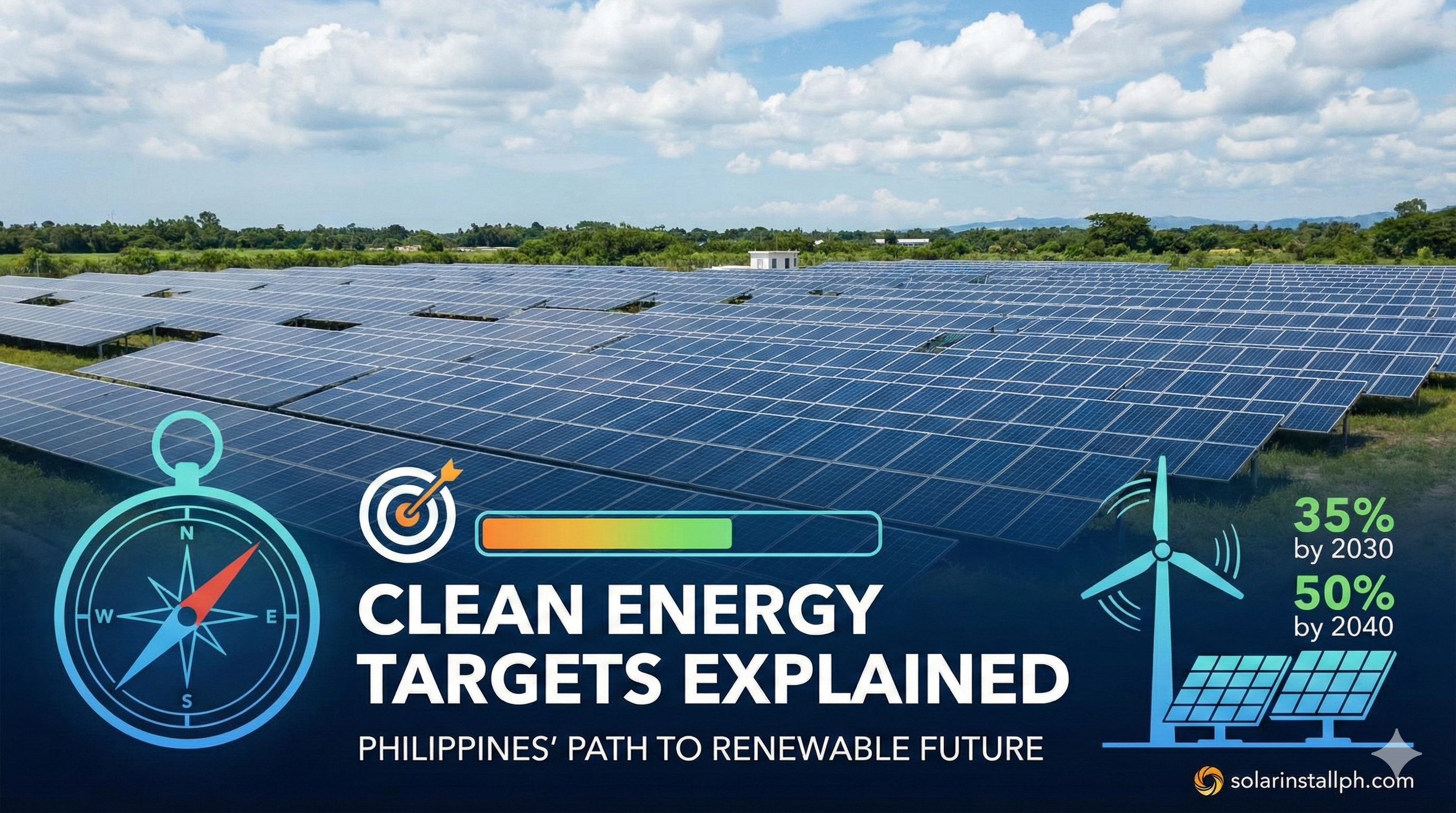
Clean Energy Targets Explained
The Philippines is undergoing a massive energy transformation. For the average Filipino, this isn't just about "going green" or corporate social responsibility; it is a direct response to some of the highest electricity rates in Southeast Asia and a chronic dependency on imported fossil fuels. In 2025 and 2026, the government’s clean energy targets have moved from high-level aspirations to concrete policies that affect your monthly bill, your choice of appliances, and the value of your home.
Under the updated Philippine Energy Plan (PEP) 2023–2050, the Department of Energy (DOE) has established a roadmap to fundamentally change where our power comes from. Understanding these targets is the first step in deciding whether now is the right time for you to invest in a residential solar system.
1. The Core Targets: 35% by 2030 and 50% by 2040
The "headline" goals of the PEP are the renewable energy (RE) share targets. Currently, renewable energy accounts for roughly 22% to 24% of the national power generation mix, dominated by geothermal and large-scale hydro. The goal is to reach a 35% RE share by 2030 and surpass 50% by 2040.
To hit these numbers, the government needs to add approximately 15.3 GW of new renewable capacity by 2030. This push is the primary driver behind the simplified approval processes we are seeing today. Because the government is in a race against time, they have made it easier for homeowners to contribute to these targets through net metering. If you are curious about the entry point for this, you can check our breakdown of residential solar costs in the Philippines to see how the market has matured.
2. Mainstreaming Net Metering and the 100kW Threshold
One of the most practical targets for homeowners is the mainstreaming of Net Metering. This is the policy that allows you to sell your excess daytime solar power back to the grid in exchange for credits. While it was once a bureaucratic nightmare, the current government directive has slashed the processing time for net metering applications to just 20 to 30 days in many areas.
Furthermore, there is a push to lower the threshold for the Green Energy Option Program (GEOP). Currently, businesses with a peak demand of 100kW can choose to source 100% of their power from renewable providers. The government’s goal is to eventually lower this threshold to zero, allowing even small households to "choose" their green energy supplier. For those in the Meralco franchise area, following our Meralco net metering guide is the best way to get started with this transition.
3. The Shift to "Solar + Storage" (GEA-4)
The government recognized that solar alone isn't enough because the sun doesn't shine at night. In 2024 and 2025, the Green Energy Auction Program (GEAP) shifted its focus toward Integrated Renewable Energy and Energy Storage Systems (IRESS). This means the government is now specifically bidding for projects that combine solar farms with massive battery banks.
This national focus on storage is trickling down to the residential market. Lithium battery prices have dropped significantly, making "hybrid" systems—those that can provide power during brownouts—the new standard. If you are looking to future-proof your home, you should look into the top solar batteries of 2025 to understand how they integrate with a standard rooftop array.
4. Decarbonizing Transport (The EVIDA Law)
The Electric Vehicle Industry Development Act (EVIDA) targets a minimum 10% EV share in the national fleet by 2040, with aspirational targets as high as 50%. The government’s "clean energy" target isn't just about the grid; it’s about moving the entire transport sector away from expensive, polluting gasoline.
For homeowners, this means your next car will likely be an EV. Sizing a solar system today should involve planning for an EV charger in your garage. You can see how this affects your system size in our comprehensive solar install guide.
5. 100% Electrification and Microgrids
A major social goal is achieving 100% electrification of the Philippines by 2028. Since running cables to every remote island is impossible, the DOE is prioritizing "Microgrids"—small, localized power systems usually powered by solar and batteries.
This goal has made high-quality off-grid components more accessible throughout the country. Even for those in the city, the popularity of these microgrids has led to a boom in the availability of reliable backup gear, such as the latest portable power stations, which can be charged via portable solar panels during emergencies.
Common Mistakes When Evaluating Targets
Waiting for "Free" Government Solar: The government's role is to provide the framework (like Net Metering and GEOP) and financing pathways (like Pag-IBIG and bank loans), not to give away free panels to the middle class. Waiting for a handout often results in years of missed savings.
Ignoring the "Generation Charge": Your bill is split into many parts. The clean energy targets primarily aim to lower the "Generation Charge," which is the largest part of your bill and the most volatile.
Assuming One Size Fits All: A system that works for a house in Manila might be under-engineered for a typhoon-prone area in Samar. Always ensure your hardware is rated for Philippine wind loads (at least 250kph).
FAQ
Are these targets legally binding?
The targets in the PEP are "indicative," but the policies that support them (like the Renewable Portfolio Standards for utilities) are legally mandated. Utilities are fined if they do not meet their annual RE increase.
How do these targets lower my bill?
As more solar and wind enter the grid, the country relies less on imported coal and gas. Over time, this stabilizes the generation charge and protects you from global price spikes caused by international conflicts.
The Philippines is moving toward a cleaner, more self-reliant energy future. Whether you are a homeowner looking to slash a PHP 10,000 monthly bill or a business owner aiming for energy independence, these targets provide the stability and legal framework to make your solar investment a "sure win" for the next 25 years.