
7 Best Ways Typhoons Damage PV
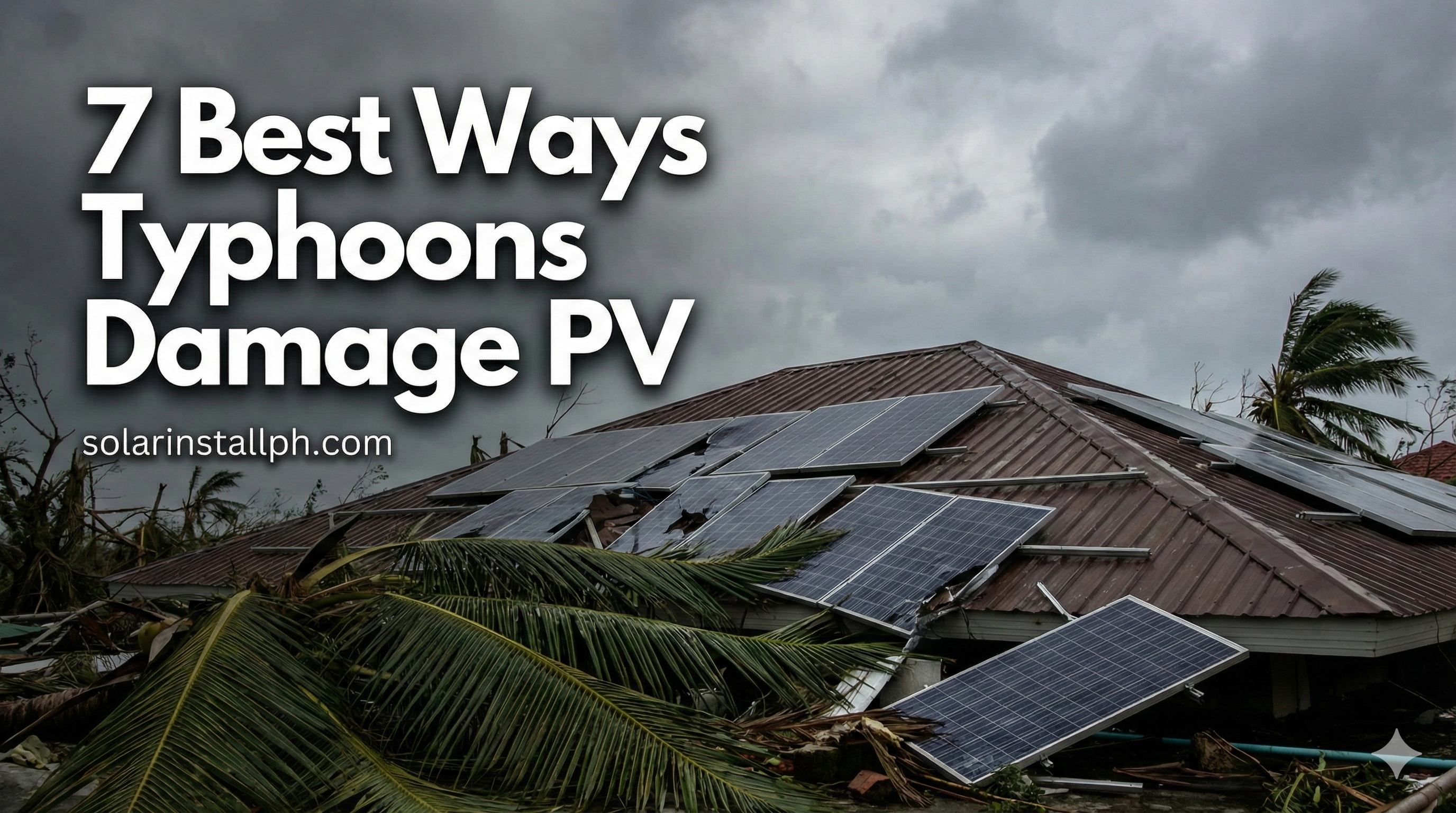
In the Philippines, we do not just ask if a typhoon will hit; we ask when and how strong. From Super Typhoon Yolanda to Odette, Filipino homeowners have learned the hard way that standard construction rules often fly out the window when wind speeds hit 250 kph.
If you have solar panels—or are planning to install them—you need to understand that wind is not the only enemy. The damage caused by typhoons is often multifaceted, involving invisible fractures, chemical reactions, and structural fatigue that might not show up until months after the storm has passed.
Here are the 7 best ways typhoons damage PV systems in the Philippine setting, and how you can defend your investment against them.
1. The "Sail Effect" (Uplift and Suction)
The most obvious form of damage is direct structural failure caused by wind uplift. However, it rarely happens because the wind pushes the panels down. It happens because the wind gets under them.
Solar panels mounted on a pitched roof create a gap between the module and the roof surface. When high-velocity wind hits the roof, it accelerates over the top of the panels (low pressure) and stagnates underneath them (high pressure). This pressure differential creates a massive lifting force, similar to an airplane wing.
The Reality Check:
Standard solar clamps are often rated for 2400 Pascals (Pa) of pressure. A Super Typhoon can easily exert forces exceeding 5400 Pa, especially at the corners and edges of the roof where wind vortices are strongest. If your installer used standard spacing for the clamps (usually 1 meter apart) instead of "typhoon spacing" (0.5 to 0.7 meters), the panels can be ripped from the rails.
For a deeper technical explanation of these forces, review our breakdown of wind load on solar panels.
2. Micro-Cracking (The Silent Killer)
You might inspect your roof after a storm, see that the glass is intact, and assume everything is fine. Two years later, your system’s production drops by 20%. What happened?
The Mechanism:
During a typhoon, the wind causes your solar panels to flex and vibrate violently. While the tempered glass on top is flexible enough to survive this, the silicon cells sandwiched inside are brittle. They can crack under the stress. These "micro-cracks" are invisible to the naked eye but sever the electrical pathways inside the cell. Over time, these cracks create "hot spots" leading to burn marks and eventual panel failure.
To detect this early, professional installers use electroluminescence (EL) testing or thermal cameras during solar panel maintenance visits.
3. Projectile Impact (Flying Debris)
In the Philippines, the wind isn't empty. It is full of branches, coconuts, and dangerously, sheets of Galvanized Iron (GI) roofing from neighboring houses.
While Tier 1 solar panels are rated to withstand hail (specifically, a 1-inch ice ball at 50 mph), they are not rated to withstand a flying coconut traveling at 150 kph. Impact damage is usually catastrophic and immediate, shattering the glass. Once the glass is compromised, moisture enters the panel, creating a shock hazard.
Tip: You cannot armor your panels against this, but you can manage the risk. Ensure your own property has no loose debris, and trim trees that overhang your array.
4. Galvanic Corrosion Acceleration
This is a slow-burn damage type often triggered by typhoons. Coastal areas like Cavite, Batangas, or Cebu are already prone to salt mist. A typhoon drives this salt spray deep into the crevices of your mounting system at high pressure.
If your installer cut corners and used dissimilar metals—for example, stainless steel bolts directly touching aluminum frames without a separating washer—galvanic corrosion will occur. The storm accelerates this by stripping away protective oxide layers and introducing a fresh electrolyte (salty rain). Over time, the bolts seize or the aluminum frames turn to dust, leading to structural failure in the next storm.
5. Water Ingress (Pressure Washing Effect)
Solar panels are waterproof, right? Generally, yes. Most panels have an IP67 or IP68 rating. However, these ratings are tested against static immersion or low-pressure spray.
Typhoons bring driven rain—water moving horizontally at 200 kph. This pressure can force moisture past the gaskets of the junction box (the black box on the back of the panel) or into the connectors (MC4). Once water gets inside the electrical contacts, it causes:
Ground Faults: The inverter detects electricity leaking to the roof and shuts down.
Arc Faults: Water causes a short circuit that can spark a fire.
6. Mounting Hardware Fatigue (Loosening)
A typhoon subjects your solar array to hours of cyclical loading—push, pull, push, pull. This vibration acts like a wrench, slowly loosening the bolts that hold the rails to the roof.
We often see systems that survived the typhoon but failed weeks later because the mid-clamps had vibrated loose. If the installer did not use DIN 25201 locking washers or proper torque markings, the clamps can slide off, leaving the panel unsecured.
This is why the choice of mounting hardware is critical. We discuss the specific requirements for Philippine weather in our guide to typhoon-resistant mounting.
7. Roof Truss Uplift (The Solar Anchor)
Sometimes, the solar system is too strong for the house.
If you bolt a rigid, high-strength aluminum frame to a weak wooden truss or a rusty steel purlin, the solar array effectively reinforces the roof sheet. However, during a typhoon, the lift generated by the solar panels is transferred to the roof structure.
If the roof trusses are not anchored to the house beams properly (common in older Filipino homes), the wind might not rip the panels off the roof—it might rip the roof off the house, with the panels still attached. The added weight and aerodynamic lift of the solar array can exceed the structural capacity of the roof framing.
Before installing, it is vital to assess if your roof structure can handle these extra forces. See our article on solar mounting and roof types for what to look for.
Summary: Protection and Insurance
You cannot control the weather, but you can control your readiness.
Specify 5400 Pa: Demand that your installer uses mounting rails and clamps rated for high wind zones.
Check the Torque: Have a maintenance team retighten all bolts annually.
Insure It: Standard home fire insurance often excludes typhoons unless you pay for the "Typhoon and Flood" rider. Furthermore, you must declare the solar system as a specific improvement to be covered.
Don't wait for the next Signal No. 3 to find out if your policy covers your panels. Read our guide on solar home insurance to ensure you are financially protected when the physical protection fails.