
5 Best Ways: Go Green Now
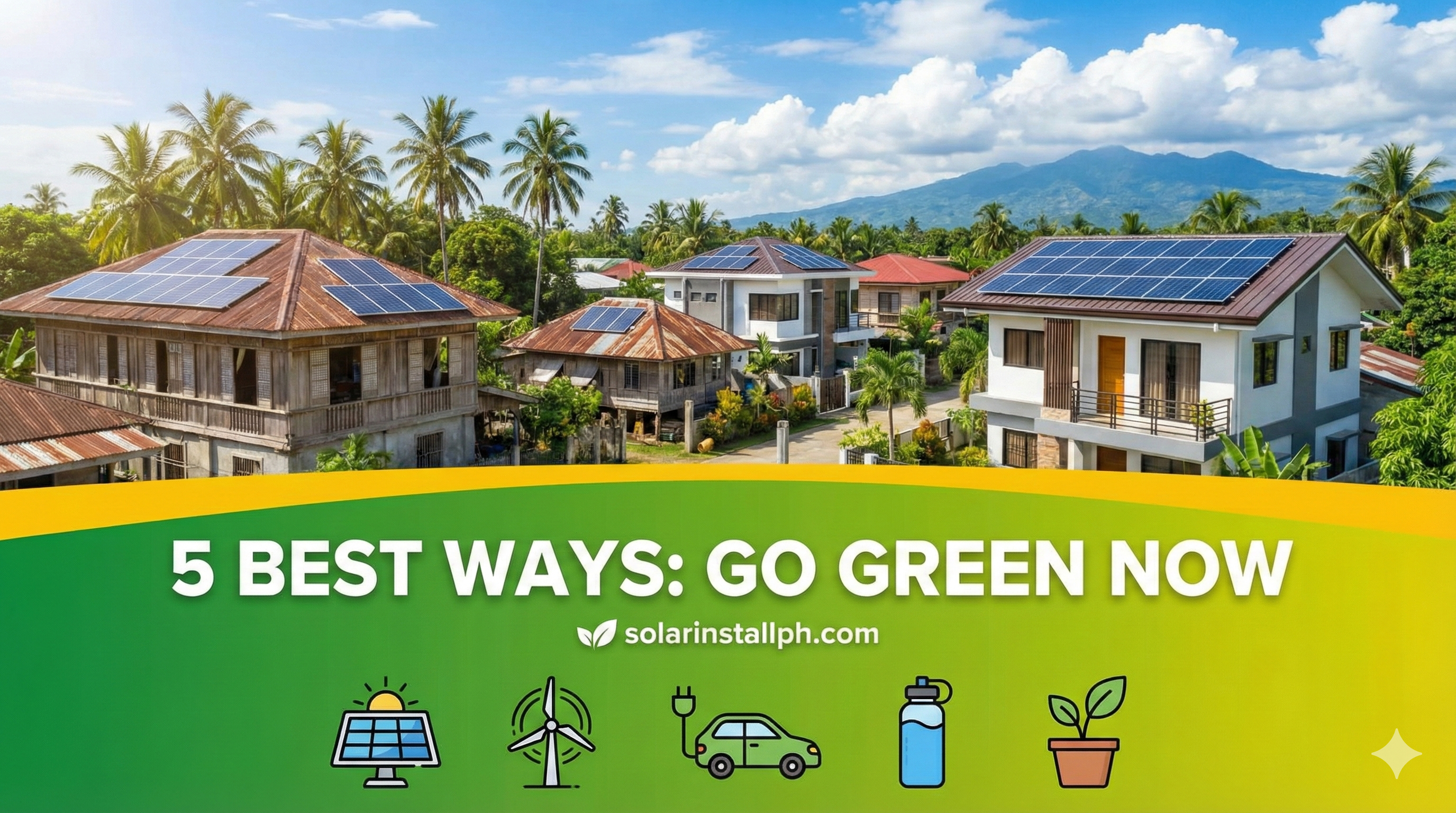
In the Philippines, "Going Green" is often marketed as a moral crusade to save the polar bears. While that is a noble sentiment, for the average Filipino homeowner or business owner in 2025, the motivation is far more pragmatic: survival.
With Meralco and provincial cooperative rates hovering between ₱12.00 and ₱16.00 per kilowatt-hour (kWh), reducing your reliance on the grid isn't just eco-friendly; it is financial self-defense. The grid is becoming more expensive and, in many areas, less reliable due to recurring Red Alerts.
Here are the 5 best, practitioner-approved ways to go green right now, ranked by their impact on your wallet and your carbon footprint.
1. Install Grid-Tied Rooftop Solar
This is the heavy hitter. No other improvement comes close to the Return on Investment (ROI) of a properly sized grid-tied solar system.
In 2025, the cost of solar hardware has stabilized, but grid electricity prices have continued their upward march. A standard 3kW to 5kW residential system can now pay for itself in 3.5 to 5 years.
How It Works
You install panels to cover your daytime loads (refrigerator, fans, WiFi, daytime air conditioning). During the day, you use your own power (cost: ₱0/kWh). At night, you use the grid. This typically slashes your bill by 30% to 50%.
The Action: Don't buy a "kit" online. Get a turnkey installation from a reputable provider who understands Philippine wind loads.
The Cost: Review our guide on residential solar costs to understand the current pricing per kilowatt in Metro Manila and the provinces.
2. Monetize Your Roof with Net Metering
Installing solar is step one. Legalizing it is step two.
Under the Net Metering Program (mandated by RA 9513), you can export the excess power your panels produce back to the distribution utility (DU). This usually happens on weekends or when you are out of the house.
Why It Matters
Without Net Metering, that excess energy is wasted. With Net Metering, the DU buys it from you (usually at a blended generation rate, approx. ₱6-7/kWh) and gives you bill credits. These credits offset your nighttime usage or your fixed charges.
The Reality: The permitting process can be tedious (requiring a Yellow Card/COC), but the long-term savings are undeniable. It turns your electric meter into a two-way revenue stream.
The Math: See exactly how this affects your bill in our breakdown of Meralco solar savings.
3. Switch to Outdoor Solar Lighting
If you aren't ready for a full rooftop system, start with your perimeter. Philippine homes often leave perimeter lights on for 12 hours a night for security. This is a "phantom load" that adds up.
The Strategy
Replace all wired perimeter lights, gate lights, and garden lights with high-quality solar equivalents.
No Wiring: You don't need an electrician.
Brownout Proof: When the grid goes down during a typhoon, your house remains lit, which is a massive security advantage.
Warning: The market is flooded with cheap, plastic solar lights that fail in 3 months. You need units with LiFePO4 batteries and aluminum housings to survive the Philippine heat and rain. Read our review of solar street lights to distinguish between toys and industrial-grade units.
4. Upgrade to High-Efficiency Inverters
"Going Green" is 50% generation and 50% efficiency. In the Philippines, your biggest enemy is heat.
If you are running a non-inverter window-type AC or an old refrigerator, you are burning cash. A modern inverter air conditioner is 30% to 50% more efficient than a conventional unit because it varies the compressor speed rather than cycling it on and off.
The Synergy
When you combine inverter appliances with solar, you can run them for "free" during the day much easier. A 1HP inverter AC might only pull 300-500 watts once the room is cool, which is easily covered by just two solar panels.
When selecting solar hardware to power these appliances, the efficiency of your solar inverter also matters. A cheap inverter generates heat and wastes power; a premium one maximizes your harvest. Check our comparison of top inverter brands.
5. Prepare for Energy Storage (Hybrid)
The final step in going green is energy independence. While grid-tied solar saves money, it shuts down during a brownout.
In 2025, lithium battery prices have dropped to a point where Hybrid Systems are becoming the new standard for upper-middle-class homes and SMEs.
Peak Shaving and Backup
A battery allows you to store your excess solar power (instead of selling it cheap via Net Metering) and use it at night or during a blackout. This is "self-consumption," and it is the most efficient use of solar energy.
The Shift: We are seeing a massive move away from lead-acid batteries toward Lithium Iron Phosphate (LiFePO4) rack-mounted batteries. They last 10+ years and are safer for residential use.
If you are located in an area with frequent power outages (like parts of Mindanao or typhoon-prone Luzon provinces), storage is not a luxury; it's a necessity. Learn which units are performing best in our analysis of top solar batteries for 2025.
Conclusion
Going green in the Philippines doesn't require a radical lifestyle change. It requires a shift in how you view capital expenditure.
You can continue paying Meralco forever, or you can divert that cash flow into assets—solar panels, inverter appliances, and batteries—that you own. The technology is proven, the ROI is solid, and the environmental benefits are a free bonus.
Start small: Swap your perimeter lights.
Think big: Get a solar quote for your roof.
Do it now: Every month you wait is another month of paying full price for dirty power.