
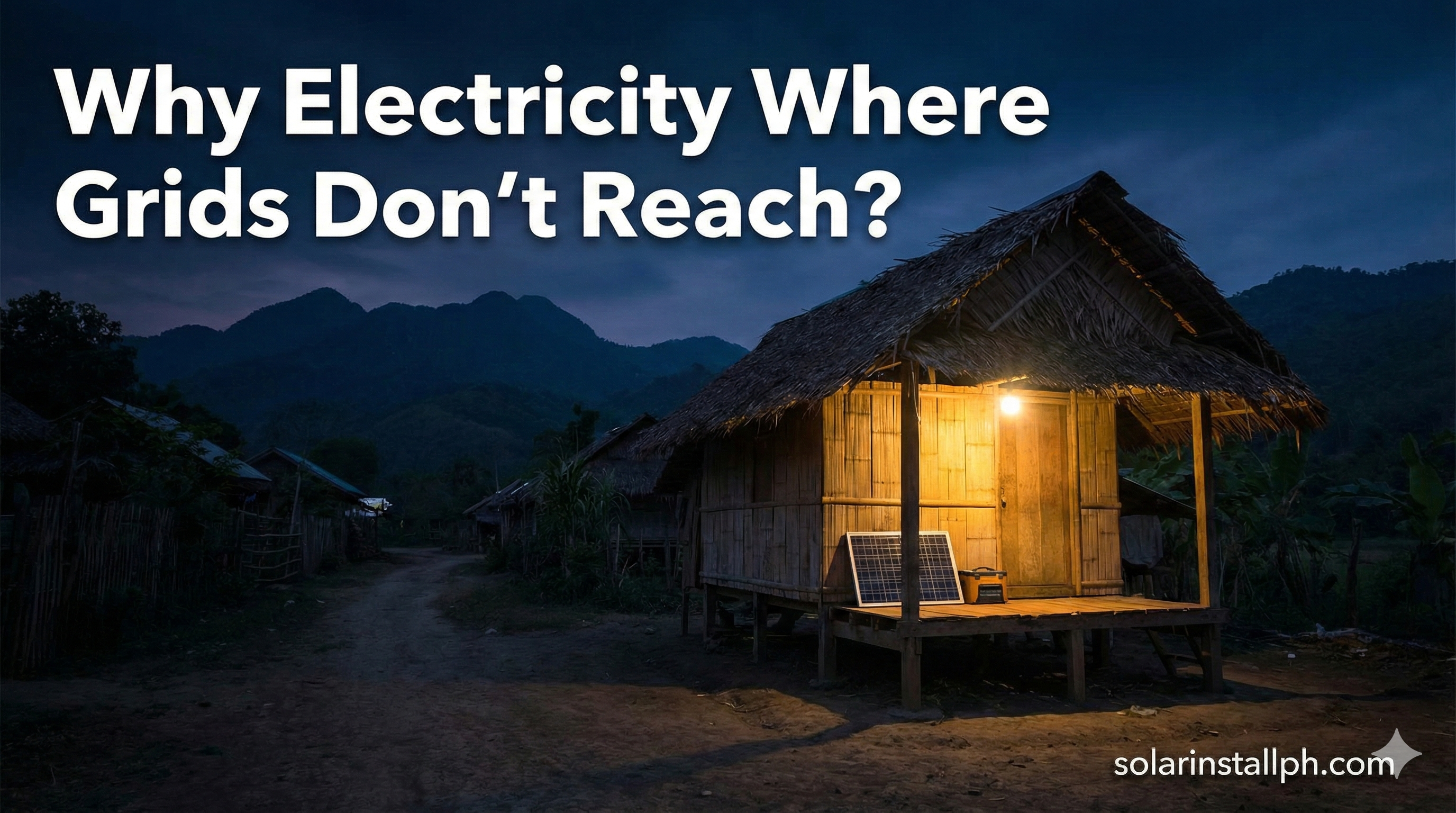
Why Electricity Where Grids Don't Reach?
In Metro Manila, electricity is a bill you pay. In the remote barangays of Palawan, the mountains of Bukidnon, or the islets of Samar, electricity is a distinct line between survival and growth.
For decades, "missionary electrification" in the Philippines meant a diesel generator roaring to life at 6:00 PM and shutting down at 10:00 PM. It meant flickering bulbs, no refrigerators, and a lifestyle dictated by the hum of an engine. But in 2025, the narrative has shifted.
Bringing power to the "last mile" isn't just about lighting up a nipa hut. It is an economic imperative that changes the fundamental math of agriculture, fisheries, and tourism.
Here is why electrifying the off-grid Philippines is the single most important infrastructure challenge we face—and why the solution is no longer just "more diesel."
1. The "Ice" Economy: Cold Storage is Cash
If you are a fisherman in a grid-tied town, you catch fish, freeze what you don’t sell, and sell it tomorrow.
If you are a fisherman in an off-grid island, you operate on a ticking clock. Without ice, your catch spoils in hours. You are forced to sell immediately to middlemen at rock-bottom prices, or dry the fish (daing/tuyo), which commands a fraction of the value of fresh catch.
Electricity enables cold storage.
Value Retention: A solar-powered freezer allows a fisherman to store high-value catch (like tanigue or lapu-lapu) and wait for market prices to rise or for the weekly boat to the mainland.
Agriculture: Farmers in upland areas lose up to 40% of their vegetables to spoilage before they even reach the market. Refrigeration stops this bleeding.
The Department of Agriculture has recently pushed for solar-powered cold storage facilities because they realized that roads alone don't save crops—temperature control does.
2. Breaking the "Diesel Trap"
The National Power Corporation-Small Power Utilities Group (NPC-SPUG) does heroic work powering our islands. But the economics are brutal.
In many remote areas, the "true cost" of generating power from diesel is between PHP 25 to PHP 40 per kWh (sometimes higher if the fuel has to be barrel-rolled onto a beach). While residents pay a subsidized rate (thanks to the Universal Charge for Missionary Electrification or UCME found on every Meralco bill), the government bleeds billions annually to bridge the gap.
Worse, diesel is logistically fragile.
Weather Delays: If a typhoon hits and the fuel barge can't dock, the island goes dark for weeks.
Maintenance: Diesel gensets need constant oil changes and parts that are rarely available locally.
Transitioning to hybrid power sources (Solar + Battery + Diesel Backup) breaks this cycle. It reduces diesel consumption by 70-80%, slashing the subsidy burden and making the community less vulnerable to fuel shortages.
3. The New Tourism Frontier
Post-pandemic travel trends have shifted. Tourists are seeking "unplugged" destinations—but they don't actually mean it.
They want to be on a secluded beach in Siargao or a mountain villa in Sagada, but they still demand:
Air conditioning at night.
Cold drinks.
Starlink internet to post on Instagram.
Hot showers.
You cannot run a premium eco-resort on a noisy generator that runs only 4 hours a night. The noise ruins the "serenity," and the lack of 24/7 power kills the guest experience.
For resort owners, off-grid solar is now a marketing asset. It allows you to build luxury accommodations in places where the grid will literally never reach, offering guests the paradox of "remote comfort."
4. Water Security
In many remote areas, water isn't pumped; it's carried.
Women and children spend hours daily hauling water from wells or springs. This is time stolen from education and livelihood.
Electrification powers electric pumps. But in off-grid areas, solar water pumps are the superior technology. Unlike diesel pumps that require a daily cash outlay for fuel, a solar pump moves water whenever the sun shines, filling overhead tanks for gravity-fed use at night.
This simple switch creates a "water tap" culture, drastically improving sanitation and freeing up labor for more productive work.
5. Digital Inclusion and Education
We saw this painfully during the pandemic: no power means no internet.
Remote schools were left behind not just because they lacked tablets, but because they couldn't charge them. Teachers in off-grid barangays often travel to the nearest town just to print modules or submit reports.
With the arrival of Low Earth Orbit (LEO) satellite internet (like Starlink), the connectivity hardware exists. But it needs reliable power. A small solar setup for a school or a barangay hall turns a disconnected village into a digitally capable community. It allows for:
Telemedicine: Consulting doctors in Manila via video call.
E-Commerce: Local weavers or craftsmen selling products directly to global buyers.
Education: Access to online learning resources that city kids take for granted.
The Reality of Implementation
So, if the benefits are so high, why isn't every island fully solarized?
Because it is hard.
Logistics are a Nightmare
Transporting lithium batteries and glass solar panels to an island involves trucks, bancas, and often human shoulders. The risk of breakage is high. A project that costs PHP 500,000 in Quezon City might cost PHP 800,000 in Calayan Island purely due to shipping and handling.
The "Free" Mindset
In some missionary areas, residents are used to paying a flat, highly subsidized fee for their limited diesel power. Transitioning to a solar microgrid often requires metering and strict collection to pay for battery replacements. Shifting the community mindset from "power is a right provided by the government" to "power is a utility we must maintain" is a social hurdle.
Technical Competence
You cannot just install it and leave. The salty air corrodes contacts. Typhoons loosen bolts. Without trained locals to maintain the system, even the best Visayas island solar projects can fail in three years.
Conclusion
We electrify the "unreached" areas not out of charity, but because it unlocks the other 50% of our country's potential.
Every time a remote farm gets a solar pump, our food security improves. Every time an island gets 24/7 power, a new tourism destination opens up. Every time a remote clinic gets a reliable vaccine fridge, our national health resilience strengthens.
The grid may never reach every corner of this archipelago. And frankly, with the cost of poles and wires, it shouldn't have to. The technology now exists to bring the power plant to the people, rather than bringing the people to the power plant.
For those planning to build in these areas, remember: solar vs diesel isn't just a math problem. It's a question of whether you want to rent your power from a fuel barge, or own it on your roof.