
Estimate Your Power System Budget
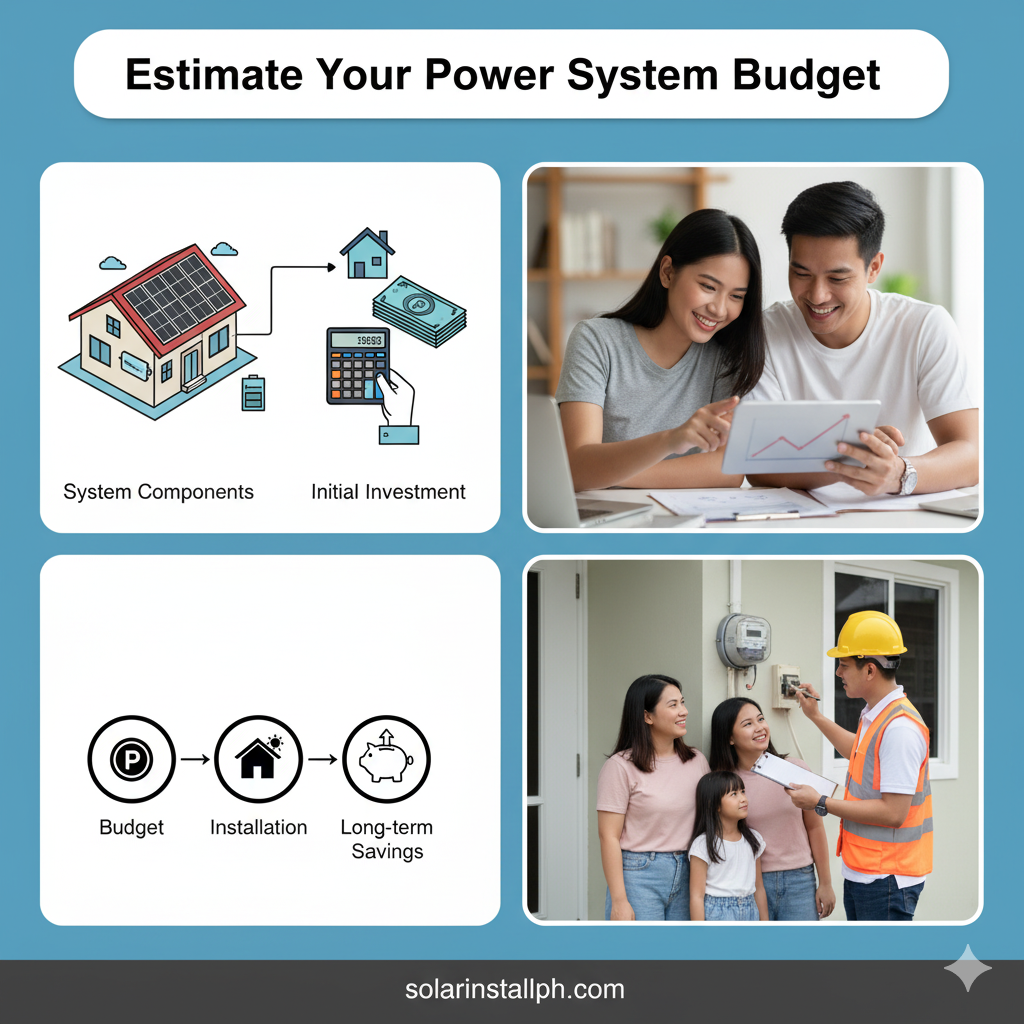
The idea of powering your home with the sun is more attractive than ever for Filipinos. With electricity rates remaining stubbornly high, investing in a solar power system has shifted from a novel concept to a practical financial strategy for thousands of households. But as you begin this exciting journey, the first and most pressing question is always: "How much do I need to budget?"
The answer isn't a single number. The cost of a solar installation is a tailored figure, a sum of various parts that depends on your energy needs, your home's characteristics, and the quality of the components you choose. Thinking of it like buying a car is helpful; a small, practical sedan has a very different price tag than a large, feature-packed SUV, yet both serve the same fundamental purpose.
This guide will provide you with the knowledge to create a realistic budget for your home's power system. We will break down the costs, show you how to estimate the right system size for your family, and explore the crucial concept of Return on Investment (ROI) to help you understand the true long-term value of your solar investment.
Step 1: Understand the Key Cost Components
A solar panel installation quote is a comprehensive package, not just a bill for the panels themselves. Understanding what goes into the total price is the first step in creating an accurate budget. Generally, the costs can be split into two categories:
Hard Costs (The Equipment): This is the physical hardware that will be installed on your property.
Solar Panels: The most visible component. Costs vary by brand, efficiency, and wattage.
Inverter: This is the heart of the system, converting the sun's DC power into usable AC power for your home.
Mounting Hardware: The racks and clamps that securely fasten the panels to your roof.
Balance of System (BOS): This includes all the essential wiring, conduits, safety breakers, and monitoring devices.
Soft Costs (Labor and Services): These are the non-hardware expenses that are crucial for a safe, legal, and effective installation.
System Design & Engineering: Creating a custom plan for your home.
Permitting & Paperwork: This is a vital service where your installer manages the applications for LGU permits and your utility's net metering program.
Installation Labor: The wages for the certified crew of technicians doing the physical work.
Warranties & Support: This covers the installer's guarantee on their workmanship.
A reputable installer provides a transparent quote that includes all these elements. This is why a simple "cost per panel" is a misleading metric; you are investing in a complete, professionally managed energy project.
Step 2: Estimate Your System Size Based on Your Electric Bill
The most significant factor determining your budget is the size of the solar system you need, measured in kilowatts-peak (kWp). The right size is directly related to your current electricity consumption.
The Golden Rule: Your Meralco bill is your most valuable budgeting tool.
Gather Your Bills: Collect your electricity bills for the past 6 to 12 months.
Find Your Average Monthly Bill: Add up the total amount due from each bill and divide by the number of months. This gives you a clear picture of your average spending.
Now, you can use this average bill to estimate the system size you'll likely need. Here are some reliable, market-based estimates for 2025 in the Philippines for a grid-tied system (the most common and cost-effective type):
For Monthly Bills of ₱4,000 - ₱8,000:
Estimated System Size: 1.6 kWp to 3.0 kWp
Estimated Budget Range: ₱100,000 - ₱180,000
This is an ideal "starter" system that can significantly offset the power consumption of your refrigerator, lights, fans, and home office equipment during the day.
For Monthly Bills of ₱9,000 - ₱15,000:
Estimated System Size: 3.0 kWp to 5.0 kWp
Estimated Budget Range: ₱180,000 - ₱280,000
This is the most common size range for a typical middle-class Filipino family home. It can handle heavier daytime loads, including one or two inverter air conditioners.
For Monthly Bills of ₱16,000 - ₱25,000+:
Estimated System Size: 5.0 kWp to 10.0 kWp
Estimated Budget Range: ₱270,000 - ₱550,000+
This is for larger homes with very high energy consumption, multiple air conditioners running throughout the day, or even small businesses.
These figures provide a solid starting point for your budget. Remember, these are all-in costs from professional installers, covering everything from equipment to labor and permits.
Step 3: Calculate Your Potential Return on Investment (ROI)
A solar power system is unique because it's an investment that pays you back. The "payback period" or ROI is the time it takes for your accumulated electricity savings to equal your initial investment. Calculating a rough estimate is essential for your budget planning.
The ROI Formula:
(Total System Cost) / (Estimated Annual Savings) = Payback Period in Years
How to Estimate Your Annual Savings:
Find Your System's Production: Your installer will provide an estimate of how many kilowatt-hours (kWh) your proposed system will generate per year.
Know Your Electricity Rate: Look at your Meralco bill for the "blended rate" or cost per kWh. As of late 2025, this hovers around ₱11-₱12/kWh in many areas.
Multiply: Annual kWh Production x Cost per kWh = Estimated Annual Savings
Example:
Let's say you're budgeting for a 3kWp system that costs ₱180,000.
Your installer estimates it will produce 4,200 kWh per year.
Your Meralco rate is ₱11/kWh.
Estimated Annual Savings: 4,200 kWh * ₱11/kWh = ₱46,200
Payback Period: ₱180,000 / ₱46,200 = ~3.9 years
In this example, after just under four years, the system has paid for itself. For the next 20+ years of its lifespan, the energy it produces is essentially free profit. This powerful financial return is why a solar system is considered a top-tier home investment. For a more detailed look, this solar ROI guide can be very helpful.
Step 4: Factor in a Contingency Fund for "Hidden Costs"
A critical part of any responsible budget is planning for the unexpected. While a good installer provides an all-inclusive quote, some issues specific to your property may require extra work that falls outside a standard installation. It's wise to set aside a small contingency fund, perhaps 5-10% of the total project cost.
Potential extra costs could include:
Roof Repairs: Your roof must be in good condition to last as long as the solar panels (25+ years). Any pre-existing leaks or structural issues must be fixed first.
Main Electrical Panel Upgrade: Older homes may need their main switchboard (panel board) upgraded to safely handle the new solar circuit.
Termite Treatment: If your home has a history of termites, treating the roof structure before installation is a necessary precaution.
Discussing these potential solar hidden costs with your installer upfront is a sign of a diligent homeowner and a transparent professional.
Step 5: Explore Financing to Make Your Budget a Reality
If the upfront cost seems daunting, don't worry. You don't have to pay for it all at once. The financing landscape for solar in the Philippines has matured significantly.
In-House Financing: Most major solar companies offer their own payment plans, often with low down payments and terms from 12 to 36 months.
Bank Loans: Banks like BPI and financing companies like SB Finance offer specific "green loans" or personal loans for solar installations, often with competitive interest rates.
Financing Companies: Providers like Home Credit also offer installment plans for solar packages.
These solar loans in the PH can make your investment manageable, with monthly payments that are often less than the amount you're saving on your electricity bill.
Conclusion: Your Path to an Empowered Budget
Estimating the budget for your home power system is a straightforward process when you break it down into these manageable steps. Start with your electricity bill to determine your needs, use market data to get a realistic price range, calculate the exciting potential of your long-term savings, and plan for all possibilities.
The journey to solar energy is a financial one, and a well-planned budget is your roadmap to success. The most important next step is to engage with professionals. Learn how to choose a solar company you can trust, get a few detailed quotes, and compare them against the budget you've created. By doing so, you transform a seemingly large expense into a smart, predictable, and powerful investment in your family's future. For a complete look at the process, a full solar installation guide is an invaluable resource.