
Factory Power: 7 Eco-Smart Solutions
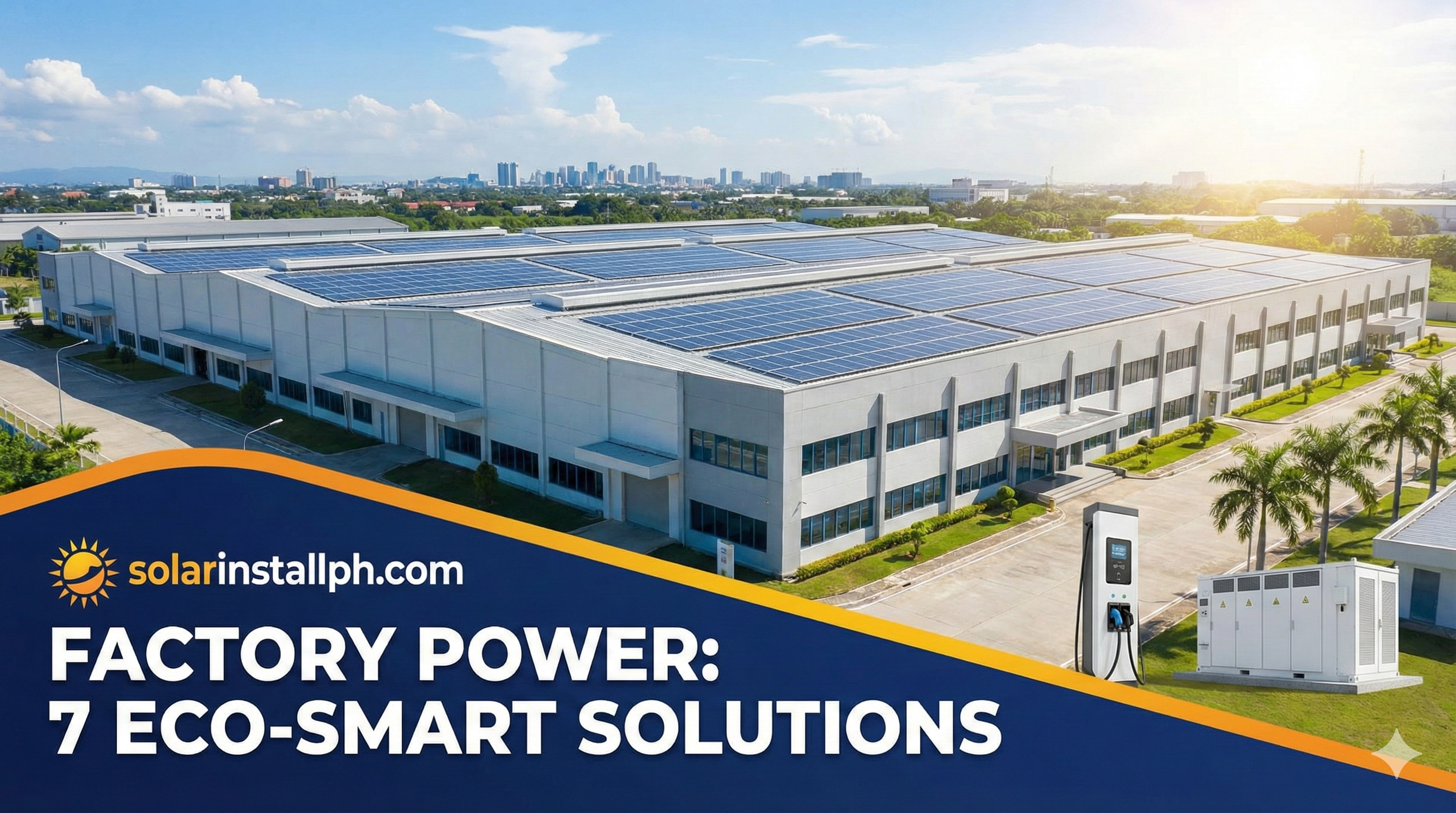
If you manage a factory in Calabarzon, Central Luzon, or Metro Manila, you are currently fighting a two-front war.
On one front, you have Meralco and electric cooperative rates averaging ₱12.00 to ₱13.00 per kWh as of mid-2025. Electricity is likely your second or third biggest line item after raw materials and labor.
On the other front, you have the Energy Efficiency and Conservation (EEC) Act (RA 11285). If your annual energy consumption hits 500,000 kWh, you are now a "Designated Establishment" (DE). This means the Department of Energy (DOE) is no longer just asking you to save power; they are legally requiring you to hire energy officers, submit annual consumption reports, and demonstrate efficiency improvements.
"Eco-smart" isn't just about saving the planet anymore—it's about compliance and survival. Here are 7 specific, high-impact solutions for Philippine factories in 2025.
1. Commercial Rooftop Solar (The LCOE Crusher)
This is the most obvious move, but the math has changed. Years ago, the ROI was 7 years. Today, with grid rates this high and panel prices stabilizing, a 500kW rooftop system often pays for itself in 3.5 to 5 years.
The concept is simple: you have thousands of square meters of idle roof space. By covering it with PV modules, you effectively pre-pay for 25 years of electricity at a Levelized Cost of Energy (LCOE) of roughly ₱3.50 to ₱4.50 per kWh. Compare that to the ₱13.00 you pay the utility. You are saving ~₱9.00 on every kilowatt-hour you generate and consume instantly.
However, sizing is critical. Over-size the system, and you waste power on weekends. Under-size it, and you leave savings on the table. You need to review our guide on commercial solar costs to understand the realistic capital expenditure (Capex) required for a system of this magnitude.
2. Zero Export & DER Compliance
For most factories, a standard "Net Metering" application won't work. The Net Metering program is capped at 100kWp. Most industrial roofs can hold 200kW to 1MW+.
If you install a system larger than 100kW, you generally fall into two categories:
Zero Export: You install a device that throttles your solar inverters to match your building's load exactly. If your factory slows down for lunch, the solar production ramps down automatically to prevent feeding back into the grid. This avoids tripping Meralco's protection systems.
Distributed Energy Resources (DER): This is the newer framework. It allows systems between 100kW and 1MW to export up to 30% of their capacity.
Navigating this is tricky. You cannot just slap 500kW on the roof and hope the utility doesn't notice. You need to understand the technical limitations of zero export systems to avoid penalties or having your service disconnected.
3. The Green Energy Option Program (GEOP)
What if your roof is old, full of vents, or just too small to offset your massive consumption?
Enter the Green Energy Option Program (GEOP).
If your factory has an average monthly peak demand of 100kW or higher, you are eligible to leave your default utility supplier (like Meralco or VECO). You can sign a contract directly with a Renewable Energy Supplier (RES) like EDC, Aboitiz, or ACEN.
The Benefit: You get 100% renewable power without spending a peso on rooftop infrastructure.
The Cost: You often get a fixed rate that is competitive against the volatile WESM-exposed rates of the grid.
The Catch: You still pay "wheeling charges" (distribution costs) to the utility, but the generation charge is often lower and greener.
Check if you qualify by reviewing the specific thresholds in our GEOP program guide.
4. Solar Process Heat (The "Invisible" Saver)
Electricity isn't the only energy cost. Many Philippine food processing, textile, and chemical factories burn bunker fuel or diesel to run boilers.
If you need heat below 100°C (for washing, pre-heating feed water, or pasteurization), Solar Thermal collectors are vastly more efficient than PV panels. A PV panel converts ~20% of sunlight into electricity. A thermal collector converts ~70% of sunlight directly into heat.
By pre-heating your boiler feed water from 25°C to 70°C using the sun, you drastically reduce the fuel needed to bridge the gap to steam. It is a low-tech, low-maintenance solution that attacks your fuel bill directly.
5. Battery Energy Storage Systems (BESS)
In the past, batteries were too expensive for factories. In 2025, with Lithium Iron Phosphate (LFP) prices dropping, they are finding a niche.
Peak Shaving: If your utility charges you a high "demand charge" based on your highest 15-minute peak usage, batteries can discharge during that spike to flatten your curve.
Brownout Insurance: In provinces with unreliable cooperatives, a BESS acts as a massive UPS. It keeps critical lines (like packaging or cooling) running during 1-hour grid blips, preventing costly restarts and material spoilage.
While still a premium upgrade, the business case is strengthening. Read more about solar battery options to see if the math works for your downtime costs.
6. Regulatory Energy Audits (The RA 11285 Requirement)
This isn't optional anymore. Under RA 11285, "Type 1" DEs (500k - 4M kWh/year) must employ a Certified Energy Conservation Officer (CECO). "Type 2" DEs (>4M kWh/year) need a Certified Energy Manager (CEM).
You are required to submit an Annual Energy Utilization Report (AEUR) every April.
Don't view this as red tape. A proper Level 1 or Level 2 Energy Audit often uncovers "low hanging fruit" that offers faster payback than solar:
Fixing compressed air leaks (which can waste 20-30% of compressor energy).
Replacing old induction motors with High Efficiency (IE3) motors.
Tuning VFDs (Variable Frequency Drives) on pumps and fans.
If you haven't done this yet, you are likely non-compliant. Learn what a professional energy audit entails so you can meet the DOE's requirements.
7. Passive Cooling and Skylights
In a tropical country, fighting heat gain is 50% of the battle.
Skylights: Warehouses often run high-bay lights 24/7. Installing polycarbonate skylights can turn those lights off from 9:00 AM to 3:00 PM.
Cool Roofs: Painting your roof white or using light-colored roofing sheets can lower internal temperatures by 3-5°C. This reduces the load on your air conditioning and improves worker productivity.
Ventilation: High-volume, low-speed (HVLS) fans are far cheaper to run than AC and can make a 35°C warehouse feel like 28°C.
Conclusion
The era of cheap electricity in the Philippines is over. The "Eco-Smart" factory of 2025 isn't just installing solar panels; it's stacking these solutions.
You might start with Rooftop Solar to cut the daytime generation charge. Then, you use Energy Audits to stop wasting that power on leaking air compressors. Finally, you use GEOP to clean up the rest of your grid consumption.
The first step is data. Look at your load profile. Are you a daytime-heavy operation? Is your peak demand over 100kW? Once you know your numbers, you can stop bleeding cash to the utility.