
System Maintenance Checklist: Expert Care Tips
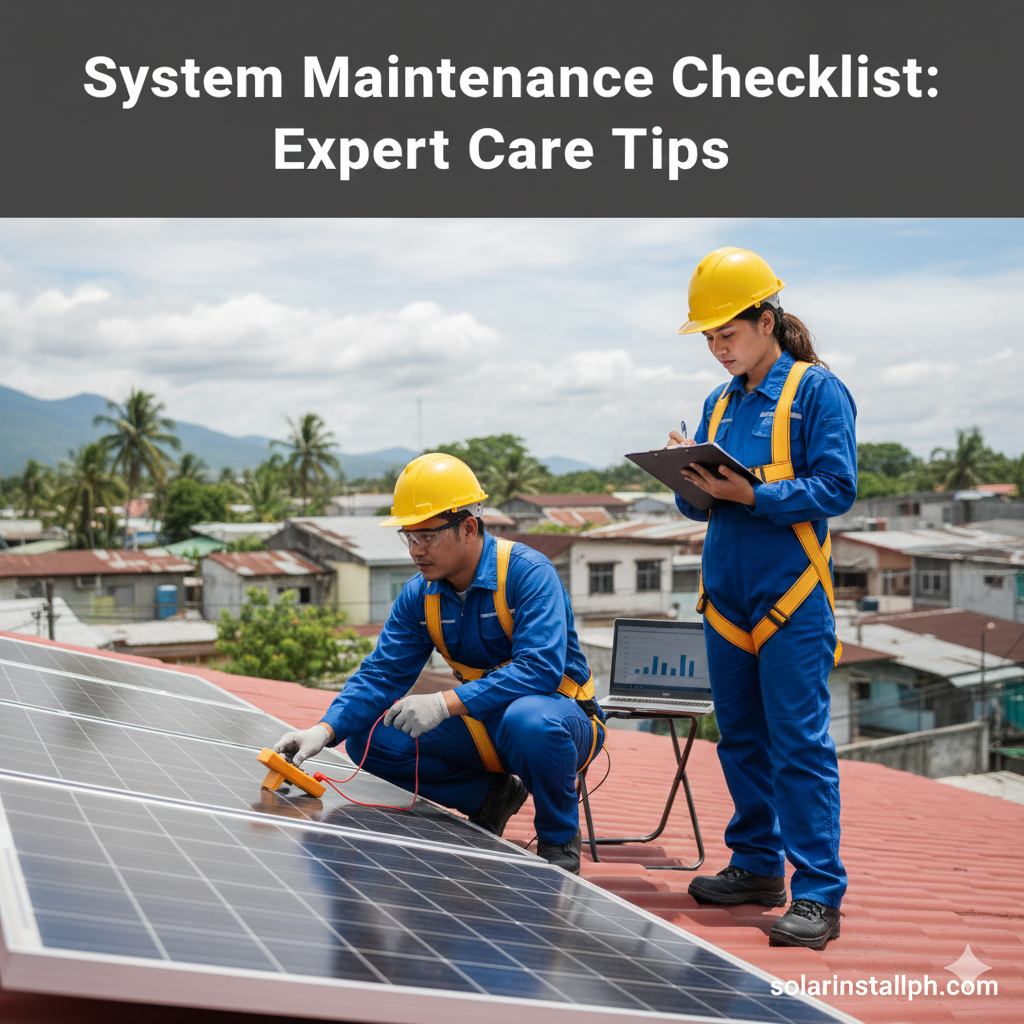
Owning a solar system in the Philippines is a bit like owning a car. It runs perfectly fine on its own for a while, but if you never change the oil or check the tires, it will eventually fail you—usually when you need it most.
In our unique climate, "set it and forget it" is a dangerous mindset. Your system fights a daily battle against extreme UV radiation, torrential typhoon rains, salt air corrosion (even if you aren't right on the beach), and the infamous Metro Manila dust-and-diesel grime.
A well-maintained system will last 25 years or more. A neglected one might start losing money after just three. To help you protect your investment, we’ve compiled an expert maintenance checklist tailored specifically for the Philippine environment.
The "Must-Do" Maintenance Checklist
We have divided this into three categories: things you can do yourself (DIY), things you should monitor digitally, and things that absolutely require a professional.
1. The Physical Inspection (Quarterly)
You don't need to climb the roof for this every time, but you do need eyes on the hardware.
Panel Soiling: Look for the "bottom edge" buildup. In our wet/dry cycles, dust flows down the panel and pools at the bottom frame, creating a strip of mud that shades the bottom cells. This can kill the output of the entire panel.
Rodent Check: Rats love the warm space under solar panels. Look for droppings on your roof or "chew marks" on visible conduits. If you see bits of black wire insulation in your gutters, you have a problem.
Inverter Ventilation: Check your inverter's heatsink (the metal fins on the back) or fans. Are they clogged with spiderwebs or lizard nests? Heat is the #1 killer of inverters in the Philippines.
Corrosion Spot-Check: If you live in a coastal area (like Cavite, Batangas, or near Manila Bay), look at the mounting clamps. White powder on the aluminum or rust on the bolts means salt corrosion is setting in.
2. The Digital "Pulse Check" (Monthly)
Your monitoring app (FusionSolar, ShinePhone, etc.) is your best diagnostic tool.
The "Bell Curve" Test: On a perfectly sunny day, your production graph should look like a smooth hill. If it looks jagged or has sudden drops, you might have a loose connection or voltage issues.
String Comparison: If you have two strings of panels (e.g., one facing East, one West), compare their voltage. A sudden drop in one string often indicates a failed panel or a blown fuse.
Error Log Review: Don't ignore the red notifications. Even "minor" errors like "Grid Voltage High" (common in provinces with unstable coops) can shorten your inverter's life over time.
3. The Professional "Deep Clean & Torque" (Annually)
Once a year, it is worth paying for a service call. A professional maintenance visit typically costs between ₱3,000 to ₱6,000, but it pays for itself by preventing major failures.
Torque Check: Technicians will retighten every electrical screw. Thermal expansion (hot days, cool nights) loosens these over time, which causes arcing and fires.
Thermal Imaging: Pros use infrared cameras to find "hotspots" on panels or breakers invisible to the naked eye.
Insulation Resistance Test: This checks if rats have chewed wires you can't see, ensuring you don't have dangerous electricity leaking into your roof.
Why "Just Waiting for Rain" Doesn't Work
A common myth in the Philippines is that our heavy rainy season cleans the panels for us.
False.
Rain removes loose dust. It does not remove:
Bird Droppings: These are acidic and can burn through the panel's coating if left for months.
Cement Dust: If a neighbor is renovating, cement dust mixed with morning dew creates a hard, limestone-like layer that rain cannot wash off.
Pollution Film: Diesel exhaust is oily. Rain slides right off it. You need mechanical agitation (scrubbing) to remove it.
If you are unsure about the specific needs of your area—for instance, if you live near a busy highway versus a leafy subdivision—check our guide on how often to clean your panels.
The "Butiki" Factor: A uniquely Filipino Problem
In other countries, they worry about snow. In the Philippines, our biggest enemy is often the humble house lizard (butiki).
Geckos are cold-blooded and seek warmth. Your inverter is a warm, cozy box. If a gecko crawls inside the ventilation slots and touches two live components, it causes a short circuit that blows the motherboard. This is often not covered by standard warranties because it is considered an "external force."
Expert Tip: During your maintenance check, inspect the mesh screens on your inverter's air intakes. If they are torn, or if your installer didn't put extra mesh screens over the fans, add them immediately (using non-restrictive mesh).
Managing Trees and Shadows
That mango tree was small when you installed your system 3 years ago. Now, it's casting a shadow on your roof from 2 PM onwards.
Shading is more destructive than you think. Because panels are connected in series, shading just 10% of one panel can drop the output of the entire string by 30% or more.
Action Item: Trim branches aggressively. If you can't trim the tree (perhaps it's the neighbor's), you might need to use panel-level optimizers to mitigate the loss.
Post-Typhoon Protocol
After a typhoon passes (Signal 2 or higher), do NOT just assume everything is fine because the lights are on.
Visual Scan: Look for flying debris impact marks on the glass. A micro-crack can turn into a fire hazard later.
Wire Check: High winds can whip loose wires around. Ensure no cables are dangling or rubbing against the abrasive roof surface.
Leak Check: Go into your attic or look at your ceiling. Solar mounts penetrate the roof. Strong winds can vibrate these mounts, cracking the sealant. Catching a leak now saves you a ceiling replacement later.
For a more detailed breakdown of what to look for after a storm, refer to our guide on solar panel maintenance.
DIY vs. Professional: Where to Draw the Line
You CAN:
Wash panels with water and a soft sponge (never pressure washers!).
Cut back shading trees.
Monitor the app and reset the Wi-Fi dongle.
You Should NEVER:
Open the inverter casing (high voltage shock risk).
Walk on a steep, wet roof without a harness.
Repair damaged wires with electrical tape (this is a fire waiting to happen).
If you suspect internal damage or see error codes you don't understand, consult our inverter error codes resource before calling a technician. It might save you a service fee if it's just a simple reset.
Conclusion
Your solar system is a financial asset. Treat it like one.
By following this simple checklist—cleaning the glass, keeping the inverter cool, and checking for pests—you ensure your system keeps printing money for you for decades.
Don't wait for the bill to go up. Go outside and look at your roof today.