
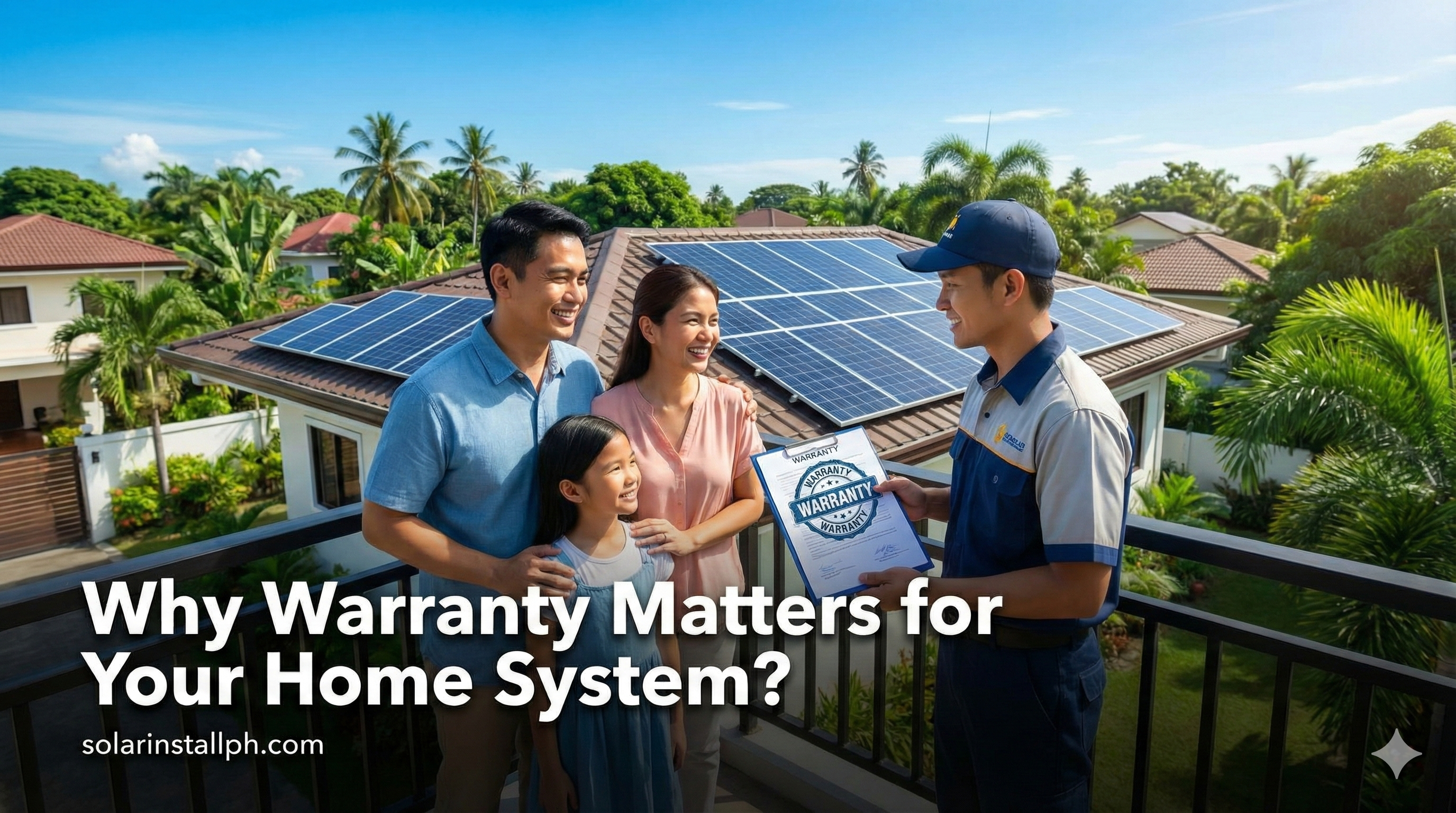
Why Warranty Matters for Your Home System?
In the Philippines, we love a good bargain. Whether it's the 11.11 sale or negotiating at the wet market, the "sulit" mentality is built into our culture. But when it comes to solar power, searching for the absolute lowest price often leads to a financial disaster three or four years down the road.
A solar power system is not a kitchen appliance that you replace every five years. It is a mini power plant attached to your roof, exposed to harsh tropical sun, salt air, monsoon rains, and the occasional super typhoon. It is designed to run for 25 years.
The only thing standing between you and a ₱500,000 paperweight is the warranty.
Many homeowners gloss over the warranty section of their quote, assuming "25 years" applies to everything. It doesn't. Understanding the fine print is the difference between a minor service call and a total system write-off.
The Three Layers of Solar Protection
A standard solar quote actually contains three or four separate warranties. You need to distinguish between them because they cover different risks and carry different timelines.
1. The Panel Warranty (Performance vs. Product)
This is the most confusing part for new buyers. You will see a "25-year warranty" plastered on the brochure. However, this is usually split into two:
Product Warranty (10–12 years): This covers physical defects. If the glass shatters spontaneously, the frame corrodes, or the backsheet peels off, this protects you.
Linear Performance Warranty (25 years): This guarantees that the panel will still produce a certain amount of power (usually 80–84%) at year 25.
The Reality Check:
In the Philippine climate, "performance" rarely fails on its own. The real risks are physical: delamination from heat, moisture ingress from humidity, or yellowing. If a panel physically fails in Year 15 but your Product Warranty was only 10 years, the 25-year Performance Warranty might not help you.
Tier 1 manufacturers are now pushing Product Warranties to 15 or even 25 years. It is worth checking our guide on comparing solar panel warranties to see which brands offer better physical protection for our tropical climate.
2. The Inverter Warranty
The inverter is the brain of your system. It converts DC power to AC and syncs with Meralco or your local coop. Because it contains sensitive electronics, capacitors, and switching processors, it is the component most likely to fail first.
Standard Duration: Most string inverters (Growatt, Huawei, Solis) come with a standard 5-year warranty.
Extended Options: Some brands allow you to purchase an extension to 10 years.
Microinverters: Brands like Enphase often come with 20–25 year warranties, which justifies their higher price point.
Why it matters:
Our grid is "noisy." Voltage fluctuations and brownouts put immense stress on inverters. If your inverter dies in Year 6 and you only had a 5-year warranty, you are looking at a replacement cost of ₱40,000 to ₱80,000. For a deeper dive, read about inverter warranty support and what typically gets covered.
3. The Workmanship (Installer) Warranty
This is the promise from the local company that installed the system. It covers the labor, the wiring, the mounting, and the roof penetration.
Standard Duration: 1 to 2 years is industry standard in the Philippines. Premium installers may offer 3 to 5 years.
Coverage: Roof leaks, loose wires, tripping breakers, or mounting rails coming loose.
If your roof starts leaking six months after installation during the first heavy typhoon of the season, this is the warranty that saves you.
The "Orphan System" Risk
The biggest risk in the Philippine solar industry right now isn't the technology—it's the stability of the installers.
The solar boom has created thousands of new "installers." Many are small teams with no office, operating out of a van/L300, offering rock-bottom prices.
Here is the scenario:
You buy a system from a freelancer because they were ₱30,000 cheaper. Two years later, your inverter shows a red error light. You call their number. "The number you have dialed is not in service." Their Facebook page hasn't been updated in months.
You now own an "Orphan System."
Even if the equipment (inverter/panels) has a 10-year factory warranty, who will process the claim?
Factories in China generally do not deal with end-users. They require the distributor or installer to process the Return Merchandise Authorization (RMA).
You cannot easily ship a 25kg inverter back to Shenzhen.
Other local installers will be reluctant to touch your system because they don't want to inherit the liability of someone else's bad wiring.
This is why the longevity of the company is just as important as the warranty document itself. We discuss this nightmare scenario in our article on what to do if your solar installer disappears.
Local Support vs. Grey Market Imports
To offer the cheapest price, some installers cut corners by buying "Grey Market" equipment.
These are genuine products (real Huawei or Longi serial numbers) but they were intended for a different market (e.g., domestic China or Vietnam). They were brought into the Philippines through unofficial channels to avoid taxes or distributor markups.
The Warranty Trap:
When these units fail, the local authorized service center may refuse to repair them because the serial number is not registered to the Philippines. You are left with a valid warranty that is geographically void.
How to protect yourself:
Ask for a warranty certificate from the local distributor, not just the manufacturer.
Ensure the quote specifies "Local Warranty Support."
Check solar reviews regarding specific companies to see if they have a track record of honoring service calls.
Red Flags in Warranty Contracts
When you are reviewing the contract, look for these "gotchas" that bad installers use to wiggle out of responsibility:
1. "Return to Base" Policies
Some warranties require you (the homeowner) to unmount the defective panel or inverter and bring it to their office in Manila. This is dangerous and impractical. A good workmanship warranty should include onsite troubleshooting, at least for the first few years.
2. Unreasonable Maintenance Clauses
Does the fine print say the warranty is void if you don't pay them for a "professional cleaning" every 6 months? Solar panels need cleaning, but you should be allowed to do it yourself or hire a third party without voiding your equipment warranty.
3. Force Majeure Exclusions
While warranties never cover "Acts of God" (direct lightning strikes, typhoons), be careful of broad exclusions. A wind rating is a wind rating. If the panels fly off in a Category 1 typhoon (signal no. 1 or 2) when they were rated for 250kph, that is a workmanship failure, not force majeure.
How to Prepare for a Warranty Claim
Hope for the best, prepare for the worst. Documentation is your shield.
Keep the Single Line Diagram (SLD): You need the electrical map of your system.
Save the Serial Numbers: Ask your installer for a list of serial numbers for every panel and the inverter. Stick this in a plastic envelope taped to your inverter or in your cloud storage.
Photos of the Install: Keep high-res photos of the roof, the wiring, and the breakers from the day it was finished. This proves the condition was good initially.
If the day comes that you need support, having these ready speeds up the process significantly. For a step-by-step approach, read our guide on filing a solar warranty claim.
Conclusion
In the solar industry, you generally get what you pay for. A "cheap" system often means zero after-sales support and a warranty that isn't worth the paper it's printed on.
When comparing quotes, assign a monetary value to the warranty. A quote that is ₱20,000 higher but comes from a company that has been around for 10 years and has a dedicated service team is actually the cheaper option in the long run.
Your solar system is an investment that should pay you back for decades. Don't let a weak warranty turn that asset into a liability. Prioritize local support, verified distributors, and established installers over the lowest price per watt.