
Philippines Rooftop Energy Pros & Cons
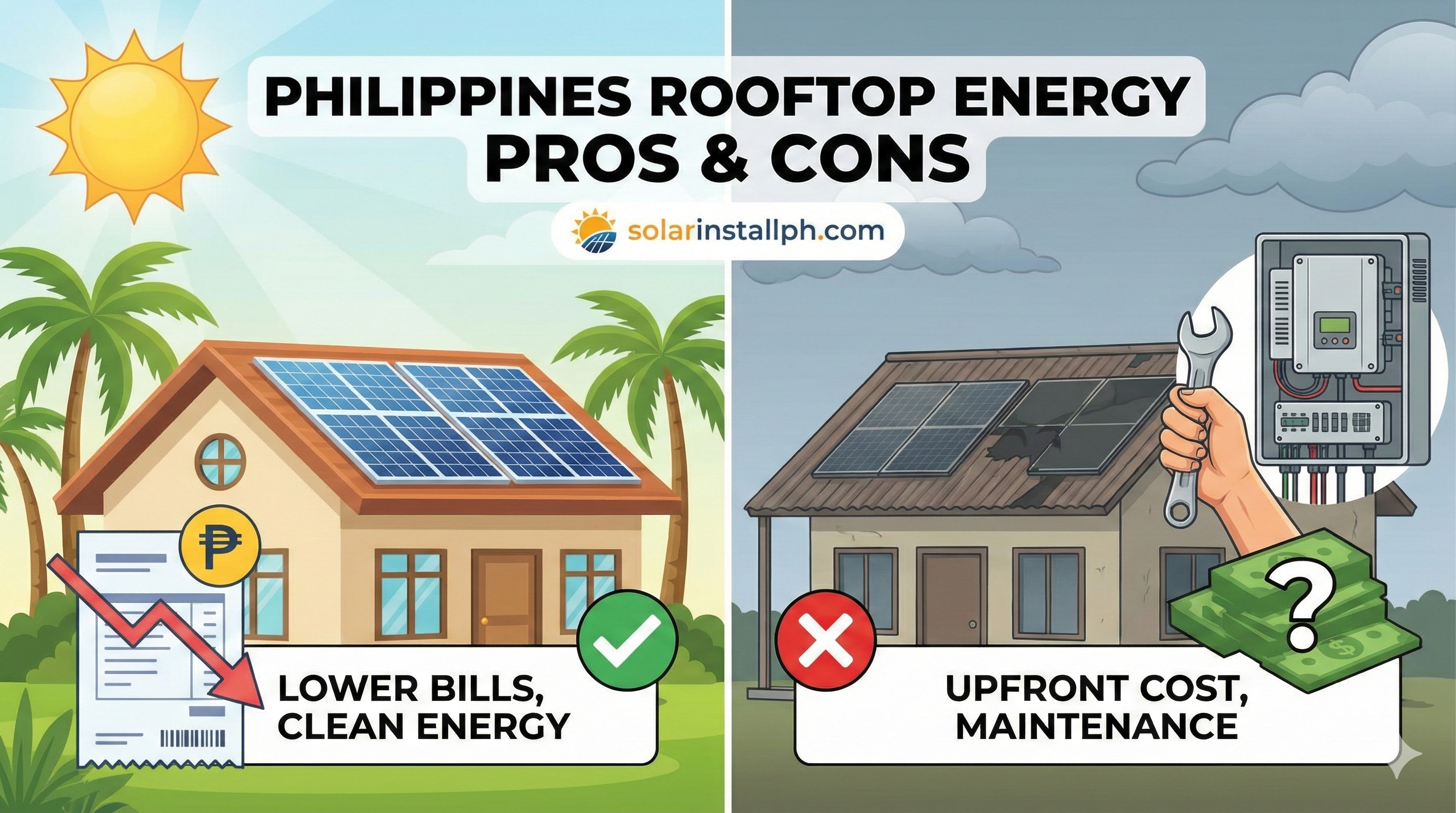
If you scroll through your Facebook feed, you will see two types of posts about solar power in the Philippines.
The first type is the glossy ad: "Zero Bill! Free Installation! Save Money Now!"
The second type is the angry homeowner: "My roof is leaking, my inverter died, and Meralco hasn't approved my meter for six months."
The truth, as always, is somewhere in the middle.
Rooftop solar is not a magic appliance you plug in and forget. It is a mini-power plant bolted to your house. It involves construction, electrical engineering, and bureaucracy. When done right, it is the best financial investment a Filipino homeowner can make in 2025. When done wrong, it is an expensive roof ornament.
Here is the unvarnished look at the pros and cons of going solar in the Philippine context.
The Pros: Why It Makes Financial Sense
1. The ROI is Unbeatable
Let’s look at the math. In Metro Manila, electricity rates are hovering between ₱13.00 and ₱14.00 per kWh depending on the monthly generation charge.
If you install a standard grid-tied system, your cost of generating power (amortized over 25 years) is roughly ₱2.50 to ₱3.50 per kWh.
You are essentially swapping a ₱13 product for a ₱3 product.
Payback Speed: A properly sized system usually pays for itself in 3.5 to 5 years.
Long-Term Gains: Solar panels typically have 25-year performance warranties. That means after year 5, you have 20 years of "free" electricity.
If you want to see the specific numbers for your budget, check our updated data on residential solar costs in the Philippines.
2. The 2025 Net Metering Upgrade
For years, Net Metering (selling excess power to Meralco) had a flaw: credits expired at the end of the year. If you saved up too much during summer, you lost it.
That changed with the recent ERC Resolution No. 15, Series of 2025.
Indefinite Rollover: Your "Peso Credits" now roll over indefinitely. You can bank the summer sun to pay for your December Christmas lights.
Transferability: If you sell your house, the credits can now transfer to the new owner.
This makes the system a much safer place to park your money. You can learn how to navigate the application in our guide to the Meralco Net Metering process.
3. The "Passive Cooling" Bonus
This is a benefit nobody talks about until they get it. Most Filipino homes have uninsulated GI sheet roofs. They get hot.
Solar panels act as a heat shield. By shading your roof, they prevent the sun from hitting the metal directly. We often see attic temperatures drop by 3°C to 5°C after installation. This means your aircon doesn't have to work as hard, lowering your bill even further.
4. Inflation Protection
Meralco rates historically rise faster than inflation. By generating your own power, you are locking in your energy price at today’s cost of equipment. When rates hit ₱16 or ₱18 per kWh in the future, you won't care. You opted out of the inflation loop.
The Cons: The Reality Check
1. No Grid, No Solar (The Brownout Issue)
This is the biggest shock for new owners.
Standard Grid-Tied Solar does NOT work during a brownout.
If the Meralco pole goes down, your inverter will shut off immediately. This is a safety feature called Anti-Islanding, required by law to prevent your panels from electrocuting linemen fixing the wires.
The Fix: You need a Hybrid Inverter and Batteries to have backup power.
The Problem: Batteries are expensive. Adding a lithium battery bank can double the cost of your system and push your ROI from 4 years to 8+ years.
For a detailed breakdown of why this happens, read our article on the pros and cons of grid-tied systems.
2. The "Buy High, Sell Low" Trap
Net Metering is great, but it is not a 1:1 trade.
You Buy at Retail: ~₱13.00/kWh.
You Sell at Generation Cost: ~₱5.00 – ₱7.00/kWh.
Because you sell your excess power at a ~50% discount, you cannot just install a massive system and expect to zero out your bill easily. You have to size the system perfectly to your daytime consumption to maximize savings. If you oversize, you are selling cheap power to the utility, which extends your payback period.
3. The Permitting Nightmare
Installing the panels takes 2 days. Getting the permits can take 2 to 6 months.
To legally operate a Net Metering system, you need:
Barangay Clearance.
Electrical Plan signed by a PEE (Professional Electrical Engineer).
Building Permit / Electrical Permit from the LGU.
Certificate of Final Electrical Inspection (CFEI).
Distribution Impact Study (DIS) from the utility.
Many homeowners get frustrated by the red tape. Some choose to go "guerrilla" and install without permits, but this carries significant risks (fines, disconnection, fire insurance voiding). We strongly advise against shortcuts. You can read about the risks in our article on skipping LGU permits.
4. Roof Leaks and Typhoons
The Philippines sits in the typhoon belt. If your installer is incompetent, they will drill holes in your roof that leak the first time it rains.
The Risk: Cheap installers use "L-feet" with no rubber flashing or apply sealant incorrectly.
The Wind Load: Cheap mounting rails can twist or detach during a Signal No. 3 storm.
You are trusting the installer to weatherproof your home. This is why the lowest bidder is often the most expensive choice in the long run.
5. Aesthetics
Let's be honest: standard solar panels can look industrial. If you have a beautiful Mediterranean-style home with curved tiles, slapping blue poly-crystalline panels on it might ruin the curb appeal. (Though modern all-black mono panels look much sleeker).
Conclusion: Is It Worth It?
For 90% of Filipino homeowners with a bill over ₱4,000, the Pros heavily outweigh the Cons.
The financial math is simply too strong to ignore. Even with the permitting hassle and the brownout limitations, the ability to cut your electric bill by 50% to 90% is life-changing for a middle-class budget.
However, solar is not for everyone:
Don't buy if your roof is shaded by a condo or a mango tree.
Don't buy if you plan to move house in 2 years.
Don't buy if you can't tolerate the 4-month wait for Net Metering activation.
For the rest of us, the best time to install was yesterday. The second best time is now.
Still analyzing the numbers? Read our final verdict on whether rooftop solar is worth it for your specific situation.