
Cut Bills: 3 Local Rooftop PV Tips
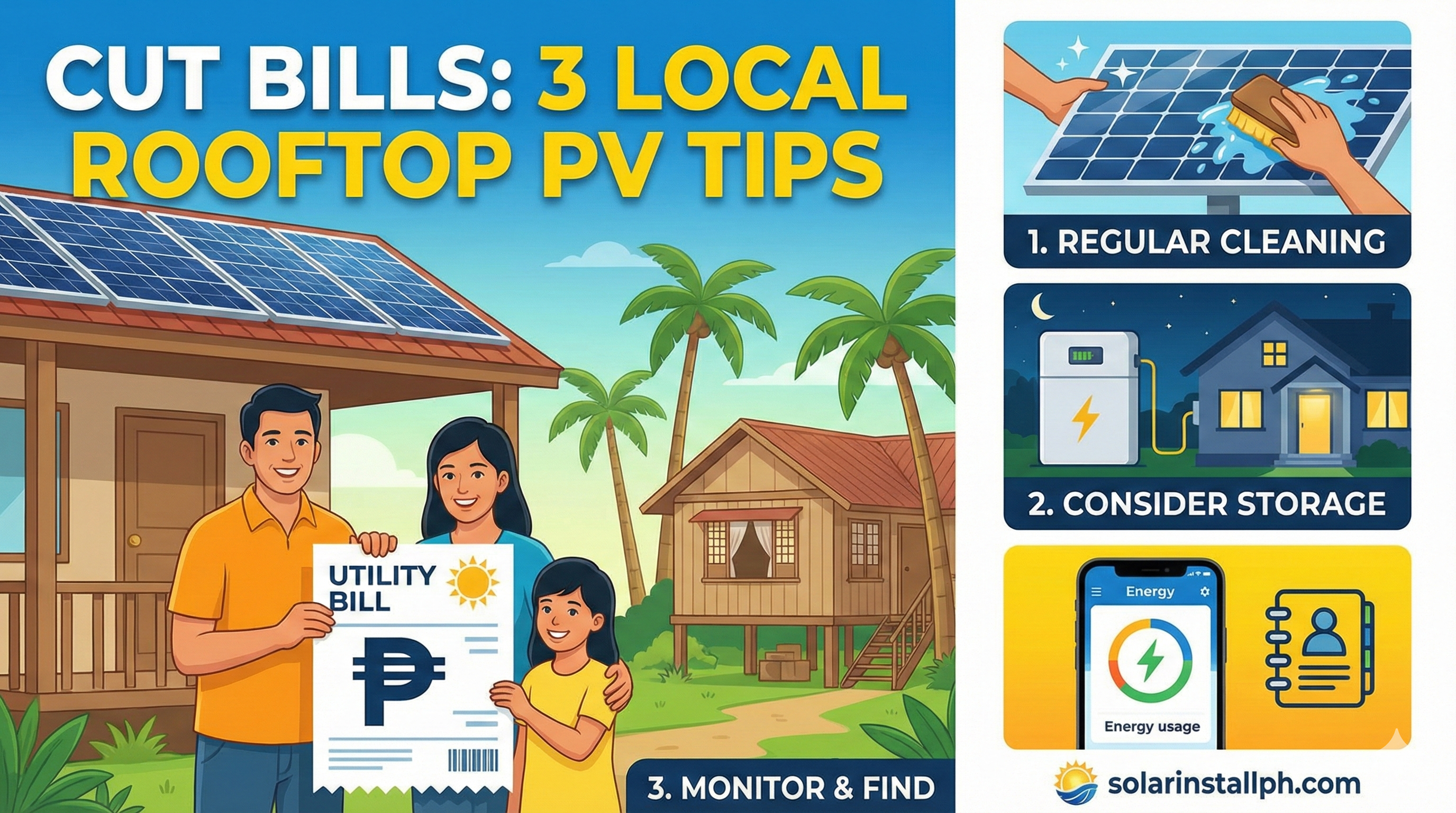
If you are reading this, you are likely holding a Meralco bill that makes you want to punch a wall. In 2025, with residential rates dancing between ₱12 and ₱14 per kilowatt-hour (kWh) depending on the generation charge and the strength of the Peso, electricity has become one of the biggest line items in the Filipino household budget.
You see neighbors installing solar panels. You see ads on Facebook promising "Zero Bills." But you also hear horror stories: systems that stop working after two years, roofs leaking during the rainy season, or installers who ghost their clients the moment the check clears.
The truth is, solar energy is the most effective way to cut your bills in the Philippines, but it is not a magic wand. It is a construction project. It requires math, compliance, and a bit of skepticism.
To actually slash your bills—and keep them low for 25 years—you need to move beyond the sales pitch. Here are three hyper-local, practical tips for Philippine rooftop PV that go deeper than "buy panels, save money."
Tip 1: Size for Your "Daytime Reality," Not Your Total Bill
The most common mistake Filipino homeowners make is sizing their system based on their total monthly bill without looking at when they use that energy.
You might tell an installer, "My bill is ₱10,000. Give me a system to wipe that out." The installer, eager for a commission, sells you a 5kW system.
Here is the problem: In a standard grid-tie setup (no batteries), your solar panels only power your house while the sun is shining (roughly 9:00 AM to 3:00 PM). If your family is at work or school during these hours and your house is empty, you are generating massive amounts of power that you aren't using.
The "Export" Trap
Without Net Metering (which we will discuss in Tip #2), that excess power flows into the grid for free. You gave Meralco free energy, and then at night, when you turn on the aircons, you buy power back at full price. This is a financial disaster.
Even with Net Metering, you are selling power at a discount.
Buying Price (Import): ~₱13.00/kWh (includes distribution, transmission, taxes, etc.).
Selling Price (Export): ~₱5.00 - ₱6.00/kWh (generation charge only).
The Strategy: You want to maximize "Self-Consumption." The most valuable kWh is the one you consume instantly because it saves you the full ₱13.00.
Audit Your Daytime Base Load: Turn on everything you normally run between 10 AM and 2 PM. Is it just a fridge and a router? Or do you have a lola watching TV and running a split-type AC?
Size Slightly Below Daytime Peak (for quick ROI): If your daytime load is 2kW, installing a 10kW system means you are exporting 80% of your production. While you get credits, the ROI is slower. A 3kW system might offer a faster payback because you are consuming nearly 100% of what you produce.
For a detailed breakdown of how system sizing affects your wallet, reviewing our guide on residential solar costs is essential before signing any contract. It explains why bigger isn't always better if your consumption habits don't match the sun.
Shifting the Load (The "Free" Upgrade)
Before you buy more panels, change your habits. This costs ₱0.
Laundry at Noon: Run washing machines and dryers when the sun is peaking.
Pre-cool the House: If you have inverter ACs, turn them on at 1:00 PM on a lower setting to cool the concrete walls. The ambient temperature will be lower at night, meaning your ACs work less when you are paying for grid power.
Tip 2: Legitimizing is Lucrative (Don't Skip Net Metering)
There is a "black market" culture in Philippine solar. Many installers will whisper, "Ma'am/Sir, let's just install a Zero Export device. No need for permits. It’s faster and cheaper."
They are lying to you. Well, they are telling the truth about it being faster, but they are lying about it being cheaper in the long run.
Why "Colorum" Solar Hurts Your Wallet
A "Zero Export" device throttles your inverter. If your panels can produce 5kW, but your house is only using 1kW, the device forces the inverter to only produce 1kW. You are throwing away 4kW of potential energy. You paid for the capacity, but you are deleting the production.
To actually cut your bill to near-zero, you need Net Metering.
The Math of Net Metering
Net Metering allows you to export that excess 4kW to the grid. Meralco (or your local DU) measures this and gives you peso credits. These credits are deducted from your bill at the end of the month.
Scenario: You export 300kWh of excess solar. Meralco credits you ~₱1,500.
Result: This ₱1,500 pays for your nighttime usage or the fixed metering charges.
This is the only legal way to offset your nighttime aircon usage without buying expensive batteries.
The "Permit Fatigue" is Worth It
Yes, the process is bureaucratic. It involves the "Yellow Card" (Certificate of Final Electrical Inspection or CFEI), the Distribution Impact Study (DIS), and plenty of waiting. It can take 3 to 6 months.
However, a legal Net Metering system adds significant value to your property and ensures safety. "Colorum" systems are a fire hazard (often installed by unlicensed electricians) and can void your home insurance. If Meralco catches you pushing power without a bi-directional meter, you face heavy fines.
Don't be intimidated by the paperwork. We have broken down the entire application process step-by-step in our Meralco Net Metering guide. Read it, print it, and hand it to your installer. If they refuse to process the permits, find another installer.
Tip 3: Engineer for the "Ber" Months and Typhoons
In California or Australia, solar advice focuses on "peak sun hours." In the Philippines, we have to design for two very different seasons: the scorching summer (March-May) and the gray, wet typhoon season (June-December).
If you design your system based only on Summer performance, you will be disappointed when your bill spikes in November.
The "Over-Paneling" Strategy
Solar panels are now relatively cheap compared to the inverter and labor. A smart local strategy is to "over-panel" your inverter.
Concept: If you have a 5kW inverter, you don't just put 5kW of panels. You put 6.5kW or even 7kW of panels (as long as the inverter's voltage input allows it).
Why? In the summer, your inverter will "clip" the excess power (capping at 5kW), which is fine. But in December, when it's cloudy and raining, that extra panel capacity helps you harvest enough diffuse light to keep your bills down. It raises the "floor" of your production during bad weather.
Typhoon-Proofing Your ROI
You cannot cut bills if your panels are flying over the neighbor's roof. We live in the typhoon belt. Standard mounting kits (rated for 2400 Pascals) are often insufficient for Bicol, Visayas, or even exposed areas in Metro Manila during a Signal No. 3 storm.
Clamp Zones: Ensure your installer uses the correct clamping zones on the panel frame. Clamping too close to the corners reduces the wind load resistance.
Rail Thickness: Demand standard structural aluminum (6005-T5) rails, not the thin, cheap stuff that bends by hand.
Walkways: Ensure there is a maintenance walkway. You need to clean these panels. If they are packed tight with no access, you will never clean them. Dirty panels in Manila's pollution can lose 15-20% efficiency.
For a deeper dive into choosing hardware that survives our climate, consult our analysis of the best solar panels for Philippine homes. We compare brands not just on price, but on frame durability and warranty support in the local market.
The Financial Reality Check: ROI in 2025
Let’s talk numbers. Many salespeople promise a 2-3 year ROI. In 2025, that is aggressive and likely misleading for a residential setup.
With current equipment prices and installation labor costs:
System Cost: A high-quality 5kW Grid-Tie system costs between ₱280,000 and ₱350,000 (turnkey with permits).
Monthly Savings: approx. ₱8,000 to ₱10,000 (depending on utilization).
Realistic ROI: 3.5 to 5 years.
This is still an incredible investment. It beats the stock market, it beats mutual funds, and it certainly beats leaving money in a savings account. After year 5, you are essentially generating free electricity for the next 20 years of the system's life.
However, this ROI calculation assumes the system keeps working. This is why choosing the right partner is critical. Do not just go for the cheapest quote on Facebook Marketplace. You are marrying this installer for 25 years. You need to know they will answer the phone when an inverter throws an error code in 2028. You can start vetting potential partners using our list of DOE-accredited installers.
What About Batteries?
"Should I get a Hybrid system with batteries to cut my bill even more?"
Generally, no. Batteries are for brownout protection, not bill cutting. The cost of storing energy in a lithium battery (roughly ₱15-20 per cycled kWh when you factor in degradation and upfront cost) is still higher or equal to the cost of grid power.
Grid-Tie: For savings (ROI focused).
Hybrid: For security (Comfort focused).
If you have critical loads like a home office, medical equipment, or just hate the heat during outages, get batteries. But don't expect them to lower your payback period; they will extend it to 7-9 years. For a comprehensive look at the math behind this, check our guide on solar ROI.
Summary
Cutting your bills with rooftop solar is a journey, not a transaction.
Analyze: Don't buy a system larger than your daytime needs unless you are committed to Net Metering.
Legalize: Net Metering is the secret weapon for 100% bill offsets. Do not skip the permits.
Reinforce: Build a system that handles low-light months and high-wind storms.
The sun in the Philippines is free, but the technology to harvest it is an investment. Treat it with the same due diligence you would give to buying a car or a lot. If you do it right, your roof becomes your most productive asset.
For more insights on the specific equipment that powers these savings, take a look at our review of the top inverter brands for 2025. The inverter is the heart of your system—choose one that can handle our fluctuating grid voltage.
Stay sunny, stay saved.