
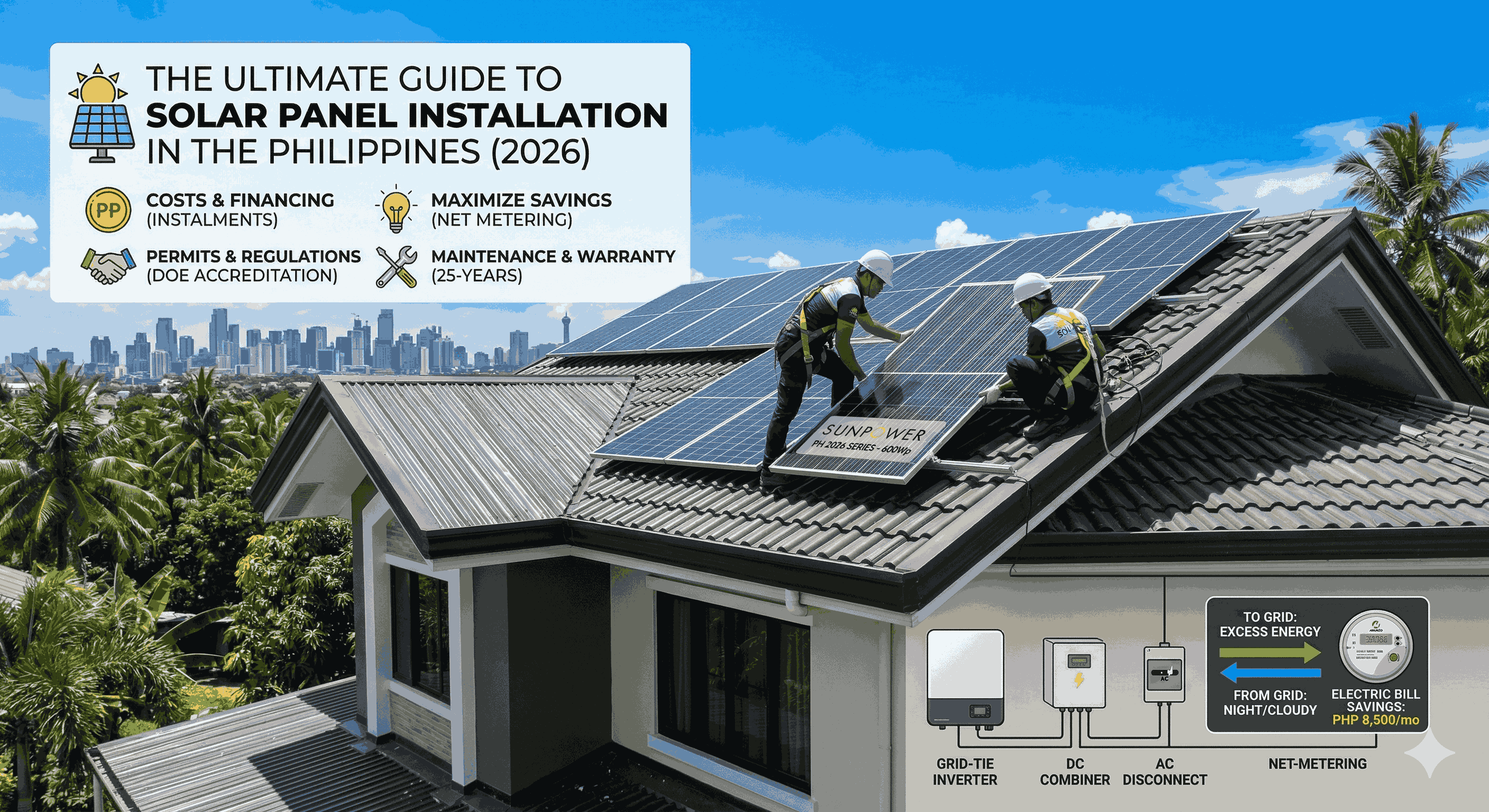
Solar Panel Installation Guide in the Philippines (2026)
The Ultimate Guide to Solar Panel Installation in the Philippines (2026)
Everything You Need to Know About Installing Solar Panels in the Philippines — From Costs and Benefits to Choosing the Right System and Installer
With electricity rates in the Philippines continuing to rise and environmental concerns becoming increasingly urgent, more Filipino homeowners and business owners are turning to solar energy as a viable solution. Solar panel installation has emerged as one of the most effective ways to reduce electricity bills, achieve energy independence, and contribute to a more sustainable future.
But navigating the world of solar panel installation in the Philippines can be overwhelming. From understanding the different types of solar systems to comparing prices, finding reputable installers, and navigating the net-metering process — there's a lot to consider.
This comprehensive guide covers everything you need to know about solar panel installation in the Philippines. Whether you're a homeowner looking to reduce your monthly electricity bills or a business owner exploring commercial solar options, this article will provide you with the knowledge and resources to make an informed decision.
What You'll Learn:
How solar panel systems work in the Philippines
The true costs of solar panel installation
On-grid vs. hybrid systems: Which is right for you?
The net-metering process and its benefits
How to choose the best solar panel company
Government incentives and subsidies available
Maintenance requirements and longevity expectations
ROI calculations and real savings examples
Understanding Solar Panel Installation in the Philippines
What Is Solar Panel Installation?
Solar panel installation is the process of mounting photovoltaic (PV) panels on your property to capture sunlight and convert it into usable electricity. In the Philippines, this process has become increasingly accessible thanks to falling equipment costs, improved technology, and growing awareness of renewable energy benefits.
A typical solar panel installation system consists of several key components:
Solar Panels — The photovoltaic modules that capture sunlight and convert it to DC (direct current) electricity
Inverter — Converts DC electricity from the panels to AC (alternating current) electricity that powers your home
Mounting Structure — The racking system that secures panels to your roof or ground-mounted installation
wiring and Connectors — Electrical wiring that connects all components safely
Metering Equipment — For net-metering installations, a bi-directional meter measures energy flow
Why Solar Panel Installation Makes Sense in the Philippines
The Philippines is uniquely positioned to benefit from solar panel installation for several compelling reasons:
Abundant Sunshine: The country receives an average of 5 to 6 hours of peak sunlight daily, with some areas experiencing even more. This makes solar energy generation highly efficient throughout the year.
High Electricity Costs: Meralco (Manila Electric Company) rates consistently rank among the highest in Southeast Asia, with residential rates often exceeding ₱10-12 per kilowatt-hour. Solar panel installation can reduce or eliminate these costs entirely.
Energy Independence: With the Philippine power grid experiencing periodic rotational brownouts and the vulnerability of infrastructure to extreme weather events, solar panel installation provides a reliable alternative energy source.
Government Support: The Philippine government has implemented net-metering policies and continues to explore incentives for renewable energy adoption, making solar panel installation more accessible and financially attractive.
Types of Solar Panel Systems
Before proceeding with solar panel installation, it's essential to understand the different system types available in the Philippines. Your choice will depend on your energy needs, budget, and desired level of independence from the grid.
On-Grid Solar Systems (Grid-Tied)
On-grid solar systems are the most common choice for solar panel installation in the Philippines. These systems are connected to the local electricity distribution grid (Meralco in Metro Manila).
How On-Grid Systems Work:
Solar panels generate electricity from sunlight
The inverter converts DC to AC electricity
Your property uses the generated electricity first
Any excess electricity is fed back to the grid
During nighttime or cloudy periods, electricity is drawn from the grid
Advantages of On-Grid Solar Installation:
Lower Initial Cost: On-grid systems don't require batteries, making them 30-40% cheaper than hybrid systems
Net-Metering Benefits: Earn credits for excess energy fed back to the grid
Minimal Maintenance: No battery replacements or complex maintenance required
Longer Lifespan: Systems can last 25+ years with minimal upkeep
Grid Reliability: You have access to grid power when solar generation is low
Disadvantages of On-Grid Solar Installation:
No power during grid outages (safety feature to prevent backfeeding)
Complete dependence on grid for nighttime electricity
Net-metering policies can change
Best For: Filipino homeowners and businesses with stable grid infrastructure who want to reduce electricity bills without the complexity of battery storage.
On-Grid Solar Installation Starting Prices in the Philippines:
System Size | Price (₱) | Estimated Monthly Savings |
|---|---|---|
3kW | 149,000 | ₱2,500 - ₱3,500 |
5kW | 205,000 | ₱4,000 - ₱5,500 |
8W | 315,000 | ₱6,500 - ₱8,500 |
16kW | 621,000 | ₱12,000 - ₱16,000 |
20kW | 721,000 | ₱15,000 - ₱20,000 |
Hybrid Solar Systems (Battery-Integrated)
Hybrid solar systems combine on-grid functionality with battery storage, providing power backup during outages and increased energy independence.
How Hybrid Systems Work:
Solar panels generate electricity from sunlight
The hybrid inverter manages power flow between panels, batteries, and the grid
Excess energy charges the batteries
During outages, batteries provide backup power
Nighttime power comes from stored battery energy
Advantages of Hybrid Solar Installation:
Power Backup: Continuous electricity during grid outages
Energy Independence: Reduced reliance on the grid
Peak Shaving: Use stored energy during expensive peak hours
Maximum Savings: Optimize when to use solar vs. grid power
Environmental Benefits: Increased self-consumption of solar energy
Disadvantages of Hybrid Solar Installation:
Higher Initial Cost: Batteries significantly increase the total investment
Battery Replacement: Batteries typically need replacement every 7-15 years
More Complex Installation: Requires additional components and expertise
Space Requirements: Batteries need dedicated storage space
Best For: Areas with unreliable grid power, businesses requiring continuous operations, and homeowners seeking maximum energy independence.
Hybrid Solar Installation Starting Prices in the Philippines:
System Size | Price (₱) | Estimated Monthly Savings |
|---|---|---|
3kW | 224,000 | ₱3,000 - ₱4,000 |
5kW | 295,000 | ₱4,500 - ₱6,000 |
10kW | 562,000 | ₱8,000 - ₱10,000 |
15kW | 835,000 | ₱11,000 - ₱14,000 |
20kW | 1,110,000 | ₱15,000 - ₱22,000 |
Off-Grid Solar Systems (Stand-Alone)
Off-grid systems are completely independent of the utility grid, requiring substantial battery storage to meet all energy needs.
Best For: Remote locations without grid access, such as farms, remote resorts, or island communities.
On-Grid vs. Hybrid: Making the Right Choice
Choose On-Grid Solar Installation If:
Your area has reliable grid power
Your primary goal is reducing electricity bills
You want the lowest upfront cost
You're satisfied with net-metering credits for backup power
Choose Hybrid Solar Installation If:
Your area experiences frequent power outages
You need backup power for medical equipment or critical systems
You want maximum energy independence
Your business requires uninterrupted power
The True Cost of Solar Panel Installation in the Philippines
Understanding the complete cost of solar panel installation is crucial for making an informed decision. While the initial investment may seem significant, the long-term savings and return on investment often justify the expense.
Breaking Down Solar Panel Installation Costs
A professional solar panel installation in the Philippines typically includes:
Professional Services (Design and Engineering)
Site assessment and energy analysis
System design and engineering
Permits and documentation
Supply of Materials
Solar panels (monocrystalline or polycrystalline)
Inverter(s)
Mounting structure and hardware
Wiring and electrical components
Safety equipment
Logistics and Delivery
Transportation to installation site
Material handling
Labor and Installation
Roof mounting and sealing
Electrical wiring and connections
Inverter installation
System testing and commissioning
Net-Metering Compliance
Electrical documentation
Meralco application processing
Final inspection coordination
Factors Affecting Solar Panel Installation Costs
Several factors influence the total cost of your solar panel installation:
System Size: Larger systems cost more upfront but typically offer better value per watt. Your system size should be based on your monthly energy consumption.
Panel Quality: Higher-efficiency panels (monocrystalline) cost more but generate more power per square meter. This is especially important if you have limited roof space.
Roof Type and Condition: Flat roofs, slate roofs, or roofs in poor condition may require additional mounting hardware or structural reinforcement.
System Complexity: Hybrid systems with batteries cost significantly more than basic on-grid installations.
Location: Installation costs may vary slightly depending on your location in the Philippines and the distance from the installer's warehouse.
Installation Timing: Some installers offer discounts during slower periods. Planning ahead can help you secure better pricing.
Hidden Costs to Watch For
When budgeting for solar panel installation, be aware of potential additional costs:
Roof Reinforcement: If your roof structure can't support the panels
Electrical Panel Upgrades: If your electrical panel needs updating to accommodate solar
Tree Trimming: If shading from trees needs to be addressed
Permit Fees: Some municipalities charge permit fees
Net-Metering Application: Application processing fees
Future Maintenance: Budget for periodic cleaning and occasional component replacement
Financing Options for Solar Panel Installation
Several financing options can make solar panel installation more accessible:
Cash Payment: The simplest option, offering the best return on investment. Many installers offer discounts for cash payments.
Bank Financing: Several Philippine banks offer solar loans with competitive interest rates. BPI, BDO, and Metrobank have specific solar financing products.
In-House Financing: Many solar installers offer installment plans, allowing you to pay over 24-60 months.
Lease Options: Some companies offer solar lease programs where you pay a monthly fee for the system without ownership.
Understanding Net-Metering in the Philippines
Net-metering is a crucial component of solar panel installation economics in the Philippines. Understanding how it works will help you maximize your savings.
What Is Net-Metering?
Net-metering is a billing mechanism that credits solar panel system owners for the electricity they add to the grid. When your solar panels generate more electricity than you consume, the excess is sent back to the grid, and you receive credits on your electricity bill.
How Net-Metering Works in the Philippines
Daytime Operation: Your solar panels generate electricity during daylight hours
Self-Consumption: Your property uses the generated electricity first
Excess to Grid: Any electricity you don't use is sent back to the Meralco grid
Credit Accumulation: You receive credits for this excess energy
Nighttime Draw: At night, you draw electricity from the grid, using your credits
Monthly Settlement: Net consumption is billed, often resulting in minimal or zero payments
Benefits of Net-Metering for Solar Panel Installation
Bill Reduction: Save up to 95% on your monthly electricity bills
Grid as Storage: The grid acts as a free battery, storing excess energy for later use
Simple Process: No battery maintenance or replacement costs
Environmental Impact: Maximizes your use of renewable energy
ROI Acceleration: Faster return on your solar panel installation investment
Net-Metering Requirements in the Philippines
To qualify for net-metering with Meralco:
Your solar panel installation must be approved by a licensed installer
The system must meet technical requirements (typically 5kW minimum)
You must apply through your distribution utility
A bi-directional meter must be installed
The installation must pass final inspection
The Net-Metering Application Process
Site Assessment: Your installer evaluates your property
System Design: Professional engineering design submitted
Application Submission: Documents submitted to Meralco
Installation: Professional installation completed
Meralco Inspection: Technical inspection by utility
Meter Installation: Bi-directional meter installed
System Activation: Net-metering activated
Most installers handle this process for you as part of the solar panel installation service.
Calculating Your ROI and Savings
One of the most important aspects of solar panel installation is understanding your potential return on investment. Let's break down the numbers.
Average Return on Investment
In the Philippines, solar panel installation typically offers:
ROI Period: 4 to 7 years
Lifetime Savings: ₱500,000 to ₱2,000,000+ over 25 years
Annual Savings: 65% to 95% reduction in electricity bills
Real Savings Examples
Example 1: Residential Home in Metro Manila
Monthly electricity bill: ₱5,000
System installed: 5kW on-grid
Installation cost: ₱205,000
Annual savings: ₱45,000 - ₱54,000 (at ₱10/kWh)
ROI period: 4-5 years
25-year savings: ₱1,125,000 - ₱1,350,000
Example 2: Residential Home in Bulacan
Monthly electricity bill: ₱8,000
System installed: 8kW on-grid
Installation cost: ₱315,000
Annual savings: ₱72,000 - ₱86,400
ROI period: 4-5 years
25-year savings: ₱1,800,000 - ₱2,160,000
Example 3: Small Business in Cavite
Monthly electricity bill: ₱15,000
System installed: 15kW on-grid
Installation cost: ₱562,000 (estimated for hybrid)
Annual savings: ₱135,000 - ₱162,000
ROI period: 4-5 years
25-year savings: ₱3,375,000 - ₱4,050,000
Factors Affecting Your Savings
System Size: Larger systems generate more savings but have higher upfront costs
Energy Consumption: Higher consumption = greater savings potential
Electricity Rates: As rates increase, your savings also increase
System Orientation: South-facing roofs in the Philippines maximize production
Shading: Trees, buildings, or other obstacles reduce production
System Efficiency: Quality components perform better over time
Solar Savings Calculator Logic
To estimate your potential savings:
Find your monthly consumption: Check your Meralco bill for kWh usage
Multiply by current rate: (kWh × ₱10-12 = monthly cost)
Calculate annual cost: Monthly cost × 12
Estimate savings: Annual cost × 0.75 (assuming 75% offset)
Determine system size needed: Annual consumption ÷ 1,460 (typical output per kW in PH)
Choosing the Right Solar Panel Company in the Philippines
Selecting the right installer is crucial for a successful solar panel installation. Here's what to look for:
Essential Qualities of a Reputable Solar Panel Company
1. Licensed and Certified
Philippine Electrical Engineer (PEE) license
Electrical Contractor License
Certifications from solar panel manufacturers
2. Experience and Track Record
Years in business
Number of installations completed
Portfolio of completed projects
Customer testimonials and references
3. Quality Equipment
Use of reputable solar panel brands (Tier 1 manufacturers)
Quality inverters from established brands
Proper mounting hardware and components
4. Warranty Coverage
Panel warranty (typically 25 years)
Inverter warranty (typically 10-12 years)
Installation warranty (typically 2-5 years)
workmanship warranty
5. After-Sales Support
Maintenance services available
Responsive customer service
Spare parts availability
6. Transparent Pricing
Detailed quotations
No hidden fees
Clear breakdown of costs
Red Flags to Avoid
⚠️ Unrealistically Low Prices: If it sounds too good to be true, it probably is. Quality solar panel installation requires proper equipment and professional labor.
⚠️ No Physical Address: Reputable companies have established offices and showrooms.
⚠️ No Portfolio: Ask to see completed installations, preferably in your area.
⚠️ Vague Warranties: Get all warranties in writing. Understand what's covered and for how long.
⚠️ Pressure Tactics: Legitimate companies don't use high-pressure sales tactics.
⚠️ No Net-Metering Experience: If they haven't handled net-metering applications before, keep looking.
Questions to Ask Before Hiring
How many solar panel installations have you completed?
Can you provide references from past customers?
What brands of solar panels and inverters do you use?
What warranties do you offer?
Do you handle net-metering applications?
What maintenance services do you offer after installation?
What happens if there's a problem with the system?
How long will the installation take?
What is included in the price?
Do you offer financing options?
The Solar Panel Installation Process
Understanding the installation process helps you prepare and know what to expect.
Step-by-Step Installation Timeline
Day 1-2: Initial Consultation
Contact solar company for assessment
Site visit and energy analysis
Receive proposal and quotation
Day 3-7: Proposal and Agreement
Review quotation
Compare options
Sign installation agreement
Pay deposit
Day 8-14: Design and Permits
Professional system design
Permit application submission
Material procurement
Day 15-21: Installation
Site preparation
Mounting structure installation
Panel installation
Inverter and electrical work
System testing
Day 22-30: Commissioning
Final electrical inspection
Net-metering application
Meter installation
System activation
Customer training
What to Prepare Before Installation
Documentation:
Proof of property ownership
Recent electricity bills
ID for application purposes
Site Preparation:
Clear roof access
Trim overhanging trees
Ensure electrical panel is accessible
Clear area for equipment staging
Homeowner Preparation:
Notify neighbors if necessary
Prepare questions for training
Arrange payment
What Happens on Installation Day
Morning: Installers arrive, set up safety equipment
Midday: Mounting rails installed, panels hoisted
Afternoon: Electrical connections made, inverter installed
End of Day: System tested, initial checks performed
Follow-up: Inspection scheduled, net-metering applied for
Most residential solar panel installations take 1-3 days, depending on system size and roof complexity.
Maintenance and Longevity
Proper maintenance ensures your solar panel installation delivers optimal performance for decades.
Solar Panel Maintenance Requirements
Regular Cleaning (Every 6-12 Months):
Remove dust, leaves, and debris
Clean with water and mild soap
Avoid abrasive materials
Check for damage or cracks
Professional Maintenance (Annually):
Electrical system inspection
Inverter performance check
Mounting hardware tightening
Panel output verification
Expected Lifespan of Solar Panel Components
Component | Expected Lifespan | Warranty |
|---|---|---|
Solar Panels | 25-40 years | 25 years |
Inverters | 10-15 years | 10-12 years |
Batteries (Hybrid) | 7-15 years | 5-10 years |
Mounting System | 25+ years | 10-25 years |
Common Issues and Troubleshooting
Reduced Output:
Check for shading from new obstructions
Clean panels if dirty
Check inverter for error codes
Contact installer if issues persist
Inverter Problems:
Most issues show error codes
Check internet connection (for smart inverters)
Restart inverter if needed
Contact maintenance service
Metering Issues:
Contact your solar installer
Check Meralco account status
Verify system is producing power
Government Incentives and Subsidies
The Philippine government offers several programs to support renewable energy adoption.
Net-Metering Policy
The net-metering policy, governed by the Energy Regulatory Commission (ERC), allows residential and commercial consumers to connect solar systems to the grid and receive credits for excess generation.
Key Points:
Applicable to both residential and commercial properties
System capacity typically limited to customer load
Monthly net billing settlement
No limit on system size for some commercial applications
Renewable Energy Act of 2008
Republic Act 9513 encourages the development, utilization, and commercialization of renewable energy sources through various incentives:
Income tax holiday
Duty-free import of renewable energy components
Special tax rates on renewable energy equipment
Accelerated depreciation
Local Government Incentives
Some municipalities and cities offer additional incentives:
Permit fee reductions
Tax incentives for businesses
Streamlined permitting processes
Upcoming Programs
The Philippine government continues to develop additional incentives. Current proposals include:
Expanded feed-in tariff programs
Residential subsidy programs
Green building requirements
EV and solar integration incentives
Frequently Asked Questions
How much does solar panel installation cost in the Philippines?
Solar panel installation in the Philippines starts at ₱149,000 for a 3kW on-grid system. Complete systems range from ₱149,000 (3kW) to ₱721,000 (20kW) for on-grid, and ₱224,000 to ₱1,110,000 for hybrid systems with batteries.
How much can I save on electricity bills with solar panels?
A properly sized solar installation can save you at least 65% on your annual electricity bill, with some systems achieving up to 95% savings through net-metering. The actual savings depend on your energy consumption and system size.
What is net-metering in the Philippines?
Net-metering allows you to feed excess solar energy back into the grid and receive credits on your electricity bill. These credits can be used to offset nighttime consumption, making it possible to achieve near-zero electricity costs.
How long is the return on investment for solar panels?
The return on investment for solar panels in the Philippines is typically between 4 to 7 years, depending on your energy consumption, system size, and electricity rates.
Where can solar panels be installed?
Solar panels can be installed on any type of roof — sloped or flat — including wood, sheet metal, tile, or slate roofs. They can also be ground-mounted with a canopy or carport structure.
Do solar panels work on cloudy days?
Yes, solar panels still produce energy on cloudy days, though in smaller quantities. The efficiency of the panels you choose is important for maximizing output in varying conditions.
How long do solar panels last?
Standard solar panels have a minimum production life of 25 years, while high-end models can last up to 40 years. Most manufacturers guarantee 80% efficiency at 25 years.
Can I add batteries to my solar system later?
If you install a hybrid inverter from the start, you can add batteries in the future. It's important to plan ahead and choose the right inverter to avoid replacing it later.
Is solar panel installation profitable in the Philippines?
Every day it becomes more difficult to cope with rising electricity bills. A properly sized and executed solar installation will save you significant amounts on your annual electricity bill, with returns typically achieved within 4-7 years.
How do I know how many solar panels I need?
A preliminary analysis is important. Factors include your contracted power, current and future consumption, roof space available, and how much you want to save. A professional installer can provide a personalized assessment.
Conclusion
Solar panel installation in the Philippines represents a significant opportunity for Filipino homeowners and businesses to reduce electricity costs, achieve energy independence, and contribute to environmental sustainability.
With transparent pricing starting at ₱149,000 for residential systems, potential savings of 65-95% on electricity bills, and ROI periods of just 4-7 years, solar panel installation makes strong financial sense for many properties.
The key to a successful solar panel installation lies in:
Choosing the Right System: Select on-grid or hybrid based on your needs and budget
Hiring a Reputable Installer: Work with licensed professionals with proven track records
Understanding Net-Metering: Maximize your savings through proper grid connection
Proper Maintenance: Protect your investment with regular care and servicing
Realistic Expectations: Understand the timeline, costs, and benefits
As electricity rates continue to rise and solar technology improves, the case for solar panel installation in the Philippines only grows stronger. Whether you're in Metro Manila, Bulacan, Cavite, Pampanga, or elsewhere in the Philippines, now is the time to explore solar energy for your home or business.
Ready to start your solar panel installation journey?
Contact a reputable solar panel company in your area for a free site inspection and personalized quotation. Your journey to energy independence and reduced electricity bills begins with a single conversation.
This comprehensive guide was created to provide accurate, up-to-date information about solar panel installation in the Philippines. Prices and policies may change, so always consult with a licensed solar installer for the most current information specific to your situation.