
Business Energy Installation Costs Explained
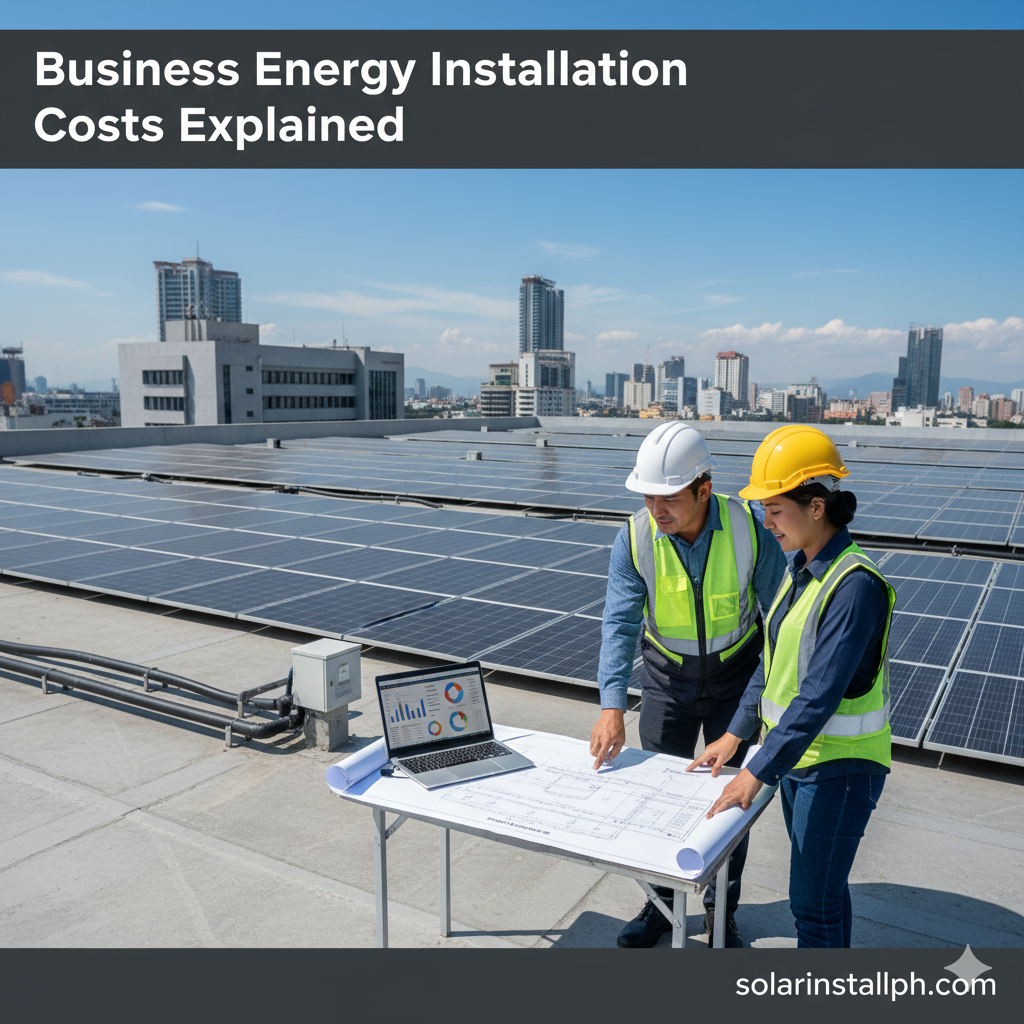
If you run a business in the Philippines, you already know the pain of opening your Meralco or electric coop bill. Commercial electricity rates here are among the highest in Asia, often exceeding ₱11 to ₱13 per kWh. For a factory, a BPO office, or a cold storage facility, this isn't just an overhead cost—it’s a threat to your bottom line.
Switching to solar is no longer just "green marketing"; it’s a financial survival strategy. But the biggest hurdle for most business owners is the upfront price tag.
"How much will it really cost?"
"Is the ROI real, or just sales talk?"
"What hidden fees are lurking in the permitting process?"
This guide breaks down the actual costs of commercial solar installation in the Philippines for 2025, moving beyond the brochure prices to the real-world numbers you need for your feasibility study.
The Cost Per Kilowatt: 2025 Benchmarks
Unlike residential systems, commercial solar benefits from economies of scale. As the system size goes up, the price per kilowatt (kW) goes down.
In 2025, realistic "turnkey" pricing (including hardware, labor, and basic permitting) generally falls into these ranges:
Small Commercial (10kW – 50kW): ₱45,000 – ₱55,000 per kW
Best for: Small offices, restaurants, convenience stores.
Medium Commercial (50kW – 100kW): ₱35,000 – ₱45,000 per kW
Best for: Warehouses, schools, medium-sized manufacturing.
Large Commercial / Industrial (100kW+): ₱30,000 – ₱38,000 per kW
Best for: Cold storage, factories, malls, large agro-industrial facilities.
Example Calculation:
If you need a 50kWp system for your warehouse roof, budget approximately ₱2.0M to ₱2.5M. If you are building a massive 1MW (1,000kW) industrial array, the cost might drop to around ₱30M – ₱35M.
These figures are for grid-tied systems (no batteries). If you require BMS setup importance for backup power during brownouts, the cost will increase significantly—often by 50% to 80%—due to the price of lithium batteries and hybrid inverters.
Breakdown of the "EPC" Quote
When you receive a quote from a solar provider, it’s usually an "EPC" contract (Engineering, Procurement, and Construction). It is critical to know where your money is going so you can spot a "low-ball" offer that cuts dangerous corners.
1. Hardware (60-70% of Cost)
Panels: Tier 1 brands (like Longi, Trina, Jinko, JA Solar) are standard. Be wary of installers offering "white label" or unbranded panels to save money; these often suffer from micro-cracks or poor degradation rates.
Inverters: For commercial setups, you will likely use three-phase string inverters (Huawei, Sungrow, SMA, or Growatt).
Mounting: This is often overlooked. In the Philippines, your mounting structure must be rated for 250kph winds. Cheap aluminum rails will buckle during a super typhoon. Ensure the quote specifies wind load ratings compliant with the National Structural Code of the Philippines (NSCP).
2. Labor and Engineering (15-20% of Cost)
This isn't just guys with drills. It includes:
Structural Analysis: A civil engineer must certify that your roof can hold the extra weight (approx 15-20kg per sqm).
Electrical Design: A Professional Electrical Engineer (PEE) must sign and seal the plans.
Safety: Commercial sites require DOLE-compliant safety officers, scaffolding, and harnesses.
3. Permitting and Soft Costs (10-15% of Cost)
This is where projects often get stuck. The bureaucracy in the Philippines is complex. Your quote should cover:
LGU Permits: Barangay clearance, building permit, electrical permit.
Meralco/DU Processing: CFEI (Certificate of Final Electrical Inspection) and Net Metering applications.
ERC Compliance: For systems over 100kW, you need a Certificate of Compliance (COC) from the Energy Regulatory Commission.
For a deeper dive on why you shouldn't cut corners here, read our article on skipping LGU permits.
Hidden Costs: What Sales Reps Forget to Mention
The sticker price is not the final price. To avoid "budget shock," factor these in:
1. Roof Preparation
Solar panels need a solid foundation. If your factory’s GI sheet roof is 15 years old and rusting, no reputable installer will put solar on it. You may need to waterproof or re-roof before installation.
Cost: varies wildly, but budget for roof repairs if your building is old.
2. Transformer Upgrades
If you plan to export excess power via Net Metering (for systems <100kW) or the Zero Export scheme, your existing distribution transformer might need upgrading to handle the reverse flow.
Cost: ₱100k – ₱500k depending on the capacity.
3. The "Zero Export" Device
For large systems (100kW+) not enrolled in Net Metering, you are strictly prohibited from feeding power back to the grid. You need a specific device to throttle your inverters if your factory's load drops.
Cost: ₱50k – ₱150k. Understand the mechanics of this in our zero export overview.
The ROI Equation: Is It Worth It?
For Philippine businesses, the math is compelling.
Avoided Cost: You are saving ₱12/kWh (grid rate).
Solar Cost: The Levelized Cost of Electricity (LCOE) for a commercial system over 25 years is roughly ₱2.50 – ₱4.00 per kWh.
Payback Period:
Most commercial systems in Luzon achieve ROI in 3.5 to 5 years.
If you operate 7 days a week (like a mall or cold storage), payback can be as fast as 3 years.
Since the panels last 25+ years, that gives you 20 years of essentially free electricity.
For specific examples of how smaller businesses handle these costs, check our breakdown of SMB solar costs.
Financing: You Don't Have to Pay Cash
In 2025, liquidity is king. You don't necessarily need to drain your Capex budget to go solar.
Bank Loans: Major banks (BPI, BDO, UnionBank) now have specialized "Green Energy" loan products with lower interest rates and longer tenors for solar projects.
Leasing / PPA: For very large roofs (typically 500kW+), some solar companies will install the system for free and sell you the power at a rate lower than Meralco (e.g., ₱9/kWh vs ₱12/kWh). You pay zero upfront.
Government Incentives: While direct cash rebates are rare, BOI-registered companies can avail of Income Tax Holidays (ITH) and duty-free importation of equipment under the Renewable Energy Act (RA 9513).
Learn more about financing options in our guide to solar bank loans.
Why "Cheapest" is Dangerous
You will get quotes that are 20% cheaper than the average. Be very careful.
In the solar industry, "cheap" usually means:
Undersized Wire: Using wires that are too thin causes voltage drop and fire risks.
No O&M Support: When an inverter fails in Year 3, the "cheap" installer is often ghosting you.
Non-Compliant Mounting: They might use clamps that corrode in 2 years, risking panels flying off during a storm.
Before signing, always perform an installer portfolio check to see their previous commercial work. Ask to talk to the facility manager of a plant they installed 3 years ago.
Conclusion
Commercial solar in the Philippines is one of the safest investments a business can make in 2025. It hedges against inflation, stabilizes your OpEx, and increases your property value.
The cost is significant—millions of pesos—but the cost of inaction is higher. Every month you delay is another month of paying ₱12/kWh to the utility when you could be generating your own power for ₱3/kWh.
Do your feasibility study. Get three quotes. Verify the engineering. And then, turn on the sun.