
3 Best Panel Efficiency for Businesses
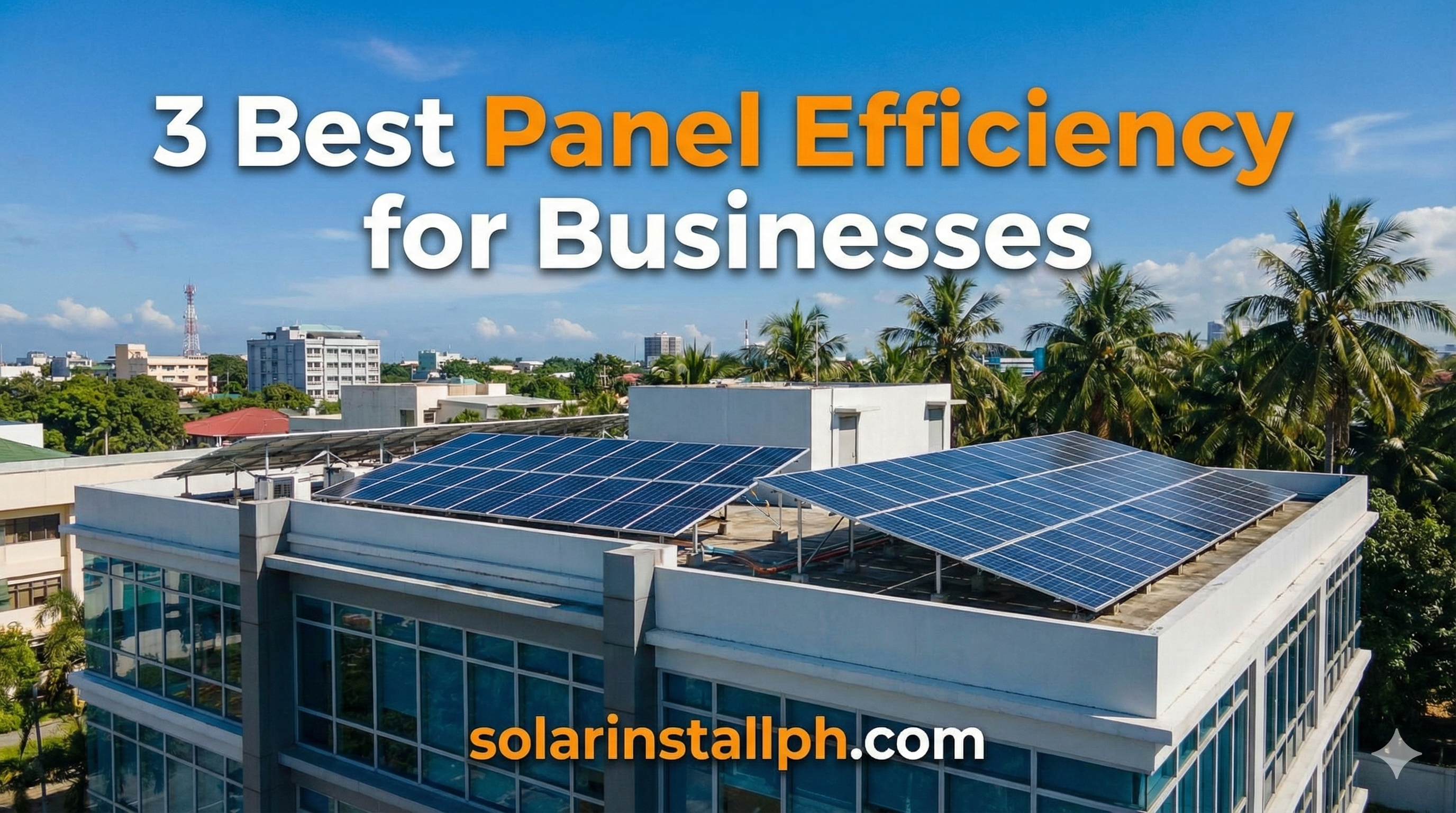
If you are a business owner in the Philippines looking at solar quotes in 2025, you are likely staring at a confusing list of percentages: 21.5%, 22.8%, 24%.
It is tempting to think that the highest number is automatically the "best." But in commercial solar, efficiency is just a measure of power density (watts per square meter). It tells you how much power fits on a specific patch of roof.
For a hotel in Makati with a tiny roof and a massive aircon bill, the highest efficiency is crucial. For a warehouse in Bulacan with 5,000 square meters of unused metal roof, paying extra for "ultra-high efficiency" is often a waste of capital.
Here is a breakdown of the three main efficiency tiers available in the Philippine market today, and which one actually makes financial sense for your specific business model.
Tier 1: The "Value" Standard (20% – 21.5%)
Technology: Monocrystalline PERC (P-Type)
Best For: Logistics Warehouses, Large Manufacturing Plants, Agricultural Buildings
A few years ago, this was the premium option. Today, standard Mono PERC panels are the workhorses of the industry. They are mature, reliable, and most importantly, cheap.
If your facility has a massive roof—think of the sprawling factories in PEZA zones or warehouses along SLEX—space is not your problem. Your constraint is budget (Capex).
The Logic: Why pay a premium to squeeze 600 watts into a small space when you have room to install two cheaper 400-watt panels?
The Math: By using slightly lower efficiency panels, you can often drive your installed cost down significantly, improving your ROI speed.
If you are looking at a project larger than 100kWp and have ample roof space, this tier often delivers the fastest payback period. You can check our guide on commercial solar costs to see how scale impacts pricing.
Tier 2: The "Smart" Standard (22% – 23%)
Technology: N-Type TOPCon (Tunnel Oxide Passivated Contact)
Best For: Most SMEs, Schools, Cold Storage, Supermarkets
In 2025, N-Type TOPCon has become the new default for smart business investments. These panels (like the Jinko Tiger Neo or Trina Vertex N) cost slightly more than the older PERC panels, but they offer specific engineering advantages for the Philippine climate.
Why N-Type Wins in the Tropics:
Better Heat Tolerance: All solar panels lose power as they get hot. N-Type panels have a lower "temperature coefficient", meaning they lose less power during a hot Manila noon compared to older tech.
Lower Degradation: They degrade slower. Over a 25-year lifespan, an N-Type system might yield 5-8% more total energy than a P-Type system of the same initial size.
For most businesses that plan to operate for decades, this is the "sweet spot" between price and performance. For a deeper dive into how brands compare in this category, read our Tier 1 solar comparison.
Tier 3: The "Performance" Standard (23.5% – 25%)
Technology: HJT (Heterojunction) or IBC (Interdigitated Back Contact)
Best For: Urban Office Buildings, Hotels, High-Consumption Facilities with Small Roofs
This is the Ferrari class. Technologies like HJT and IBC (used by brands like SunPower or high-end series from major Chinese manufacturers) squeeze every possible drop of energy out of sunlight.
The Use Case:
Imagine a 10-story office building in BGC. You have a tiny roof deck cluttered with cooling towers and elevator shafts. You have very little space, but your electricity bill is millions of pesos per month.
In this scenario, space is your most expensive asset.
You must use the highest efficiency panels to generate a meaningful amount of power.
These panels are significantly more expensive per watt, but if they allow you to offset an extra 20% of your bill compared to standard panels, the math works out.
The Hidden Factor: Bifacial Gain
For factories with white metal roofs (common in the Philippines to reflect heat), there is a "cheat code" to efficiency: Bifacial Panels.
Bifacial panels have glass on both sides. They catch direct sunlight from above and reflected light from the white roof below.
A 22% efficient bifacial panel on a white roof can perform like a 24% or 25% efficient panel because of the bonus power from the back.
This is often cheaper than buying premium HJT panels.
If you own a manufacturing site, painting your roof white and using bifacial N-Type panels is often the single most effective way to maximize production. Learn more about the specifics of factory rooftop solar setups here.
Summary: Which One Fits Your Business?
Business Type | Roof Space | Recommended Tier | Why? |
Warehouse | Massive | Tier 1 (Mono PERC) | Lowest upfront cost; space is free. |
Manufacturing/SME | Moderate | Tier 2 (N-Type) | Best heat performance and long-term savings. |
City Office/Hotel | Limited | Tier 3 (HJT/IBC) | Max power density is required to make a dent in the bill. |
Why Long-Term Efficiency Matters
Remember that the efficiency number on the datasheet is only for Day 1. Business solar is a 25-year asset.
Degradation: Standard panels lose about 0.55% of their power every year. Premium N-Type panels might only lose 0.4%.
The 25-Year Gap: By year 20, the "Smart Tier" system will likely be producing significantly more power than the "Value Tier" system.
Before signing a contract, ask your installer for a degradation chart. Understanding solar panel degradation is critical for calculating your true internal rate of return (IRR).
Conclusion
Don't get tricked into overpaying for 24% efficiency if you have a 5,000sqm roof that is mostly empty. Conversely, don't cheap out on older tech if you have a small roof and a high daytime load.
The best efficiency for your business isn't the highest number—it's the one that delivers the lowest Levelized Cost of Electricity (LCOE) over the life of the system.
For a clearer picture of when you'll break even, check out our guide on solar payback factors.
Next Step
Are you managing a facility with a white-painted metal roof? Would you like me to calculate the potential "bonus power" you could get from using bifacial panels versus standard ones?