
Maintain Peak Power: Your Efficiency Guide
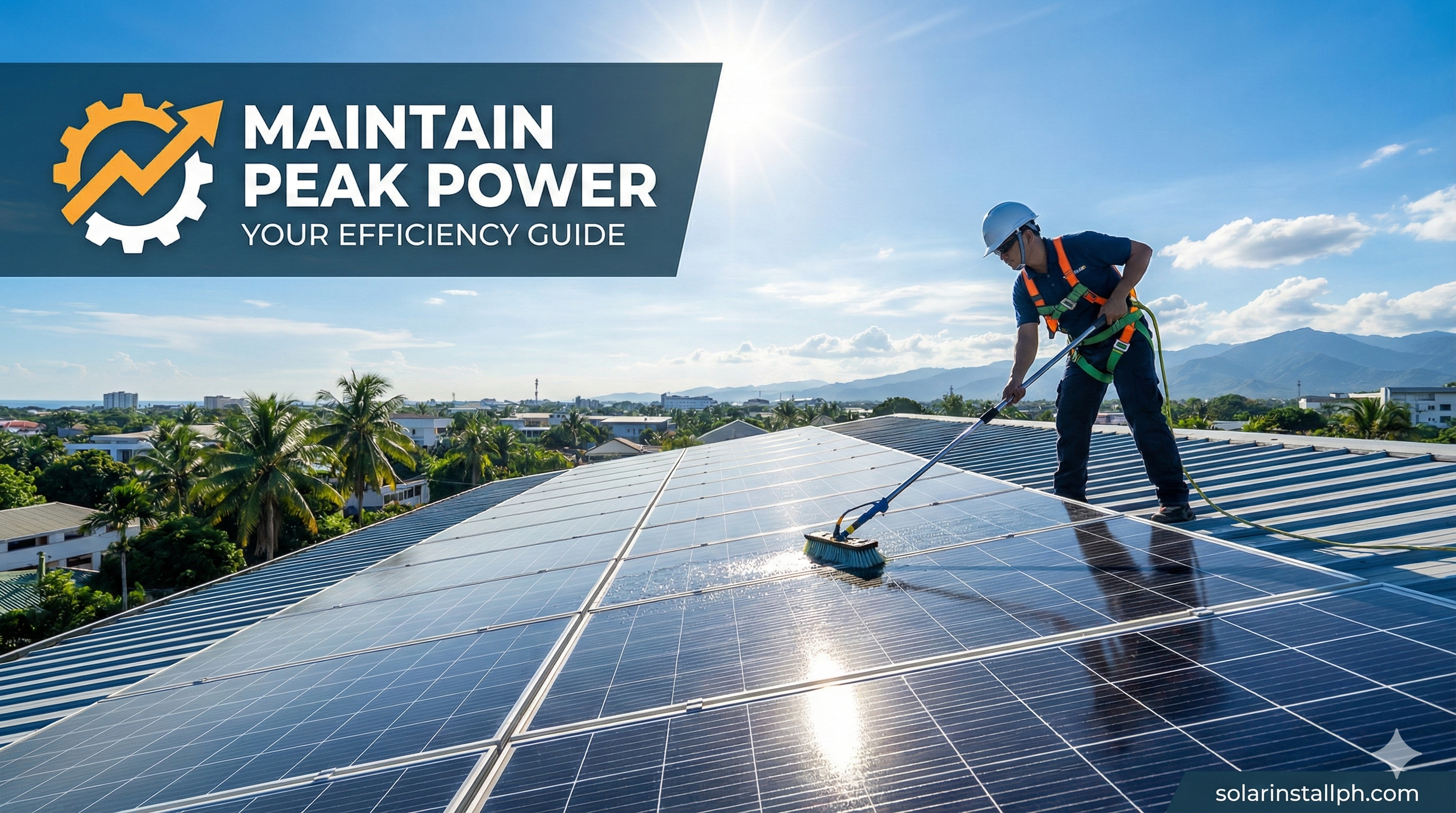
There is a dangerous myth in the Philippine solar industry: "Install it and forget it."
While solar panels are low maintenance compared to a car or an air conditioner, they are not no maintenance. They sit on your roof, exposed to the harsh Philippine elements—dust, bird droppings, typhoon debris, and smog—24/7.
If you ignore your system for two years, you aren't just letting it get dirty; you are actively losing money. A neglected system in Metro Manila can lose 15% to 25% of its power output due to soiling alone. That’s like paying for a 5kW system but only getting the output of a 3.5kW system.
Here is your practical guide to keeping your solar investment running at peak efficiency in the tropical setting.
1. The "Invisible" Thief: Soiling
In the Philippines, we have two main seasons: the wet season (cleaning season) and the dry season (dust season).
During the dry months (March to May), dust, pollen, and diesel soot from jeepneys accumulate on your panels. This creates a "gray layer" that blocks sunlight.
The Impact: A thin layer of dust can drop efficiency by 5%. A thick layer of bird droppings or construction cement dust can drop it by 20% or more.
The Fix: You don't need to clean them weekly. In dusty urban areas, a quarterly clean is usually sufficient. In rainy provinces, the typhoons might do the job for you.
Pro Tip: If you live near a rice field (during harvest) or a construction site, check your app. If you see a gradual decline in midday peaks, it’s time to wash.
For a detailed breakdown of when to schedule this, read our guide on solar cleaning frequency.
2. The Danger of DIY Cleaning
It is tempting to just grab a garden hose and spray the roof at noon. Do not do this.
Solar panels in the Philippine noon sun can reach surface temperatures of 65°C to 80°C.
Thermal Shock: Spraying 25°C tap water onto 75°C glass creates immediate thermal shock. This can cause the tempered glass to shatter or develop micro-cracks that permanently ruin the panel.
The Safe Window: Only clean your panels before 7:00 AM or after 5:00 PM.
The Method: Use plain water and a soft sponge. Do not use abrasive scouring pads, and avoid harsh detergents that can strip the anti-reflective coating.
If your roof is steep or dangerous, do not risk your life to save a few pesos. Hiring a pro is cheaper than a hospital bill. For safety protocols, check our article on solar panel maintenance.
3. The "Heat Trap"
We often think "more sun = more power," but heat is actually the enemy of solar efficiency. Panels lose voltage as they get hotter.
Roof Ventilation: Ensure there is a gap (at least 10cm) between your panels and the roof surface. This allows air to flow underneath and cool the cells.
Leaves and Debris: In the Philippines, falling leaves from mango or mahogany trees can accumulate under the panels. This blocks airflow, creating a "heat trap" that cooks your panels and cables, accelerating degradation.
Make sure to clear debris from under the array, not just on top of it.
4. The Vegetation Battle
Our tropical climate makes plants grow incredibly fast. A tree that was 2 meters away from your roof last year might be casting a shadow on your bottom row of panels today.
The "String" Effect: Most residential systems use string inverters. If just one panel is shaded by a branch, the performance of the entire string can drop to match that weak panel.
The Solution: Trim your trees before the rainy season starts. If shading is unavoidable (e.g., a neighbor's building), you might need to install optimizers.
Learn how to identify if trees are killing your yield in our guide to solar panel shading.
5. Inverter Health: The Forgotten Box
Your solar panels might last 25 years, but your inverter likely won't unless you take care of it.
Dust Filters: Many string inverters have cooling fans with dust filters. In dusty garages, these clog up, causing the inverter to overheat and throttle its power (derate).
The Fix: Check the intake vents every 6 months. If they are fuzzy with dust, wipe them down or vacuum them (while the unit is off).
Error Codes: Don't ignore the red light. Modern inverters tell you exactly what is wrong. If you see a flashing red light, consult the manual or your installer immediately.
For a list of common warning signs, check our resource on inverter error codes.
6. Pest Control (The Pigeon Problem)
Pigeons love solar panels. The gap between the panel and the roof is a perfect, predator-free shelter for nesting.
The Risk: Bird droppings are highly acidic and can etch the glass. Worse, nesting materials (twigs and dry leaves) under the panels are a fire hazard.
The Solution: If you see birds constantly landing on your roof, install "critter guards" or mesh wire around the perimeter of your array before they build a nest. It is much harder to evict them once they have laid eggs.
7. Monitoring: Your Daily Checkup
You don't need to climb the roof to know if something is wrong. Your monitoring app (usually on your phone) is your best diagnostic tool.
Compare Strings: If you have two strings of equal size, they should produce roughly the same power. If String A is generating 15kWh and String B is only generating 8kWh, you have a problem (blown fuse, loose wire, or heavy shading).
Watch the Curve: On a sunny day, your power curve should look like a smooth bell. If it looks jagged or "bumpy," you might have loose connections or intermittent voltage issues.
Understand that all systems degrade slightly over time. To know what's normal and what's not, read about solar system lifespan.
Conclusion
Efficiency isn't just about buying the most expensive panels; it's about respecting the equipment.
Wash the dust off every 3-6 months (early morning only).
Trim the trees that cast shadows.
Clean the inverter vents.
Monitor the app for sudden drops.
By following these simple steps, you ensure that your system pays for itself as quickly as promised, rather than becoming a dusty ornament on your roof.
Next Step
Have you noticed a sudden drop in your solar production on the app? Would you like me to walk you through a basic troubleshooting checklist to identify if it's a soiling issue or an inverter fault?