
Grid Payback Perks for You
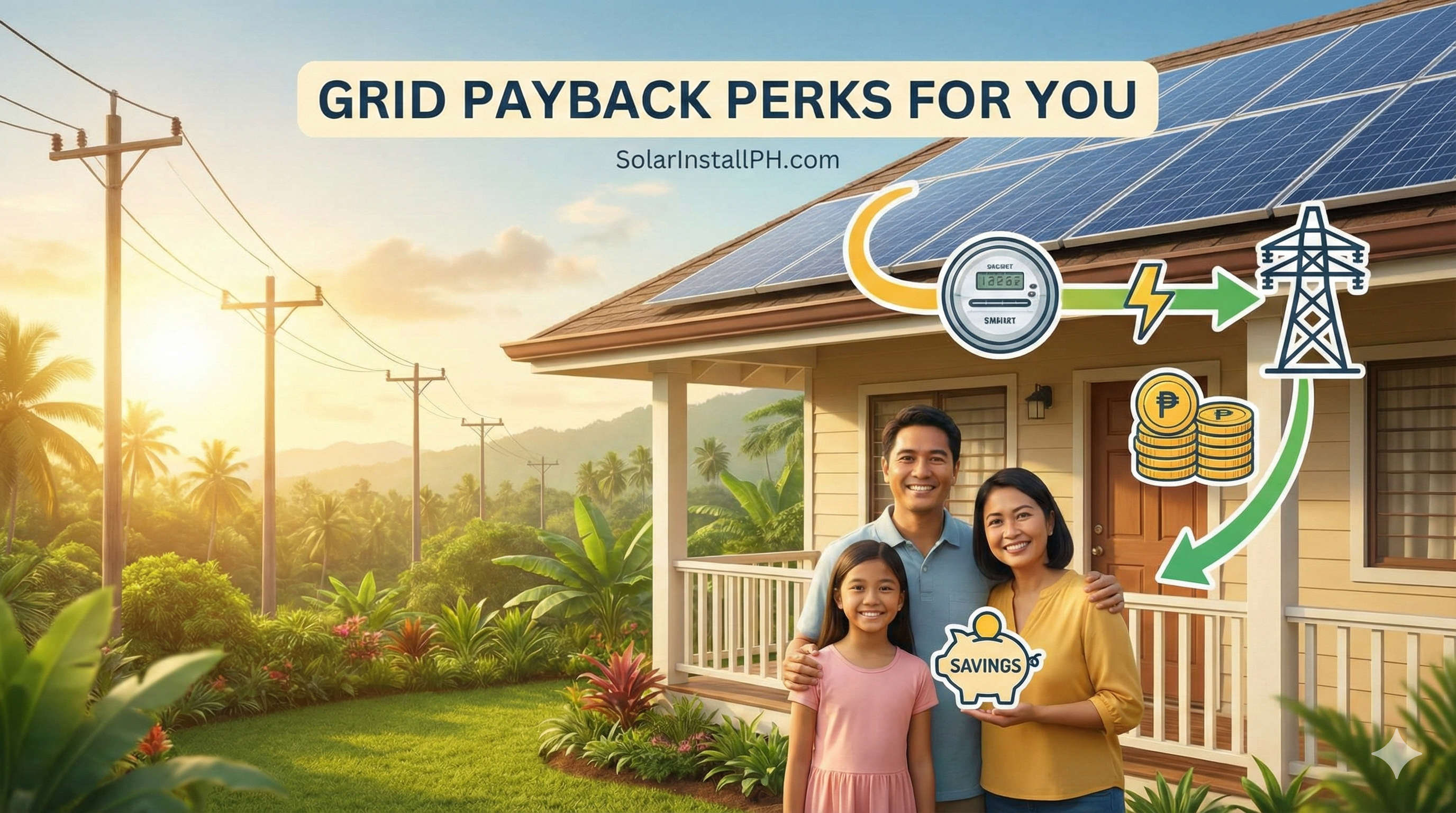
If you are like most Filipinos considering solar, you are probably fixated on one thing: daytime savings. You imagine running your aircon for free while the sun is blazing.
That is certainly the best part. But it is only half the story.
The other half is what happens when you aren't home. On a Tuesday afternoon, when your panels are pumping out 5 kilowatts of power but your house is empty, where does that energy go? Without the right setup, it vanishes into thin air.
This is where Net Metering comes in. It is the only mechanism that allows you to turn that wasted energy into actual money—specifically, peso credits on your next electric bill.
Here is a breakdown of the specific "grid payback perks" you unlock when you go through the official Net Metering process in the Philippines, and why it is worth the bureaucratic headache.
Perk #1: The "Auto-Deduct" on Your Nighttime Bill
The biggest misconception about Philippine solar is that you need batteries to save money at night. You don't.
With Net Metering (authorized under RA 9513), the grid acts as your financial buffer. When you export excess power, you earn credits. When you use power at night, these credits are automatically deducted from your bill.
The "Net Billing" Reality
It is important to understand that in the Philippines, we use a Net Billing scheme, not a 1:1 kilowatt exchange.
You Buy Power at the Retail Rate (approx. ₱12–₱13/kWh).
You Sell Power at the Blended Generation Rate (approx. ₱6–₱8/kWh).
While this isn't a perfect 1-to-1 swap, it is still powerful. If you export 200 kWh in a month (easy for a 5kW system), you could knock ₱1,200 to ₱1,400 off your bill. For many households, this is enough to wipe out the remaining "nighttime" charges, potentially bringing your bill down to zero or just the lifeline rate.
For a deeper dive into the math, read our guide on how net metering credits are calculated.
Perk #2: The "Infinite Battery" (That Never Degrades)
Batteries are sexy, but they are expensive. A decent 5kWh lithium battery costs upwards of ₱80,000 and will eventually degrade after 10–12 years.
The grid, however, is an "infinite battery."
Capacity: You can dump as much power as you want (up to 100kW).
Maintenance: Zero. You don't have to check water levels or monitor temperatures.
Lifespan: Infinite.
By using Net Metering, you are effectively using Meralco or your local coop as your storage device. You send them power at 10 AM, and you "take it back" (financially speaking) at 8 PM. This allows you to achieve massive ROI without the heavy upfront cost of a physical battery bank.
Perk #3: The Inflation Shield
Have you noticed how the Generation Charge on your bill fluctuates wildly? It goes up when coal prices rise or the Peso weakens against the Dollar.
Here is the hidden perk: Your export rate is tied to the Generation Charge.
When electricity prices skyrocket, the rate at which you sell power back to the grid also increases. This creates a natural hedge against inflation. While your neighbors are complaining about the rising cost of power, your solar credits are quietly increasing in value, keeping your net bill stable.
To see how this impacts your long-term returns, check out our solar ROI guide.
Perk #4: Increased Property Value
This is a perk that rarely gets discussed in the Philippines, but it is becoming real. A house with a fully permitted, Net Metered solar system is an asset.
For Buyers: It means moving into a home with a guaranteed low electric bill.
For Sellers: It justifies a higher asking price.
Unlike a DIY "guerrilla" setup (which can be a liability/fire hazard), a Net Metered system has a Certificate of Final Electrical Inspection (CFEI) and an ERC Certificate of Compliance. It proves the electrical system is up to code and legal.
The "Anti-Perk": The Danger of Zero Export
So, what happens if you don't apply for Net Metering?
You are forced to use Zero Export devices. These limit your solar production to match your house load exactly. If your panels could produce 5kW but you are only using 500 watts, the inverter throttles down, and you lose that potential 4.5kW of power.
Worse, if you don't have a Zero Export device and you push power to the grid without a bi-directional meter, the old digital meter will read that export as consumption. You will literally pay Meralco for the privilege of giving them free power.
If you are stuck in the permitting phase, you can use zero export settings to protect yourself temporarily, but it should never be the permanent plan.
How to Unlock These Perks (The Process)
Getting these perks isn't automatic. You have to earn them through paperwork.
Distribution Impact Study (DIS): The utility checks if the grid can handle your power.
CFEI: Your City Hall checks your wiring.
ERC COC: The Energy Regulatory Commission gives you a license to generate.
It is a tedious 3-4 month process, but the long-term financial "perks" are undeniable.
Warning: Do not try to skip the LGU permits. It is the most common reason applications get rejected. Read more about the risks of skipping LGU permits.
Conclusion
The "Grid Payback" isn't just about the pesos you see on your bill. It is about turning your roof into an active asset that interacts with the city's infrastructure. It transforms you from a passive consumer into a "prosumer"—someone who produces value.
While the application process can be frustrating—especially with Meralco or difficult electric coops—the math remains clear. The credits you earn over 25 years will pay for the system multiple times over.
Next Step: If you are ready to start the application, make sure you know exactly what your utility requires. Read our specific Meralco net metering guide to prepare your documents before you even sign the contract.