
What Powers Energy Independence?
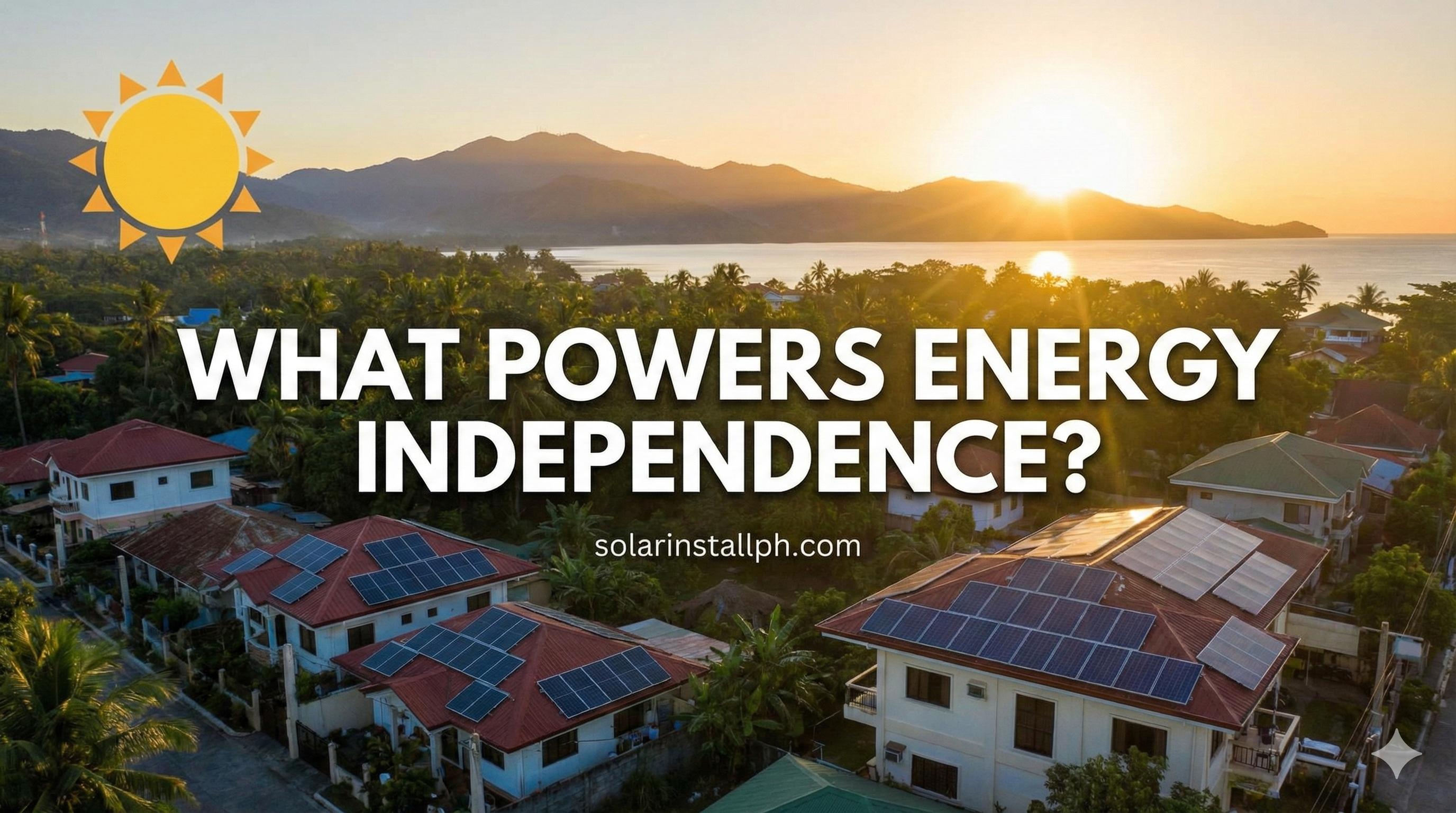
Electricity rates in the Philippines are not just high. They are volatile. As of early 2026, residential customers in the Meralco franchise area and various provincial cooperatives are paying between ₱13 and ₱15 per kilowatt-hour. For a middle-class household, this translates to a monthly bill that often rivals a car payment or a mortgage. Energy independence in this context is not an environmentalist’s dream. It is a strategic financial move for homeowners and businesses tired of being at the mercy of global fuel prices and a fluctuating peso.
True energy independence is powered by a combination of high-yield hardware, favorable local regulations, and rigorous structural engineering. In an archipelago hit by an average of 20 typhoons a year, "freedom" from the grid is a technical challenge as much as it is a financial one.
The Financial Engine: High Rates and Declining Costs
The primary driver for energy independence in the Philippines is the sheer cost of grid power. Unlike other countries where government subsidies drive solar adoption, the Philippine market is driven by "grid parity." This is the point where generating your own solar power is significantly cheaper than buying it from a utility.
When you invest in a rooftop system, you are essentially pre-paying for 25 years of electricity at a locked-in rate. While the upfront investment is significant, the market has seen a steady decline in equipment prices. However, it is vital to distinguish between "cheap" and "cost-effective." A system built with substandard components will fail long before it pays for itself. Understanding the current residential solar installation costs is the first step in determining if your household can achieve a meaningful return on investment.
The Regulatory Framework: RA 9513 and Net Metering
Energy independence does not necessarily mean cutting the cord entirely. For most urban Filipinos, "freedom" means a grid-tied system that uses the utility as a giant, free battery. This is made possible by Republic Act 9513, or the Renewable Energy Act of 2008.
The Net Metering program is the cornerstone of this independence. It allows you to sell excess power generated during the day back to the grid in exchange for credits. These credits then offset the power you consume at night. However, the process is not as simple as plugging in a panel. It requires technical studies, local government unit (LGU) permits, and a Certificate of Compliance (COC) from the Energy Regulatory Commission (ERC).
Many homeowners find the bureaucracy daunting. For those in the metro, navigating the Meralco net metering guide is a prerequisite for a legal and safe installation. Without a proper bi-directional meter, your solar system might actually cause your standard meter to charge you for the power you export.
Engineering for the Typhoon Belt
In the Philippines, the sun is not your only concern. The wind is equally important. A solar panel is effectively a glass sail. If the mounting system is not engineered for the "Big One," your investment can become a liability during a Signal No. 4 typhoon.
Independence is useless if your system is ripped off the roof during the first major storm of the season. Most Tier 1 panels are rated for high wind pressures, but the weakness is usually in the racking and the roof attachments. Achieving true resilience requires engineered typhoon-resistant mounting systems that use stainless steel hardware and reinforced rails. Proper spacing of roof penetrations and the use of high-grade industrial sealants are what differentiate a professional installation from a DIY project that will eventually leak.
The Role of Battery Storage in 2026
For those in brownout-prone provinces or those seeking absolute autonomy, battery storage is the missing piece of the puzzle. Lithium Iron Phosphate (LiFePO4) batteries have become the gold standard for Philippine homes. They are safer than older lead-acid variants and can handle the deep cycling required in our tropical climate.
However, batteries add a significant "resilience premium" to the total project cost. While they provide the peace of mind of having lights, fans, and Wi-Fi during a grid failure, they also extend the time it takes for the system to pay for itself. Balancing the need for backup power with the goal of financial savings is one of the most critical factors that determine your solar payback period. For many urban dwellers, a grid-tied system without batteries remains the most logical financial choice, while hybrid systems are better for those prioritizing reliability.
The Human Element: Vetting Your Installer
The boom in the solar industry has attracted many new players. While more competition usually leads to better pricing, it has also led to a rise in substandard installations. In January 2026, the Department of Energy (DOE) emphasized the need for "legitimate investors" after terminating nearly 18,000 MW of renewable energy contracts due to non-performance.
On a residential level, this means you must do your due diligence. A solar system is a 25-year marriage with a contractor. You need to ensure they have the technical expertise to handle high-voltage DC wiring and the administrative capability to handle the permitting process. It is non-negotiable to verify your solar installer credentials and check their track record of successfully permitted projects. A cheap quote that skips the LGU permits or the Meralco application is a red flag that will likely lead to legal and safety issues down the line.
Common Myths vs. Philippine Reality
Myth: Solar doesn't work when it's raining.
The Philippines has a long rainy season, but solar panels do not need direct sunlight to produce power. They use irradiance. Even on a cloudy day in July, a well-designed system will produce between 10% and 25% of its rated capacity. Over a year, the surplus from the summer months usually more than compensates for the lower production during the monsoon season.
Myth: You can go "Off-Grid" easily.
Going completely off-grid in a major city like Manila or Cebu is technically possible but rarely makes financial sense. The amount of battery storage required to handle three consecutive days of heavy rain is immense and expensive. For most, the most practical version of energy independence is a hybrid system that remains connected to the grid but relies on it only as a last resort.
Myth: Solar is maintenance-free.
Dust, soot from traffic, and bird droppings can significantly reduce the efficiency of your panels. In urban areas, a layer of grime can drop your production by 15% in just a few months. Regular cleaning and a yearly check of the electrical connections are necessary to maintain your energy sovereignty.
Evaluating Your Own Situation
Energy independence is not a one-size-fits-all solution. Your path depends on your load profile. If you have inverter air conditioners running during the day, your solar system will pay for itself much faster than if your house is empty until 6:00 PM.
Step one is to look at your latest electric bill. Find your "baseload"—the amount of power your home uses even when you aren't thinking about it (refrigerators, stand-by appliances, security cameras). Step two is to assess your roof. If it is shaded by a nearby building or a tall mango tree, your generation will suffer. A professional site survey using shading analysis tools is the only way to get a realistic estimate of your future savings.
Summary Checklist for Energy Independence
Determine your daytime load: Solar works best when you use the power as it is generated.
Choose the right system type: Grid-tied for ROI, Hybrid for resilience, Off-grid for remote areas.
Invest in quality mounting: Ensure the rails and hooks are rated for Philippine wind speeds.
Get the permits: Legal solar is safe solar. Follow the Net Metering process.
Monitor your production: Use an app to track how much you are generating and adjust your heavy appliance use to match peak sun hours.
Conclusion
Energy independence in the Philippines is a strategic hedge against a high-cost energy environment. By generating your own power, you insulate your household from the price hikes that are inevitable in a fuel-importing nation. However, this freedom is powered by more than just sunshine. It is powered by correct sizing, legal compliance, and structural integrity.
If you treat your solar installation as a serious infrastructure project rather than a consumer gadget, it will provide stable, low-cost power for the next two decades. The goal is energy sovereignty—the ability to look at a Meralco rate hike and know that your monthly expenses remain unchanged.
FAQ
Does solar increase my property tax?
In the Philippines, solar panels are often considered movable equipment or "machinery" for residential purposes. While practices vary between LGUs, most do not increase real property tax for small residential installations. In fact, many local governments are looking at ways to incentivize solar adoption through tax credits.
What is the lifespan of a typical inverter in the PH?
While panels are rated for 25 years, the inverter is the hardest-working part of the system. In our heat, a high-quality string inverter typically lasts 10 to 12 years before needing a major service or replacement. It is wise to factor in one inverter replacement over the life of the system when calculating your long-term ROI.
Can I run my aircon at night on solar?
Only if you have a battery storage system (Hybrid or Off-grid). A standard Grid-tied system stops producing power as soon as the sun goes down. To run your aircon at night using solar energy, your panels must charge a battery during the day, which then releases that energy after dark. For most, it is more economical to use solar for daytime aircon use and rely on Net Metering credits to lower the cost of nighttime cooling.