
5 Best: Energy Investment Pros & Cons
In the first month of 2026, Meralco announced a slight reduction in residential power rates to approximately ₱12.95 per kWh. While any drop is welcome, the reality for Filipino households remains clear. We still pay some of the highest electricity prices in Asia. This economic pressure has turned rooftop solar from an environmental statement into a primary financial investment.
When we talk about "energy investment" in the Philippines, we are usually looking at five distinct strategies. Each has a specific set of pros and cons that dictate whether the system will actually pay for itself or become a costly maintenance headache.
1. The High-Yield Grid-Tied System
For most homeowners, the best entry point is a grid-tied system designed to offset daytime loads. This is a pure financial play where the goal is to reduce the amount of electricity you buy from your distribution utility.
The Pros
The return on investment (ROI) for these systems is remarkably high. In the current market, well-engineered commercial and residential projects often see an internal rate of return (IRR) between 18% and 25%. This far outperforms traditional bank savings or conservative bonds. The system works by consuming solar power first, effectively replacing ₱13 power with free sunshine.
The Cons
The biggest hurdle is the reliance on the grid. If the grid goes down, your solar goes down. This is a safety requirement to prevent your system from sending power back into a line that technicians might be repairing. Additionally, your profitability depends on your specific solar payback factors such as roof orientation and whether you have shading from nearby trees or neighbors.
2. The Hybrid Resilience Strategy
With the increasing frequency of grid instability in provinces and even in parts of Metro Manila, many are investing in hybrid systems that include battery storage.
The Pros
Resilience is the primary advantage. A hybrid system allows you to maintain critical loads like refrigerators, lights, and Wi-Fi during brownouts. Unlike a noisy diesel generator that requires constant refueling, a solar battery bank silently recharges every morning. It provides a level of energy independence that a standard grid-tied system cannot match.
The Cons
The cost is the primary drawback. Adding lithium iron phosphate (LiFePO4) batteries can nearly double the initial price of the installation. When evaluating residential solar cost in 2026, you must factor in that batteries have a shorter lifespan than panels, usually requiring replacement after 10 to 12 years. This adds a "re-investment" cost that standard systems avoid.
3. The Property Value Enhancement
Solar is increasingly viewed as a permanent home improvement that increases the market value of a property. Real estate developers and individual sellers are now marketing "solar-powered homes" as premium listings.
The Pros
Appraisal data suggests that homes with solar installations sell faster and at a higher price point. Buyers are often willing to pay more upfront for a house that guarantees lower operating costs for the next 25 years. It transforms a monthly liability (the electric bill) into a capital asset.
The Cons
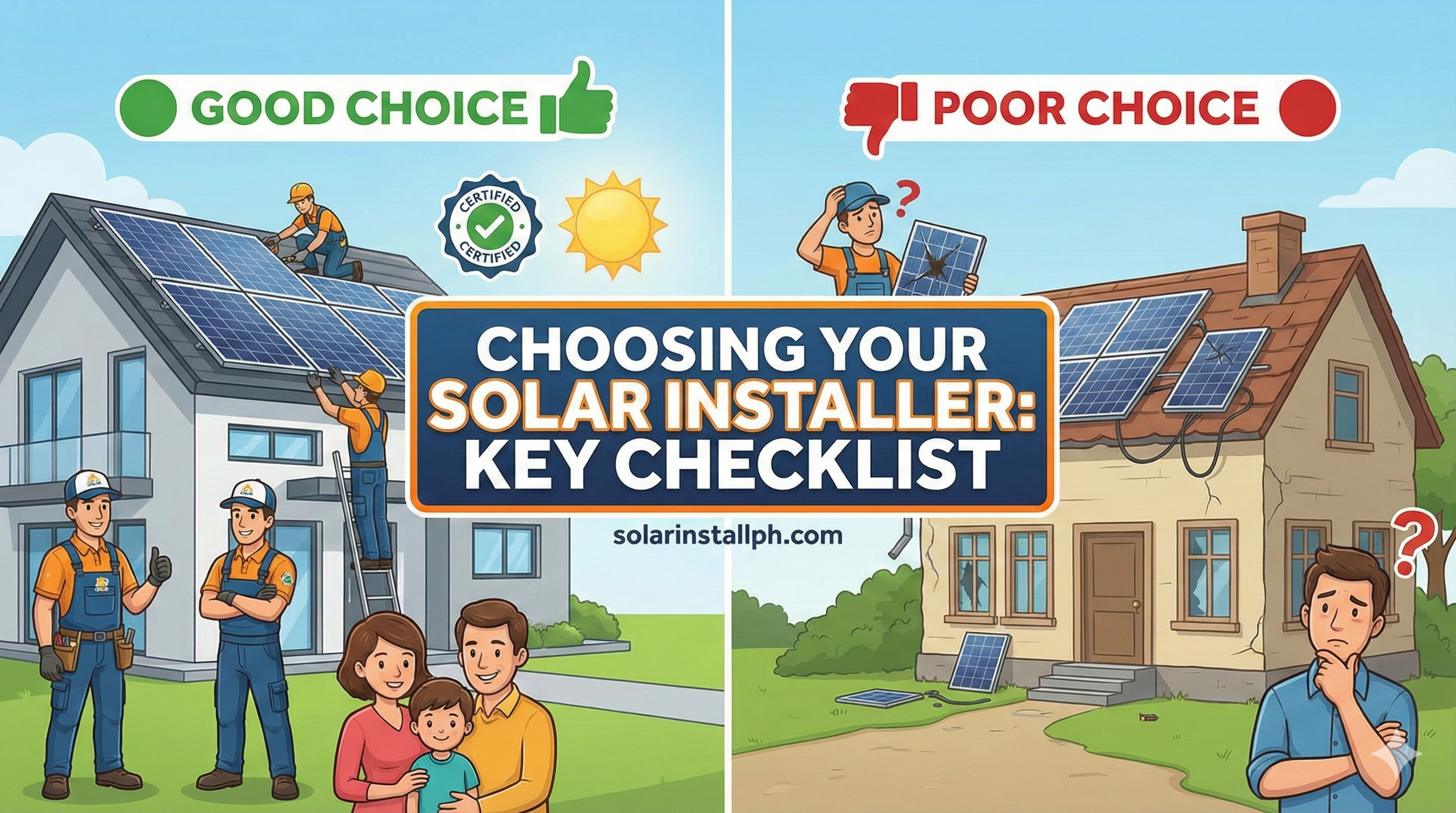
This investment only works if the system is documented and transferable. If you used a "fly-by-night" installer who left no blueprints or warranty documents, the solar system can actually become a liability during a building inspection. To protect this investment, you must verify installer credentials and ensure you have a complete turnover folder with all technical specifications and maintenance logs.
4. The Regulatory and Incentive Play
The Renewable Energy Act (RA 9513) provides several incentives that Filipino investors often overlook. These are designed to make the transition to clean energy more affordable through tax mechanisms and credits.
The Pros
Homeowners can benefit from the Net Metering program, which allows you to earn credits for excess power sent back to the grid. There are also fiscal incentives like zero-rated VAT on RE equipment and potential income tax holiday components for larger commercial systems. These incentives can shave 12% or more off the effective cost of the system.
The Cons
The "paperwork wall" is a significant hurdle. Getting a Net Metering agreement requires permits from the LGU and a Certificate of Compliance from the Energy Regulatory Commission. If you are a Meralco customer, you need to follow a very specific Meralco net metering guide to ensure your meter is swapped for a bi-directional one. This process can take three to six months, delaying the full realization of your savings.
5. The Structural and Typhoon Play
In the Philippines, an energy investment is also a structural investment. You are essentially mounting glass sails on your roof in a country that experiences 20 typhoons a year.
The Pros
Investing in high-quality mounting hardware and professional engineering provides peace of mind. A system built to withstand Signal No. 5 winds (up to 250 kph or more) ensures that your investment does not become flying debris during the typhoon season. This structural integrity also prevents roof leaks, which are common with substandard installations.
The Cons
Top-tier engineering comes with a higher price tag. Many low-cost installers save money by using thin aluminum rails and fewer roof attachments. Choosing the cheaper option might save ₱20,000 today but cost you the entire system later. It is critical to prioritize typhoon-resistant solar mounting even if it increases the upfront capital expenditure.
How to Evaluate Your Own Situation
Before committing to any of these energy investments, you need to analyze your consumption habits. Solar provides the best return when you "self-consume" the power. If your house is empty during the day and you have heavy air conditioning use at night, a grid-tied system without Net Metering will provide very little benefit.
Check your monthly kWh usage.
Identify your "baseload" (the appliances that run 24/7).
Assess your roof space for shading issues between 9:00 AM and 3:00 PM.
FAQ
Is solar still a good investment if electricity rates drop?
Yes. Even with the modest ₱0.16 per kWh drop in January 2026, the overall rate is still nearly ₱13. Solar remains profitable as long as the cost of generating your own power is lower than the utility's retail rate, which is currently the case for almost all grid-tied users in the Philippines.
Can I start small and expand later?
It is possible, but not always cost-effective. Modern inverters have "sweet spots" for efficiency. Adding more panels later may require upgrading the inverter or the wiring, which can lead to higher labor costs than if you had installed the full system at once.
Does solar increase my real property tax?
Under current guidelines, solar equipment is often considered personal property or is exempted as part of renewable energy incentives. However, policies can vary by city. It is best to consult with your local assessor's office during the permitting process.