
Power Your Home: 5 Green Energy Tips
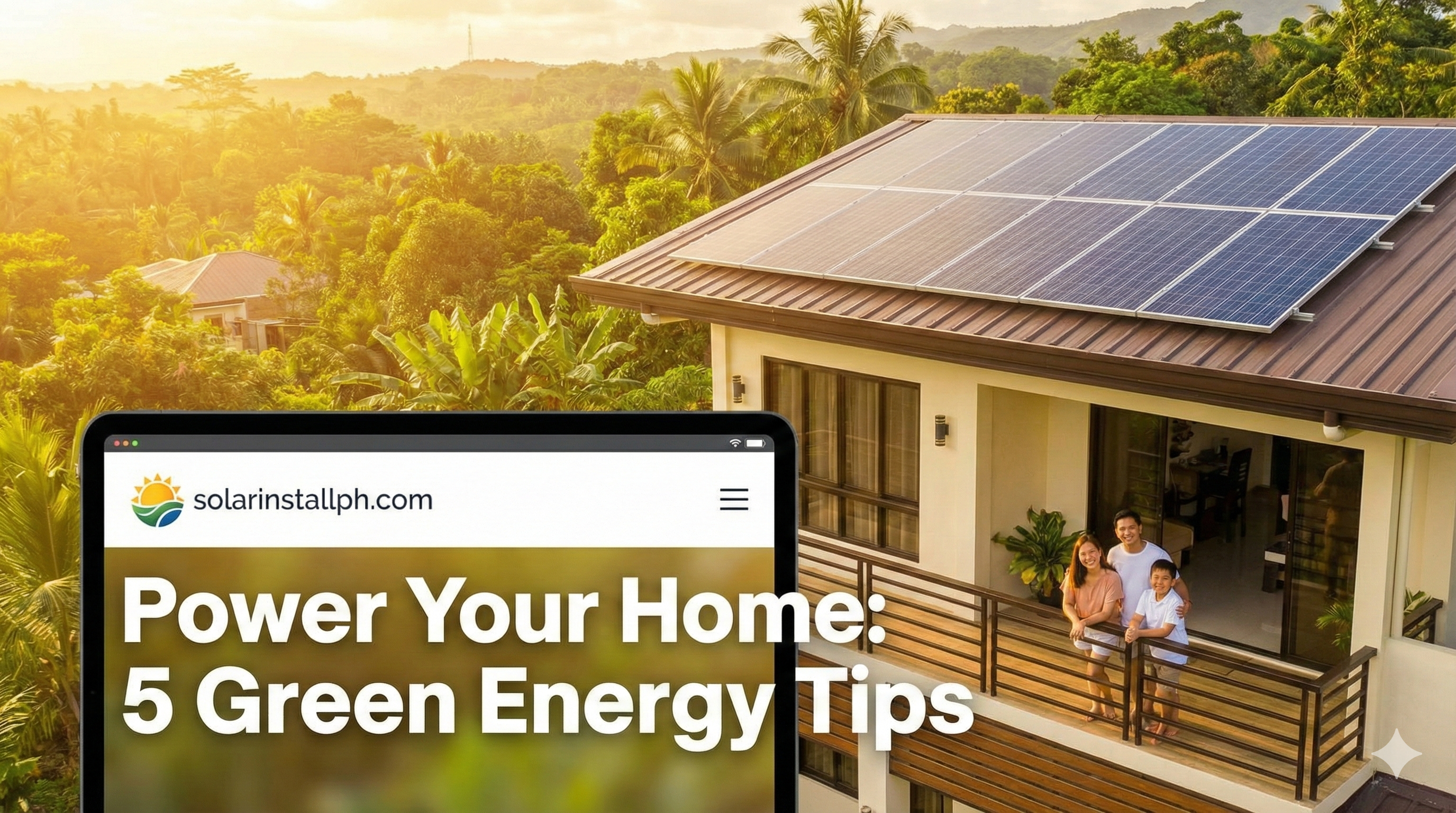
If you are a homeowner in the Philippines, "going green" is rarely just about saving the planet. It is about survival. With electricity rates hovering between ₱11 and ₱13 per kWh in Metro Manila and often higher in provinces served by smaller electric cooperatives, reducing your reliance on the grid is a financial necessity.
However, the rush to install solar often leads to expensive mistakes. We see homeowners buying oversized batteries they do not need, skipping crucial efficiency upgrades, or falling for "zero bill" marketing myths that ignore the realities of Philippine regulation.
To power your home effectively and sustainably, you need a strategy that prioritizes Return on Investment (ROI) and system longevity over marketing hype. Here are five practical tips to transition your Filipino home to green energy without wasting money.
1. Audit and Reduce Your Load Before You Generate
The most expensive kilowatt-hour is the one you waste. Before you spend hundreds of thousands of pesos on solar panels, you must ensure your home isn't bleeding energy. Solar power is an expensive way to run inefficient appliances.
The "Bucket Leaks" Analogy
Imagine your home energy usage is a bucket with holes. Pouring more water (solar energy) into a leaking bucket is inefficient. You need to plug the leaks first. In the Philippine context, these leaks usually come from three main sources: old air conditioning units, inefficient refrigeration, and "vampire" loads.
Practical Efficiency Steps
Switch to Inverter Air Cons: An old window-type non-inverter AC can consume 1.5 kWh to 2.0 kWh per hour. A modern inverter unit might drop that to 0.6 kWh or less once the room is cool. Solar sizing is linear; if you halve your consumption, you halve the cost of the solar system required.
Check Your Fridge Seals: In our tropical climate, refrigerators work overtime. If the rubber seal is loose, the compressor never stops.
LED Lighting: This is standard now, but ensure you aren't running old incandescent bulbs in high-traffic areas.
Conducting a proper audit is the first step. You need to know your daytime baseload versus your nighttime peak. If you skip this, you will likely buy a system that is either too small to make a dent in your bill or too large for your actual needs. For a deeper dive into how to analyze your current usage, read our guide on conducting a home energy audit.
2. Understand Net Metering (It’s Non-Negotiable)
Many homeowners assume that once they install solar, their electric bill will magically hit zero. This is false. Without a specific mechanism called Net Metering, any excess energy your panels produce during the day—when you are at the office and your lights are off—is sent to the grid for free.
How Net Metering Works in the Philippines
Under the Renewable Energy Act of 2008 (RA 9513), you are entitled to get paid for the excess power you export to the grid. The utility (like Meralco, VECO, or your local coop) installs a bi-directional meter.
Import: When you use grid power at night, the meter spins forward.
Export: When your solar produces more than you use at noon, the meter spins backward (digitally recording credits).
The credits you earn are deducted from your bill. This is the only way to offset your nighttime usage and lower your bill significantly.
The "Zero Export" Trap
Some installers might suggest a "zero export" device to avoid the hassle of permitting. While this stops you from giving free power to the utility, it wastes potential savings. If your system is capable of generating 5kW but your house only needs 1kW at that moment, the zero export device throttles the system down to 1kW. You lose 4kW of potential production.
Applying for Net Metering involves paperwork—Certificates of Final Electrical Inspection (CFEI), distribution impact studies, and yellow cards. It is tedious, but skipping it destroys your ROI. To navigate the specific requirements in Metro Manila and beyond, reviewing the Meralco Net Metering guide is essential before signing a contract.
3. Choose the System Type That Matches Your Grid Reality
Not all green energy systems are built the same. In the Philippines, the choice usually comes down to two configurations: Grid-Tie or Hybrid. Your location and the reliability of your local power grid should dictate this choice, not the salesperson's commission.
The Grid-Tie System (Best for ROI)
A grid-tie system connects directly to the utility lines. It is the most common and affordable setup.
Pros: Cheapest cost per watt; no expensive batteries to replace every 5–10 years; 4–5 year ROI.
Cons: It shuts down during a brownout. This is a safety requirement (anti-islanding) to protect linemen fixing the wires.
If you live in an area with stable electricity (rare brownouts), grid-tie is the smartest financial move. It offsets your bill purely through generation and Net Metering. You can learn more about the specific economics in our overview of grid-tied solar systems.
The Hybrid System (Best for Reliability)
A hybrid system includes batteries (Lithium Iron Phosphate or LiFePO4). It can store energy for use at night or during power outages.
Pros: Total energy independence during brownouts; works when the grid is down.
Cons: Significantly more expensive (batteries can double the system cost); ROI extends to 7–9 years; batteries degrade over time.
Do not buy a hybrid system just because it sounds "cooler." Only buy hybrid if:
You experience frequent brownouts.
You have critical loads (medical equipment, servers, business operations) that cannot stop.
You are in an area where the electric cooperative does not allow Net Metering (rare, but it happens).
4. Hardware Selection: Durability Over Aesthetics
The Philippines is one of the harshest environments for solar equipment. We have high humidity, salt spray in coastal areas, extreme heat, and most importantly, typhoons. A "green" home is not green if the panels fly off the roof during the first Signal No. 3 storm.
Solar Panels (PV Modules)
You will encounter terms like Monocrystalline, Polycrystalline, PERC, and Bifacial.
Stick to Tier 1 Brands: Brands like Longi, Jinko, Trina, and Canadian Solar have proven track records. "Tier 1" is actually a financial rating of bankability, but it correlates strongly with manufacturing quality.
Wind Load Rating: Ensure the mounting system and panels are rated for at least 2400 Pascals (Pa) of wind load, though 5400 Pa is preferred for typhoon belts like Bicol or Eastern Visayas.
Inverters
The inverter is the brain of the system and the component most likely to fail. It converts DC power from panels to AC power for your home.
String Inverters: Good for unshaded roofs. Brands like Huawei, Growatt, and Sungrow are common here.
Microinverters: Good for complicated roofs with shading issues. Enphase is the market leader but comes at a premium.
Mounting Systems
Do not cut corners on the aluminum rails and L-feet. If an installer uses cheap galvanized iron that rusts in two years, your "green" investment becomes a safety hazard. Aluminum 6005-T5 is the standard.
For a detailed breakdown of which manufacturers are currently leading the market in reliability and support, check our analysis of top solar brands for 2025.
5. Calculate the Financials Coldly
Green energy is an investment asset. Like a rental property or a bond, it has upfront costs, maintenance expenses, and a yield. You need to calculate the payback period based on real numbers, not optimistic projections.
The Cost of Installation
As of 2025, a reputable turnkey grid-tie installation in the Philippines generally costs between ₱45,000 to ₱60,000 per kilowatt-peak (kWp).
A 5kWp system (typical for a family home with 3-4 ACs) might cost roughly ₱250,000 to ₱300,000.
A Hybrid system with batteries will push this to ₱80,000 - ₱100,000 per kWp or more.
The Payback Equation
To find your payback period:
Calculate Monthly Savings: If a 5kW system generates roughly 600-700 kWh per month, and you offset electricity costing ₱12/kWh, that is ₱7,200 to ₱8,400 in savings monthly.
Divide Cost by Annual Savings: If the system costs ₱300,000 and saves ₱90,000 a year, your payback is 3.3 years.
Note: This assumes 100% self-consumption. With Net Metering, export rates are lower (generation charge only, approx ₱5-6/kWh), so real-world payback is usually 4 to 5.5 years for grid-tie.
Financing
Cash is king for the shortest payback, but financing is available.
Pag-IBIG: Offers home improvement loans that can cover solar.
Bank Loans: BPI, BDO, and Security Bank have specific "Green Energy" loan products.
Installer Financing: Some installers offer in-house terms, but check the interest rates carefully.
Always factor in the degradation of panels (roughly 0.5% per year) and the potential need to replace the inverter once (usually around year 10-12) during the system's 25-year life. For a comprehensive look at the numbers, refer to our guide on solar ROI.
Summary Checklist for the Filipino Homeowner
To successfully power your home with green energy, follow this linear path:
Audit: Replace that 10-year-old air conditioner first.
Analyze: Look at your Meralco/Coop bill. Determine your average daytime vs. nighttime kWh usage.
Select: Decide if you need batteries (Hybrid) or just savings (Grid-tie).
Vet: Hire a DOE-registered installer who handles the Net Metering permits for you.
Compute: ensure the payback period makes sense for your financial goals.
Going solar is one of the few home improvements that pays you back. But like any construction project in the Philippines, it requires diligence. Treat it less like buying an appliance and more like building a small power plant on your roof. Done right, it secures your home against rising inflation and energy insecurity for decades.