
Battery Longevity: 10 Maintenance Tips
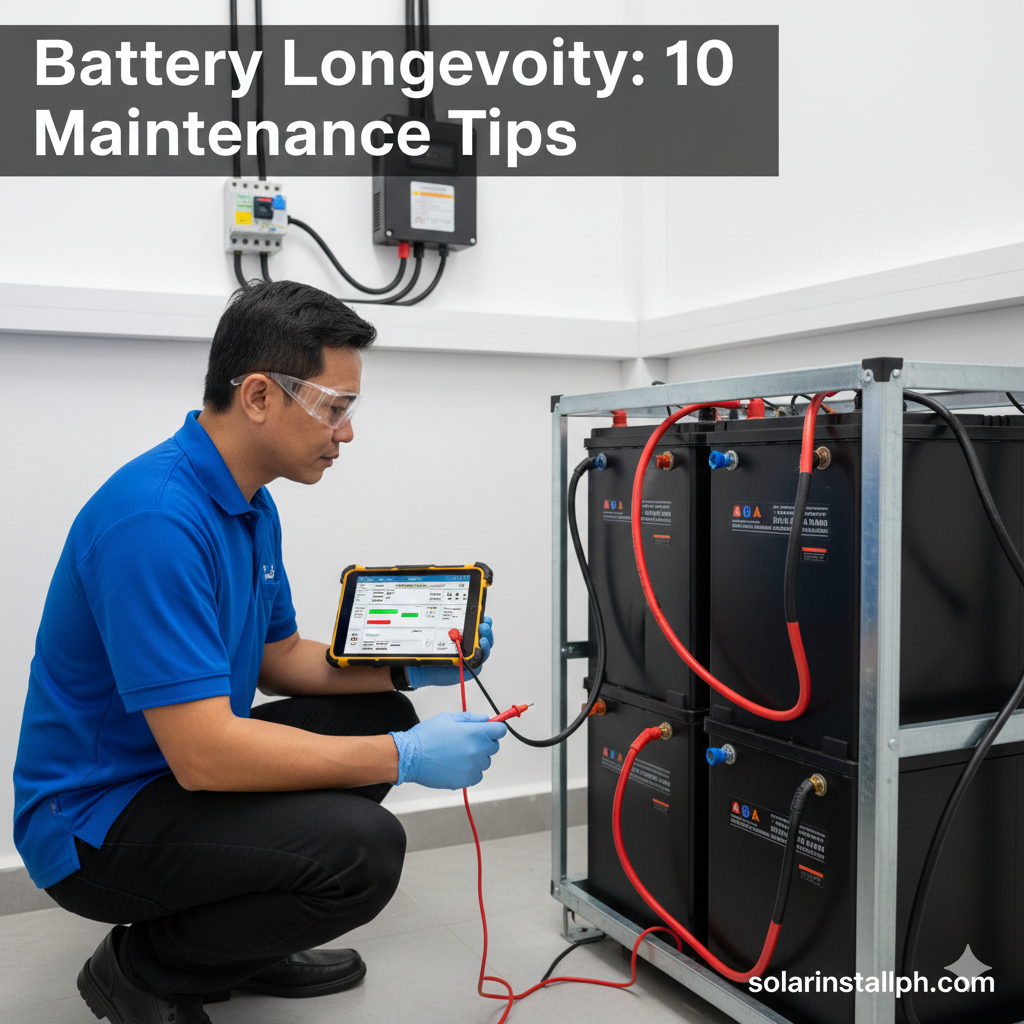
Batteries are the single most expensive consumable in a solar energy system. While solar panels can sit on your roof for 25 years with little more than a yearly wash, batteries are chemical organisms that age every single day.
In the Philippines, we have a unique challenge: heat. Whether you are using traditional Lead-Acid (Deep Cycle/Gel) or modern Lithium Iron Phosphate (LiFePO4), our tropical climate is effectively a slow-motion stress test. An ambient temperature of 32°C can slash a lead-acid battery’s lifespan by half compared to one kept at 25°C.
Replacing a battery bank can cost anywhere from ₱50,000 to over ₱200,000 depending on the capacity. The difference between replacing them in 3 years versus 7 years (for lead-acid) or 10 years versus 15 years (for lithium) often comes down to how well you treat them.
This guide covers 10 practical maintenance tips to squeeze every drop of value from your energy storage system.
1. Respect the Depth of Discharge (DoD) Limit
The fastest way to kill a battery is to drain it too deeply, too often. This is called the Depth of Discharge (DoD).
For Lead-Acid batteries (Flooded, AGM, or Gel), the "50% Rule" is non-negotiable. If you have a 200Ah battery, you should never use more than 100Ah. Every time you dip below 50%, you cause irreversible chemical damage to the lead plates. In a blackout-prone area like Mindoro or Palawan, it’s tempting to run the lights until the battery dies, but doing so frequently will destroy the bank in less than two years.
For Lithium (LiFePO4), you have more freedom. You can typically discharge them to 80% or even 90%. However, constantly pushing them to 0% will still stress the cells.
Action: Check your inverter settings. Set the "Low Voltage Cut-off" or "DoD Limit" to a safe margin. For lead-acid, this is usually around 48V (for a 48V system) or 50% capacity. For lithium, set it to retain at least 10–15% buffer.
2. Fight the Heat (Temperature Management)
Heat is the silent killer of batteries in the Philippines.
For every 10°C rise above 25°C, the chemical reaction inside a lead-acid battery doubles, which sounds good for performance but actually accelerates corrosion and water loss, halving its service life. Lithium batteries are more resilient but still suffer at temperatures above 40°C.
If your batteries are stored in a galvanized iron shed in Cavite with no insulation, they are likely baking at 45°C during the afternoon.
Action:
Relocate: Move batteries to the coolest part of the house, like a ground-floor utility room or a shaded garage with good airflow.
Insulate: If they must be outside, use an insulated enclosure.
Ventilate: Install a simple exhaust fan to pull hot air out of the battery box.
3. Check and Tighten Terminals (Torque Checks)
Solar systems undergo "thermal cycling." Wires heat up when high current flows during the day and cool down at night. This expansion and contraction can slowly loosen the bolts on your battery terminals.
A loose connection creates resistance. Resistance creates heat. In severe cases, this heat can melt the terminal or even start a fire. Even in mild cases, it causes "voltage drop," fooling your inverter into thinking the battery is dead when it isn't.
Action: Once a year, turn off the system and use an insulated wrench to check the tightness of every battery bolt. Do not overtighten, as you can crack the casing, but ensure they are snug.
4. Keep Terminals Corrosion-Free
If you use Flooded Lead-Acid batteries (the ones with caps you open), acid mist can escape during charging. This settles on the terminals and creates a white or blue powdery corrosion (lead sulfate). This corrosion blocks the flow of electricity.
Even sealed batteries can corrode if you live near the ocean, thanks to the salty air.
Action:
Inspect: Look for white powder on the posts.
Clean: Mix baking soda and water into a paste. Use an old toothbrush to scrub the terminals. The baking soda neutralizes the acid. Wipe it clean and dry.
Protect: Apply a thin layer of petroleum jelly or dielectric grease to the clean terminals to seal them against the air.
5. Equalization Charging (Lead-Acid Only)
Over time, the individual cells in a lead-acid battery bank can drift apart. One cell might be at 2.1V while another is at 1.9V. Sulfation—crystals forming on the plates—can also harden.
"Equalization" is a controlled overcharge that boils the electrolyte slightly. This mixes the acid (preventing stratification) and dissolves the sulfate crystals.
Warning: Never equalize Sealed (AGM/Gel) or Lithium batteries unless the manufacturer explicitly permits it. You will ruin them.
Action: Check your inverter’s manual. Most modern inverters can be scheduled to run an equalization charge once a month for flooded batteries. Ensure your water levels are topped up before you do this.
6. Monitor Voltage Balance
If you have a 24V or 48V system made of multiple 12V batteries connected in series, they must stay balanced. If one 12V block is weaker than the others, it will drag the whole bank down. The inverter will cut off power because of the "weak link," even if the other batteries are full.
This is a common issue with older lead-acid vs lithium setups. The "middle" batteries in a string often get hotter and die faster.
Action: Use a multimeter to measure each 12V battery individually while the system is resting. If one reads 12.6V and another reads 11.8V, you have a serious imbalance. You may need a "battery balancer" (an inexpensive device available on Shopee/Lazada) to actively shuffle energy between them.
7. The "Watering" Ritual (Flooded Batteries Only)
If you chose the cheapest option—flooded lead-acid golf cart batteries—you signed up for maintenance. These batteries vent water as vapor during charging. If the plates get exposed to air, they oxidize and die instantly.
Action:
Check: Every 2–4 weeks (more often in summer).
Fill: Add distilled water only. Never use tap water (mineral water), as the minerals will poison the chemistry.
Level: Fill only to the bottom of the vent well. Do not overfill, or the acid will bubble out during charging and eat your concrete floor.
8. Calibrate Your State of Charge (SoC)
Your inverter or monitor displays a percentage (e.g., "85% Battery"). But how does it know?
Most systems estimate this based on voltage, which is notoriously inaccurate for Lithium (LiFePO4) because lithium voltage stays flat for most of the cycle. Over months, the "100%" reading might drift, leading to a situation where the screen says 30% but the lights suddenly go out.
Action:
Lead-Acid: The system usually resets to 100% when it hits the "Float" voltage. Ensure your solar panels can fully charge the bank at least once a week to reset this counter.
Lithium: If your battery capacity needs seem off, try to fully charge the battery to 100% and leave it there for a few hours. This allows the internal Battery Management System (BMS) to "top balance" the cells and recalibrate the capacity reading.
9. Adjust Charge Settings for Seasonality
The Philippines has two distinct seasons: wet and dry. Your battery settings might need to adapt.
In the rainy season (Habagat), you have less sun. If your "Bulk" and "Float" timers are too short, the battery might never get fully charged. A battery that sits at 80% charge for weeks will suffer from "sulfation" (lead-acid) or memory issues.
Action:
Rainy Season: You might need to lower your daily usage or increase the "grid charge" amperage (if you have a hybrid inverter) to ensure the batteries get a full top-up from Meralco occasionally.
Dry Season: Monitor for overheating. If the batteries are getting too hot during the midday charge, dial back the charging amps. It is better to charge slower and cooler than fast and hot.
10. Beware of "Vampire" Loads
Sometimes the battery drains overnight even when you think everything is off. This is often due to the inverter’s own self-consumption or small appliances left on standby.
Large hybrid inverters can consume 50W–100W just to stay awake. Over a 12-hour night, that’s 1.2kWh—enough to drain a small battery bank significantly.
Action: If you are leaving the house for a vacation, do not just turn off the appliances; turn off the inverter if there are no critical loads (like a fridge/security cam). For daily use, audit your "always-on" loads. A Wi-Fi router, TV on standby, and microwave clock add up. Reducing these preserves your solar battery lifespan by reducing the nightly cycle depth.
Summary Checklist
Frequency | Action | Battery Type |
Weekly | Check ventilation & room temp | All |
Monthly | Check water levels | Flooded Lead-Acid |
Quarterly | Check terminal torque & corrosion | All |
Annually | Clean casing & inspect wiring | All |
Taking care of your batteries is not just about technical pride; it’s about economics. A well-maintained lithium bank can serve you for 15 years, lowering your cost-per-kWh to near zero. A neglected one is just a very expensive paperweight.
For more technical details on system configurations, check our guides on hybrid inverter battery setups and solar battery safety.