
What Safeguards Prevent Typhoon Damage?
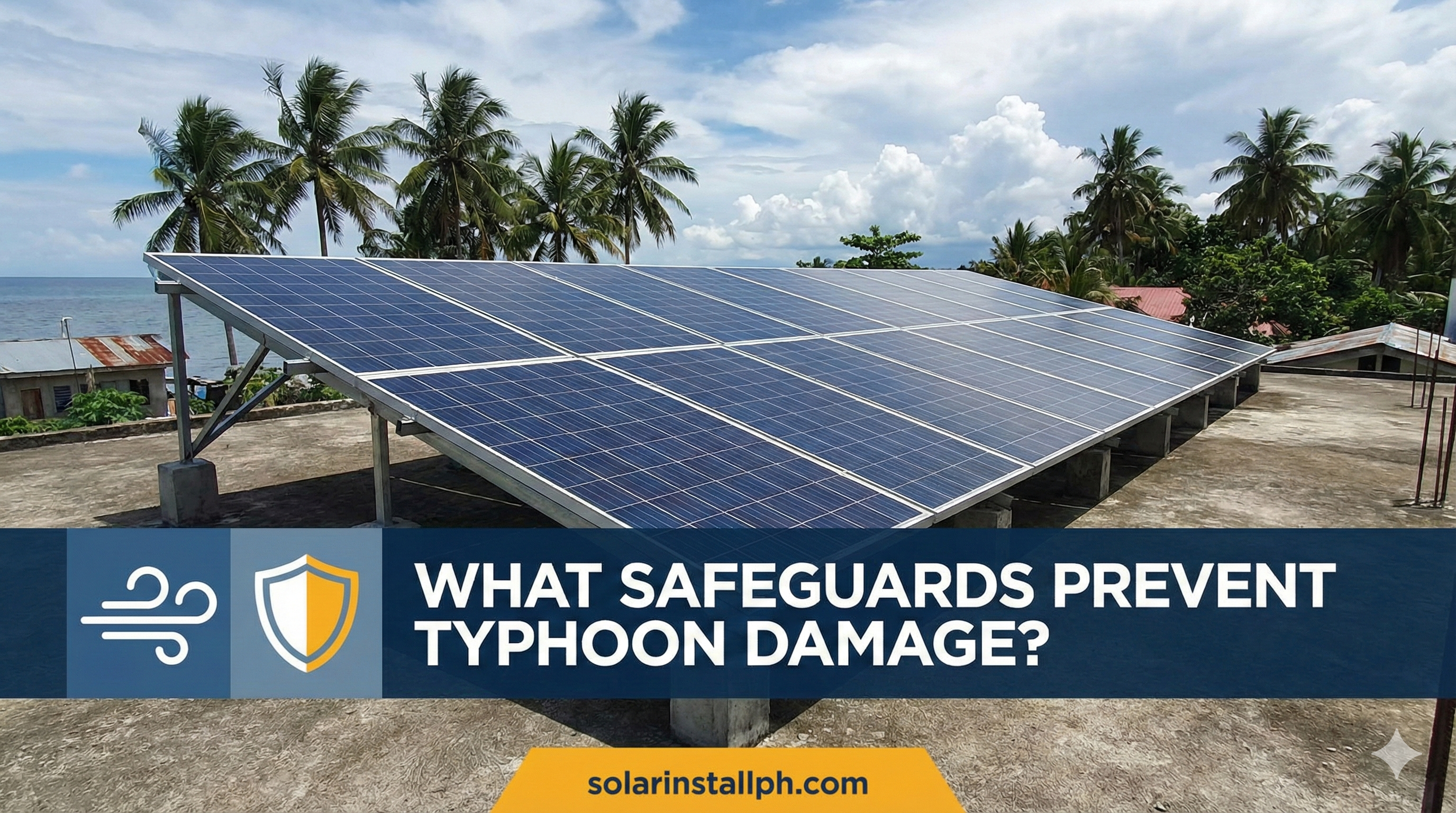
In the Philippines, buying a solar system is often an act of optimism. You are betting on sunny days and lower Meralco bills. But the reality of our geography means you are also betting against the 20 typhoons that enter our Area of Responsibility every year.
When a Super Typhoon like Odette or Egay hits, the question isn't just "Will my lights stay on?" It is "Will my investment stay on the roof?"
We have all seen the photos: twisted aluminum rails, shattered glass, and solar panels flung into rice fields like playing cards. This damage is almost always preventable. It is rarely an "Act of God"; more often, it is an act of cost-cutting.
To ensure your system survives the next Signal No. 4, you need to understand the safeguards that separate a permanent asset from a temporary one.
1. The "Typhoon-Rated" Mounting Standard (5400 Pa)
The most critical safeguard is invisible to the naked eye: the wind load rating.
Most standard solar mounting kits are rated for 2400 Pascals (Pa). This is the international baseline, designed to withstand wind speeds of roughly 130 to 140 kph. In Europe or the US, this is sufficient. In the Bicol Region or Eastern Visayas, it is a liability.
The Physics of Uplift
During a typhoon, wind doesn't just push down on your panels; it gets under them. This creates a pressure differential that sucks the panels upward—the same physics that allows an airplane to fly.
The Safeguard: You must demand a mounting system rated for 5400 Pascals.
The Difference: A 5400 Pa system is engineered to survive wind speeds exceeding 250 kph. It uses thicker rails, stronger clamps, and tighter spacing between supports.
If your installer cannot show you the datasheet proving the 5400 Pa rating of their mounting kit, walk away. For a deeper explanation of how wind load ratings work in our context, read our guide on wind load factors for solar.
2. Structural Reinforcement: The "Third Rail"
Standard installation manuals typically call for two rails per row of panels. The panel is clamped at four points (two on top, two on bottom).
This "four-point" hold is fine for static loads (snow or gravity), but under the violent vibration of a typhoon, the panel glass can flex excessively. This flexing causes the tempered glass to shatter or the aluminum frame to buckle.
The Safeguard: The Third Rail
For typhoon-prone areas, we recommend installing a third rail running across the center of the panels. Alternatively, installers can use a "shared rail" matrix that increases clamping points from 4 to 6 per panel.
Rigidity: This extra support stiffens the entire array, preventing the "wobble" that leads to failure.
Redundancy: If one clamp fails, you have five others holding the panel down.
While this adds about 10–15% to the mounting material cost, it effectively doubles the system's grip strength. To see how this impacts your total budget, check our breakdown of residential solar costs.
3. High-Tensile Aluminum (6005-T5)
Not all aluminum is created equal. The standard alloy used in window frames and cheap solar rails is 6063-T5. It is lightweight and easy to extrude, but it is relatively soft.
The Safeguard
A typhoon-proof system uses Aluminum 6005-T5.
Strength: 6005-T5 has significantly higher tensile strength and yield strength than 6063. It resists bending and tearing under extreme loads.
Corrosion Resistance: It holds up better against the salt spray that accompanies typhoons in coastal provinces like Cavite or Batangas.
When you review your quotation, look for the specific alloy grade. If it just says "Aluminum Rails," ask for the specs. The difference between 6063 and 6005 is the difference between a bent rail and a straight one after the storm.
4. Anti-Loosening Washers (DIN 25201)
A typhoon is not a single impact; it is 12 to 24 hours of continuous vibration. This vibration acts like a wrench, slowly loosening the bolts that hold your mid-clamps and end-clamps.
We have seen systems where the rails survived, but the clamps vibrated loose, allowing the panels to slide off and crash to the ground.
The Safeguard
Your installer should use locking washers (often referred to by the standard DIN 25201 or similar wedge-locking technologies). These washers use tension, not just friction, to prevent loosening.
Torque Check: As part of your annual maintenance, every bolt should be re-torqued. If you haven't done this recently, read our solar panel maintenance guide to see what else you might be missing.
5. Roof Integration: Anchoring to the Skeleton
The strongest solar system is useless if it rips your roof off.
In many Filipino homes, the Galvanized Iron (GI) roof sheets are attached to the steel purlins with simple umbrella nails or rivets. Solar panels add weight (approx. 20kg per panel) and massive wind drag to this structure.
The Safeguard
L-Feet Penetration: The mounting "L-feet" must not just sit on the roof sheet; they must be screwed directly into the purlins or trusses underneath using heavy-duty Tek screws.
Structural Audit: Before installation, a competent installer will check if your purlins are rusted or undersized. If they are, they must be reinforced (sistering) before the solar is installed.
For older homes, this step is non-negotiable. Learn more about assessing your roof's readiness in our article on solar mounting and roof types.
6. Micro-Crack Prevention
Even if your panels don't fly away, wind can kill them from the inside. Violent flexing causes "micro-cracks" in the silicon cells. These invisible fractures sever the electrical flow, leading to "hot spots" and a 20–30% drop in production over time.
The Safeguard
Glass-Glass Modules: Consider using bifacial dual-glass panels. These have tempered glass on both the front and back (instead of a plastic backsheet). The sandwich structure is far more rigid and resistant to cracking.
Panel Quality: Stick to Tier 1 brands known for durable frames. You can compare the top options in our review of best solar panels for Philippine homes.
Summary: The Price of Resilience
Safeguarding your system against typhoons costs money. Upgrading to 5400 Pa mounting, adding a third rail, and using 6005-T5 aluminum might add ₱15,000 to ₱20,000 to the cost of a standard 5kW system.
But compare that to the cost of failure:
Replacement Cost: Replacing two broken panels and labor = ~₱25,000.
Deductible: The standard insurance deductible is 2% of the system value (~₱6,000 to ₱10,000).
Downtime: Weeks of lost savings while waiting for repairs.
In the Philippines, "typhoon-proof" is not a luxury upgrade. It is the baseline requirement for a system that lasts 25 years. Don't settle for a system built for fair weather; build one that handles the storm.
Concerned about the financial side of these upgrades? Check our guide on solar ROI calculations to see how durability impacts your long-term savings.