
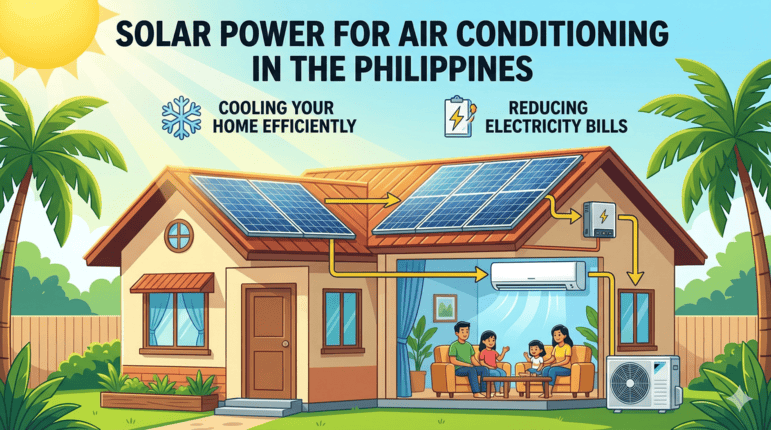
Solar Power for Air Conditioner in the Philippines: A Guide
Solar Power for Air Conditioner in the Philippines
Installing 6×330 W solar panels slashes Philippine air-conditioning costs by PHP 1,500–3,000 monthly and can pay for itself within 3–5 years.
Why Air Conditioners Are Killing Your Electricity Bill
Before we dive into solar solutions, let's understand the problem. In the Philippines, air conditioners are responsible for up to 63% of your total household energy consumption. Running a typical 1.02 kW air conditioner for just 8 hours daily can consume approximately 163 kWh per month [1].
Here's the math:
20 days × 8 hours = 160 hours of operation
1.02 kW × 160 hours = 163 kWh/month
At PHP 0.80–1.20 per kWh, that's PHP 130–195 just for one AC unit
Multiply that by multiple units running throughout the hot season, and you could be looking at PHP 5,000–10,000 monthly on cooling alone. It's no wonder many Filipino homeowners are searching for alternatives.
How Solar Power for Air Conditioning Works
The concept is elegantly simple. Here's what happens:
Solar panels capture sunlight and convert it into direct current (DC) electricity
The inverter converts DC to AC — the type of electricity your air conditioner uses
The AC runs on solar energy during the day, reducing grid dependency
Excess energy can be exported to the grid (for on-grid systems), earning you credits
Two Types of Solar Systems for Air Conditioning
System Type | How It Works | Best For |
|---|---|---|
On-Grid | Connected to the electrical grid. Uses solar during the day, draws from grid at night | Budget-conscious homeowners |
Off-Grid | Uses solar batteries for storage. Fully independent from the grid | Areas with frequent outages, remote locations |
The on-grid system is the most popular choice in the Philippines because it's more affordable and allows you to earn credits through net metering.
How Many Solar Panels Do You Need?
The number of panels depends on your AC's energy consumption. Based on typical usage:
To power a 1.0–1.5 HP AC unit: You'll need approximately 6 solar panels of 330W–405W each
Total estimated generation: Around 241 kWh/month, which covers average AC usage
Here's a quick breakdown:
AC Size | Monthly Consumption | Solar Panels Needed | Estimated System Size |
|---|---|---|---|
1.0 HP | 120–150 kWh | 4–5 panels (330W) | 1.5–2 kWp |
1.5 HP | 160–200 kWh | 5–6 panels (330W) | 2–2.5 kWp |
2.0 HP | 220–280 kWh | 7–8 panels (330W) | 2.5–3 kWp |
Cost Breakdown: Is It Worth It?
Let's be realistic about the investment. Here's what you'd typically need for a solar-powered AC setup:
Component | Estimated Cost (PHP) |
|---|---|
Solar Panels (6×330W) | 50,000–60,000 |
Inverter (Pure Sine Wave) | 25,000–35,000 |
Charge Controller | 15,000–20,000 |
Batteries (if off-grid) | 30,000–50,000 |
Installation & Accessories | 20,000–30,000 |
Total (On-Grid) | 110,000–145,000 |
Total (Off-Grid) | 170,000–220,000 |
The ROI (Return on Investment)
Monthly savings: PHP 1,500–3,000 (depending on AC usage)
Payback period: 3–5 years
System lifespan: 25+ years
Additional benefit: Reduce CO2 emissions by up to 20 kg per year [2]
In simple terms, a PHP 150,000 investment can save you PHP 30,000–50,000 in electricity over 3 years—all while increasing your property's value.
Benefits of Solar-Powered Air Conditioning in the Philippines
1. Massive Electricity Savings
The most obvious benefit. Once your system is installed, your AC runs on free sunlight.
2. Environmental Impact
Using solar energy reduces your carbon footprint. A typical solar AC setup can reduce CO2 emissions by 20 kg per year [2].
3. Energy Independence
With an off-grid system (加上 batteries), you're protected from brownouts and power interruptions—common during summer in the Philippines.
4. Increased Property Value
Homes with solar panel systems command higher resale values. Studies show homes with solar sell faster and at a premium [3].
5. Low Maintenance
Solar systems require minimal upkeep—mostly just cleaning the panels twice a year and occasional inverter checks.
Common Questions Answered
"Will solar panels work on cloudy days?"
Yes! Solar panels still generate electricity on overcast days, though at reduced efficiency (typically 10–25% of rated output). Your on-grid system will simply draw more from the grid during very cloudy periods.
"Can I use my existing AC unit?"
Absolutely. Solar systems can power any standard AC unit. You don't need to buy a special "solar AC"—you just need enough solar capacity to meet its energy needs.
"How long does installation take?"
Most residential solar installations take 2–5 days, depending on system size and complexity.
"What about the rainy season?"
The Philippines still receives adequate solar irradiation during the rainy season. Your system will generate less energy, but grid connection ensures you always have power.
Making the Switch: Your Next Steps
Ready to slash your electricity bill and enjoy cooler comfort without the guilt? Here's what to do:
Calculate your energy needs — Know how much your ACs consume monthly
Get a professional assessment — Reputable solar companies offer free site inspections
Compare quotes — Get at least 3 quotations from different providers
Check incentives — Look for available solar rebates or financing options
Start small if needed — You can always expand your system later
The Philippines has abundant sunshine—why let it go to waste when it could be cooling your home for free?
Conclusion
Solar power for air conditioning isn't just an eco-friendly trend—it's a practical financial decision for Filipino homeowners. With electricity prices rising and solar technology becoming more affordable, there's never been a better time to make the switch.
The math is simple: Invest now, save for 25+ years. Your future self (and your wallet) will thank you.
References
[1] Solar Lab Philippines. "Solar Power for Air Conditioner in the Philippines."
[2] Solar Lab Philippines. "Solar Energy Kit for Air Conditioning."
[3] Solar Lab Philippines. "Do Homes With Solar Panels Sell Faster."