
Budgeting Your Home's Energy System Installation
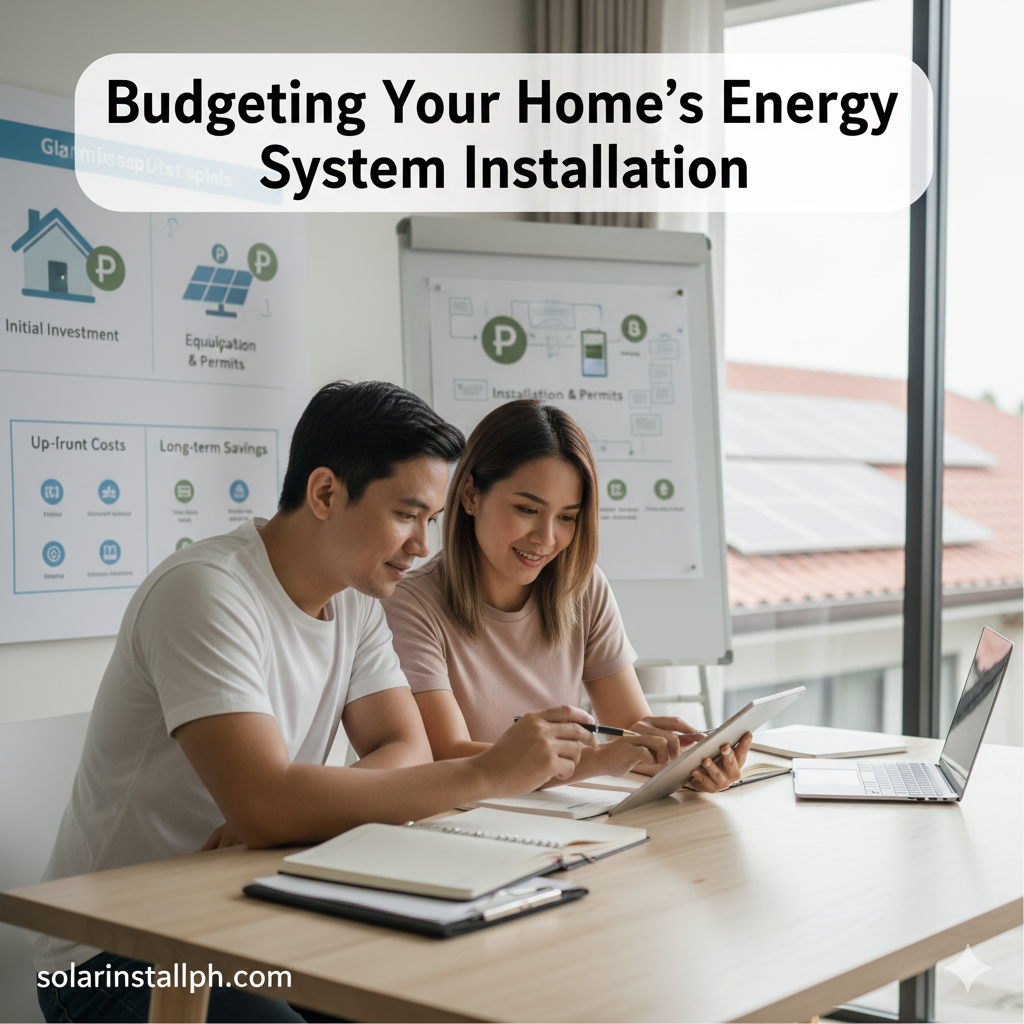
The decision to invest in a solar energy system for your home is one of the most financially empowering moves a Filipino family can make. It’s a definitive step towards breaking free from the cycle of ever-increasing electricity rates and gaining control over a crucial household expense. However, the path from interest to installation is paved with financial questions. The upfront cost, while significantly lower than a decade ago, remains a major investment that requires careful planning and strategic budgeting.
Thinking of a solar installation not as a simple purchase but as a long-term home upgrade, much like a major renovation or buying a car, is the correct financial mindset. It’s an asset that generates tangible returns from the day it's switched on. But how do you budget for it? How do you transform a six-figure price tag into a manageable financial plan?
This guide is designed to walk you through the essential steps of budgeting for your home's solar energy system. We will explore how to accurately forecast costs, calculate your potential return on investment, navigate the various financing options available in the Philippines, and plan for every expense, ensuring your solar journey is as smooth and predictable as possible.
1. Deconstructing the Upfront Investment
The first step in any budget is to understand exactly what you are paying for. A solar installation quote is more than just the price of the panels; it's a comprehensive package of hardware, labor, and professional services. A transparent quote from a reputable installer will typically break down the cost into two main categories:
Hard Costs (The Hardware): This is the tangible equipment that will be installed on your property. It generally accounts for 60-70% of the total project cost.
Solar Panels: The core component, with costs varying based on brand, efficiency (monocrystalline vs. polycrystalline), and wattage.
Inverter: The "brain" of the system that converts DC power from the panels to usable AC power for your home. Costs differ for standard string inverters, microinverters, or battery-ready hybrid inverters.
Mounting System: The racking and clamps that secure the panels to your roof. Quality is non-negotiable here to withstand the Philippines' typhoon seasons.
Balance of System (BOS): This includes all the necessary wiring, conduits, circuit breakers, and monitoring software.
Soft Costs (The Labor and Services): These non-hardware costs are equally vital and can make up 30-40% of the total price.
System Design and Engineering: Customizing the system size and layout for your specific energy needs and roof structure.
Permitting and Paperwork: This is a significant service. Professional installers handle the entire administrative process, from securing local government unit (LGU) building and electrical permits to processing the crucial net metering application with your utility provider (like Meralco).
Installation Labor: The wages for the certified crew of technicians who will physically mount the panels and wire the system.
Warranties and After-Sales Support: The installer’s workmanship warranty and their commitment to providing service for the life of the system are factored into the price.
Understanding this breakdown helps you compare quotes more effectively and appreciate that you're investing in a complete, professionally managed project, not just a set of panels.
2. Calculating Your Return on Investment (ROI)
To create a sensible budget, you need to see solar as an investment, not just an expense. The most important metric for this is the Return on Investment (ROI), or the payback period—the time it takes for your accumulated electricity savings to equal the initial cost of the system.
Calculating an accurate ROI involves a few key steps:
Analyze Your Current Electricity Bill: Gather your electricity bills for the last 12 months. Calculate your average monthly consumption in kilowatt-hours (kWh) and your average cost per kWh. This is your baseline. For example, a home consuming 500 kWh per month at ₱11/kWh has a monthly bill of ₱5,500.
Estimate Your Solar Production: Your installer will provide a generation estimate for the proposed system, measured in kWh per year. This figure is based on your location's sun hours, the system's size, and its efficiency.
Calculate Your Annual Savings: Multiply the estimated annual solar production (in kWh) by your average cost per kWh. If a system generates 6,000 kWh per year, your estimated annual savings would be 6,000 kWh x ₱11/kWh = ₱66,000.
Determine the Payback Period: Divide the total upfront cost of the system by your estimated annual savings.
Formula: Total System Cost / Annual Electricity Savings = Payback Period in Years
Example: ₱300,000 System Cost / ₱66,000 Annual Savings = ~4.5 years
In the Philippines, the typical payback period for a residential solar system is between 4 to 7 years. After the payback period is over, the energy your system produces is essentially free for the remainder of its 25+ year lifespan. A detailed solar ROI guide can provide more nuanced calculations.
3. Exploring Your Financing Options
The high upfront cost is the biggest hurdle for most Filipinos. Fortunately, the financial landscape has evolved, and there are now multiple pathways to affording a solar installation without needing to pay the full amount in cash.
Outright Cash Purchase: If you have the funds available, paying in cash offers the best financial return. You avoid interest payments, and the savings start accruing to you immediately, leading to the shortest possible payback period.
Bank Financing / Solar Loans: Recognizing the growing demand, several major Philippine banks now offer specific loan products for renewable energy. BPI, for instance, has its "Solar Mortgage" program, which can be integrated into a new or existing housing loan. Other institutions, like SB Finance (an affiliate of Security Bank), have partnered directly with solar providers to offer personal loans of up to ₱2 million for solar installations, payable over up to 36 months. These bank loans often have more competitive interest rates than standard personal loans.
In-House Financing from Installers: Many solar companies have developed their own financing plans to make their products more accessible. These can be very attractive, sometimes offering zero-interest installment plans for a set period (e.g., 12-24 months) with a required down payment. Others offer longer-term "rent-to-own" models with little to no upfront cost, where you pay a fixed monthly amount that is often lower than your current electricity bill. This is an excellent option for those who want to start saving from day one without a large cash outlay. Explore different solar loans in the PH to find the best fit for your budget.
Home Equity Loan: If you have significant equity in your home, you may be able to take out a home equity line of credit (HELOC) from your bank. Because the loan is secured by your property, it can sometimes offer lower interest rates than unsecured personal loans.
4. Planning for Potential "Hidden Costs"
A critical part of budgeting is creating a contingency fund for unexpected expenses. While a reputable installer provides an all-inclusive quote, certain issues related to your property's specific condition may fall outside the standard scope of work. It’s vital to discuss these possibilities with your installer beforehand.
Be prepared for potential solar hidden costs such as:
Roof Repairs: A solar panel system has a warranty of 25 years or more. Your roof needs to be in good condition to last just as long. If your installer finds leaks, structural weaknesses, or significant rust, these issues must be rectified before solar panels can be installed.
Electrical Panel Upgrade: Older homes may have main electrical panels (switchboards) that are not rated to handle the additional circuit from a solar power system. An upgrade to a modern panel is a necessary safety measure and will be an additional cost.
Complex Installations: If your roof is particularly steep, made of delicate materials like clay tiles, or requires an unusually long wiring run from the panels to the inverter, the additional labor and specialized equipment may increase the cost.
A good rule of thumb is to set aside a contingency fund of 5-10% of the total project cost to cover any such unforeseen but necessary upgrades.
5. Leveraging Government Incentives to Your Advantage
The Philippine government encourages the adoption of renewable energy through several incentives that can effectively lower the net cost of your investment. Under the Renewable Energy Act of 2008, homeowners who install solar are entitled to:
Duty-Free Importation: Solar companies can import renewable energy equipment, including panels and inverters, free of customs duties. This benefit is passed on to you in the form of a lower overall system price.
VAT Zero-Rating: The sale of power from renewable sources is zero-rated for Value-Added Tax (VAT).
Net Metering Program: This is the most significant financial incentive. It allows you to export your excess solar energy to the grid for credits, which directly offset the cost of the electricity you consume at night.
While the Philippines does not currently offer direct cash rebates or widespread tax credits for residential installations, these existing fiscal incentives are built into the economics of going solar, making it a more attractive investment.
Budgeting for a solar energy system is a process of careful research and planning. By understanding the true costs, calculating your long-term savings, exploring all available financing routes, and preparing for contingencies, you can confidently make an investment that will pay dividends for decades. The journey begins with knowledge and a solid financial plan, turning the dream of energy independence into an achievable reality. The best first step is to get a detailed quote and expert advice by learning how to choose the right solar company for your needs. For a complete overview of the journey, refer to a comprehensive solar installation guide.