
7 Best: Home Electricity Savings Manila
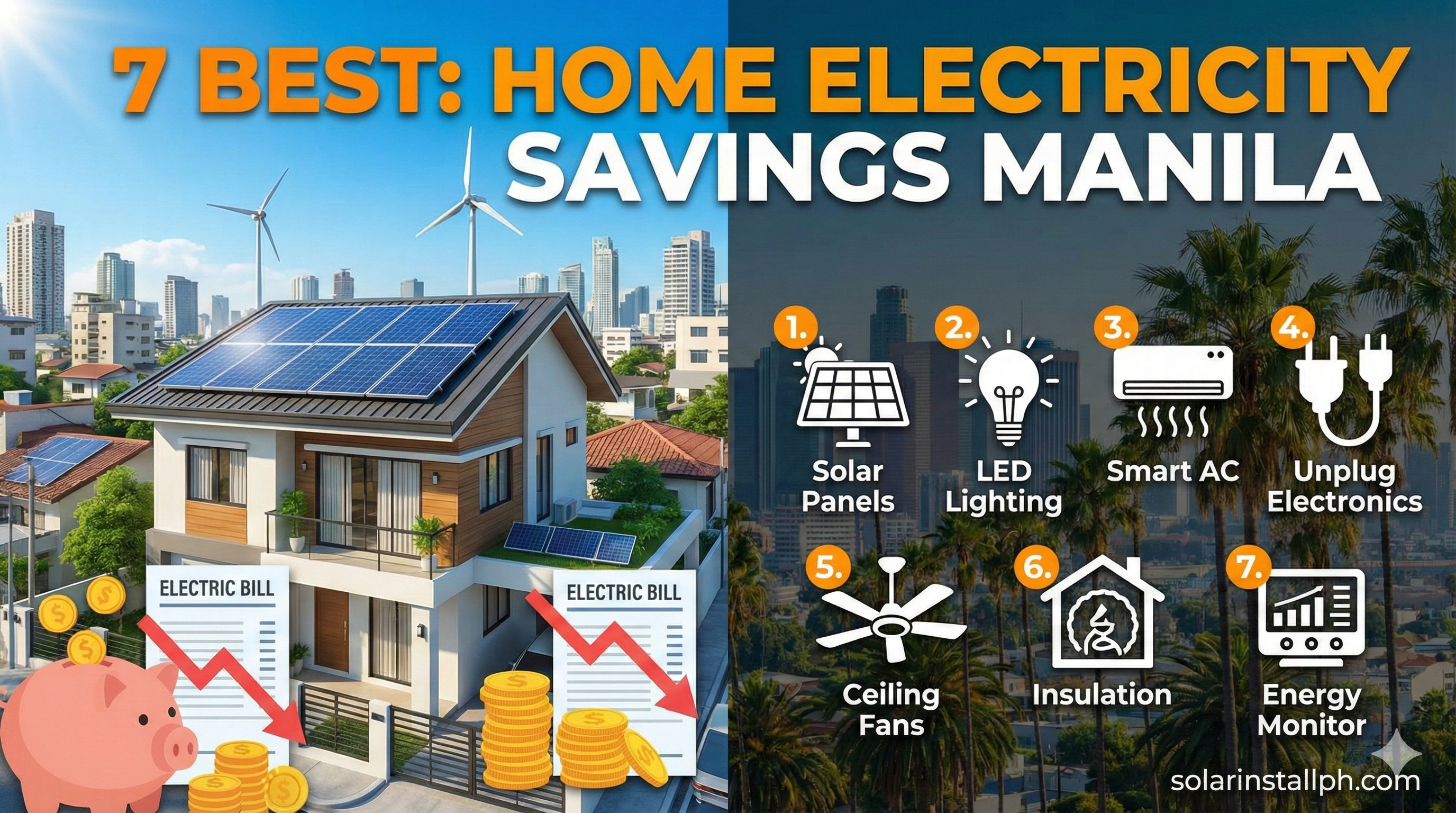
If you live in Metro Manila, you are fighting a two-front war. On one side, you have the Urban Heat Island effect, where concrete and asphalt trap heat, keeping your home hot even at 10 PM. On the other side, you have Meralco rates that have danced between ₱11 and ₱14 per kWh throughout 2024 and 2025.
For the average middle-class household in Quezon City, Makati, or Pasig, an electric bill of ₱8,000 to ₱15,000 is becoming terrifyingly normal.
Forget the generic advice about "unplugging your charger" (which saves you maybe 50 centavos a month). To actually dent a Manila electric bill, you need aggressive, high-impact strategies. You need to target the heavy loads and stop paying for heat you didn't ask for.
Here are the 7 best ways to reduce home electricity costs in Manila, ranked by practical impact and Return on Investment (ROI).
1. The "Inverter Swap" (Targeting the 60%)
In a tropical climate, air conditioning is not a luxury; it is a survival tool. It also accounts for 50% to 60% of your total bill.
If you are still running a non-inverter window-type aircon from 2015, you are essentially burning money. Old ACs run on a "start-stop" cycle. The compressor blasts at 100% power, cools the room, shuts off, and then blasts again when the temperature rises. That startup spike is expensive.
The Fix: Switch to a modern Inverter Split-Type or Window Inverter.
The Math: An inverter unit varies the speed of the compressor to maintain temperature without stopping. This cuts consumption by 30% to 50%.
The ROI: Replacing a 1.5HP non-inverter (consuming ~1.4 kWh/hour) with a 1.5HP inverter (averaging ~0.6 kWh/hour after cooling down) can save you ₱1,500 to ₱2,000 per month if you run it nightly. The unit pays for itself in under two years.
However, brand matters. Some "inverters" are better than others. Before you buy, check our review of the top inverter brands available in the Philippines for 2025 to ensure you get durable electronics that can handle Manila’s dirty power grid.
2. Roof Insulation (Stopping the Oven Effect)
Most Manila homes have a fatal flaw: uninsulated GI sheet roofs.
At 1 PM, the temperature inside your roof cavity can hit 60°C. That heat radiates down through your ceiling, turning your bedroom into an oven. Your aircon then has to fight this heat load before it can even start cooling the air.
The Fix: Install PE Foam Insulation (at least 10mm to 15mm thick, preferably double-sided foil).
Why it works: It reflects 97% of radiant heat.
The Result: A passive drop of 3°C to 5°C in indoor temperature.
The Bill Impact: Your aircon compressor works less hard. Instead of running at high frequency to fight the heat, it cruises at low frequency.
If you are renting or in a condo where you can't touch the roof, use blackout curtains with a white backing. The white side faces the window to reflect the harsh Manila sun, preventing your condo unit from becoming a greenhouse.
3. Grid-Tied Solar (The "Daytime Eraser")
If your daytime bill is high—because of a home office, kids on summer break, or elderly parents at home—efficiency isn't enough. You need to produce your own power.
Grid-Tied Solar is the standard solution for Metro Manila. It has no batteries (which are expensive and degrade). It simply syncs with Meralco.
How it works: When the sun shines, your house uses solar power first. If you need 1,000W and the solar provides 1,000W, your meter stops moving. You pay Meralco zero for that hour.
Cost vs. Value: A typical 3kW to 5kW system costs significantly less now than it did five years ago.
ROI: With rates at ₱13/kWh, a grid-tied system usually pays for itself in 3.5 to 5 years. After that, the energy is free for the remaining lifespan of the panels (25+ years).
This is a construction project, not an appliance purchase. You need to understand the numbers. Read our breakdown of residential solar costs to set a realistic budget for a standard Manila rooftop.
4. Net Metering (The "Rollover" Advantage)
If you get solar, you must apply for Net Metering.
Without it, any excess power you generate (like when you go to the mall on a Sunday but your panels are blasting power) is given to Meralco for free. With Net Metering, Meralco buys that excess power and gives you Peso Credits.
New for 2025: The rules have improved. Under the latest ERC resolutions, Net Metering credits generally have better rollover provisions (indefinite banking in many cases), meaning you don't lose the value you generated in summer when the rainy season hits.
The Strategy: You "bank" credits during Manila’s scorching dry season (March–May).
The Payoff: You use those credits to lower your bill in December or during rainy months when solar production is lower.
This transforms your system from a "daytime saver" to a "bill wiper." However, the application process in Manila involves specific paperwork with the LGU and Meralco. To navigate this without headaches, consult our guide to the Meralco Net Metering process.
5. The Condo "Smart Cool" Strategy
Manila is Condo City. If you live in BGC, Ortigas, or Taft, you likely cannot install solar panels on the roof. You are stuck with the rates and the building's constraints.
The Fix: optimize air circulation and cleaning.
The Fan Assist: Run a stand fan with your aircon. The moving air creates a wind-chill effect, allowing you to set the AC at 25°C while feeling like it’s 22°C. This 3-degree difference saves about 15% on the compressor load.
Condenser Cleaning: In condos, the outdoor unit (ACCU) is often shoved into a tiny balcony or utility ledge. It gets clogged with city dust and smog rapidly. A dirty condenser cannot release heat, causing the amp draw to spike. hose it down (gently) or have it chemically cleaned every 3–4 months, more often than the standard 6-month recommendation for houses.
If you have a balcony with direct sun, you might be able to use portable solar generators for charging gadgets or running fans, but check your admin rules. For more on what is possible in high-rises, see our article on solar options for condo dwellers.
6. Killing the "Vampires" (Refrigerator & Dispenser)
In many Filipino homes, the refrigerator is an heirloom. We keep it running until it dies.
But a 15-year-old ref with a loose rubber gasket is a disaster. It runs 24/7 trying to cool the kitchen.
The Test: Put a piece of paper in the door and close it. If you can pull the paper out easily, your seal is broken. You are leaking cold air.
The Dispenser: Those hot/cold water dispensers are convenient, but keeping water near-boiling 24/7 consumes more energy than a small ref. If you don't need hot water at 3 AM, put the dispenser on a timer or just use a kettle.
Replacing an old ref with a high-efficiency inverter model can save ₱400 to ₱800 per month.
7. Understanding Your Meralco Bill "Breakers"
Finally, you need to understand the "Lifeline" and "Tiered" nature of costs.
While the "Lifeline Rate" subsidy (for very low consumption) likely doesn't apply to you if you are reading this, staying in lower consumption tiers protects you from volatile generation charges.
More importantly, you need to verify if you are actually saving money. Many people install solar or buy new appliances and think they are saving, but increased usage eats the gains.
The Audit: Compare your kWh consumption year-over-year (e.g., June 2024 vs. June 2025), not just the Peso amount, since rates fluctuate.
The Analysis: If you installed solar and your bill dropped from ₱10,000 to ₱5,000, is that good? Maybe. But if you should have dropped to ₱2,000 based on your system size, you have a problem (either behavior or technical).
We have detailed case studies on this. Check out our real-world data on Meralco solar savings scenarios to benchmark your own home's performance against similar Manila households.
Conclusion
Saving electricity in Manila isn't about suffering in the heat. It's about efficiency and production.
If you have the capital, Insulation + Inverter AC + Solar is the trifecta that solves the problem permanently. If you are renting, focus on Airflow + Inverter Appliances.
Don't let the heat win. Start with the heavy hitters, ignore the gimmicks, and take control of your meter.