
Power Your Planet: Installation Guide
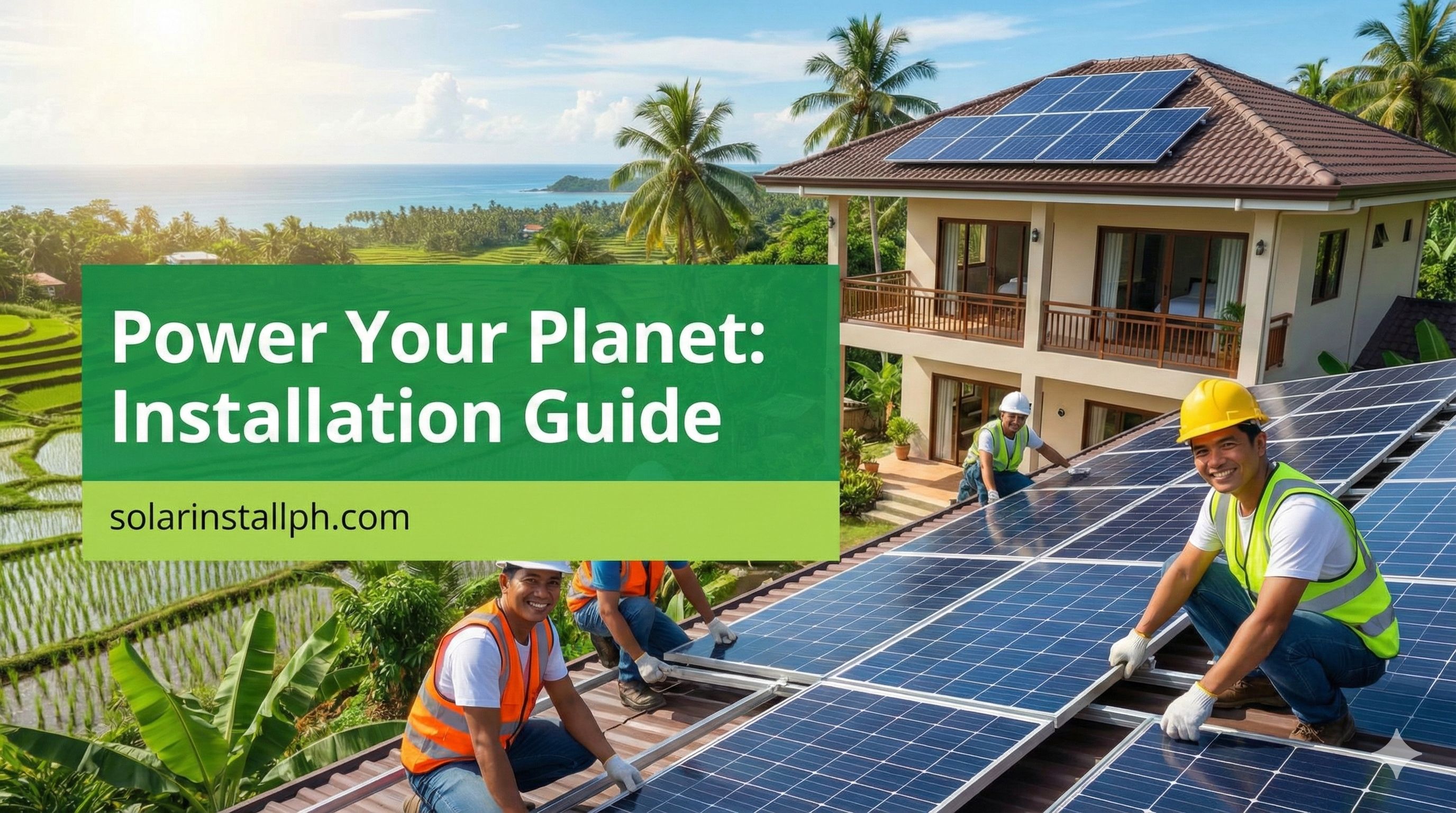
If you live in the Philippines, you are likely paying one of the highest electricity rates in Asia. Every time you open that Meralco or electric cooperative bill, you’re reminded that renting your power is a losing game.
You’ve probably seen neighbors installing panels or heard about "zero bills," but the actual process of getting from wanting solar to having a working, legal system can feel opaque. It’s not just about slapping panels on a roof; it’s a construction project involving electrical engineering, government permits, and heavy-duty hardware that needs to survive a typhoon.
This guide walks you through the end-to-end reality of installing a solar system in the Philippine context—no fluff, just the operational steps you need to take.
Phase 1: The Honest Assessment
Before you spend a peso, you need to do the math. Solar isn't magic; it's an investment that relies on your consumption patterns.
1. Analyze Your Load
Grab your last three electric bills. Look at your average kWh usage, not just the peso amount.
Daytime vs. Nighttime: Solar only generates power when the sun shines (roughly 9:00 AM to 3:00 PM is your peak window in PH). If you are an office or a household that runs aircons during the day, your ROI will be fast (4–5 years).
The "Magic" Number: For most Filipino middle-class homes, a 3kW to 5kW system is the sweet spot. This usually offsets a ₱4,000 to ₱8,000 monthly bill.
2. The Roof Check
Go outside and look at your roof.
Orientation: A south-facing roof is perfect. East and West are okay (you get morning or afternoon peaks). North is the least efficient but still usable in our latitude.
Shading: This is the enemy. If you have a mango tree or a neighbor’s two-story firewall casting a shadow on your roof between 9 AM and 3 PM, your efficiency will tank.
Structural Integrity: Can your roof hold the weight? Solar panels weigh about 20kg each. If your GI sheets are rusting or your trusses are undersized, fix the roof first.
Phase 2: Choosing Your Hardware
The market is flooded with brands. Some are excellent; some are fire hazards.
Solar Panels
Stick to Tier 1 brands (e.g., Longi, Jinko, Canadian, Trina, JA Solar). "Tier 1" is a bankability rating, but it generally correlates with quality control.
Monocrystalline panels are the standard now. Don't let anyone sell you old Polycrystalline (blue) panels unless they are dirt cheap.
Bifacial panels (which gather light from both sides) are trendy but only worth it if you have a reflective white roof or ground mount; on a dark flush-mounted roof, they are a waste of money.
Inverters: The Brain
The inverter converts DC solar power to AC power for your appliances.
String Inverters (Grid-Tie): Brands like Huawei, Growatt, or Solis. Efficient and cheaper. Best if you have no shading issues.
Microinverters: Brands like Enphase. Each panel has its own mini-inverter. If one panel is shaded, the others keep working. safer (lower voltage) but much more expensive.
Hybrid Inverters: These can manage batteries. Essential if you want backup power during brownouts, but they increase the cost significantly.
Mounting Structures (Crucial for PH)
This is where many cheap installers cut corners. We live in a typhoon belt.
Wind Load: Your mounting rails and L-feet must be rated for at least 240kph wind loads.
Material: Ensure they use anodized aluminum or hot-dipped galvanized steel. Standard steel will rust out in our humid, salty air within three years.
For a deeper dive on keeping your panels on your roof during a storm, read our guide on typhoon-resistant mounting.
Phase 3: finding the Right Installer
Do not DIY a grid-tied system unless you are a licensed Electrical Engineer. The risks of fire or back-feeding the grid (killing a lineman) are too high.
When vetting installers, look for:
PCAB License: This proves they are a legitimate construction contractor.
Safety Officer: Do they wear harnesses? If you see installers walking on a roof in slippers without ropes, fire them immediately.
Real References: Ask for photos of installs they did 2 years ago, not just last week. You want to see how their work holds up.
We have a dedicated article on how to verify installer credentials to help you screen out the fly-by-night operators.
Phase 4: The Permitting Maze
This is the part nobody likes, but it is mandatory if you want Net Metering (where Meralco/DU buys your excess power).
The "Legal" Process
Barangay Clearance: For "Solar Installation."
Distribution Impact Study (DIS): Your installer applies with the DU to ensure the transformer can handle your export.
Building & Electrical Permit: You need to submit plans signed by a Professional Electrical Engineer (PEE) and a Civil Engineer to your LGU (City Hall).
Certificate of Final Electrical Inspection (CFEI): Once installed, the LGU inspects and issues this.
Net Metering Agreement: You submit the CFEI to the DU to swap your meter.
Note: Some homeowners skip permits (illegal) and install "Zero Export" devices. While this prevents the meter from spinning backward, it blocks you from selling excess power, which significantly lengthens your ROI.
For a full breakdown of the paperwork, check our resource on permitting requirements.
Phase 5: Installation Day
A typical residential install takes 2–4 days.
What to Watch For
Penetrations: Every hole they drill in your roof must be sealed with specialized solar sealant (like Sikaflex), not just generic silicone.
Cable Management: DC cables should not be resting on the roof surface where water flows. They should be clipped neatly to the rails.
Grounding: This is non-negotiable. The frames, the rails, and the inverter must all be bonded to a proper earth pit.
Curious about how the actual construction days play out? We break it down in our step-by-step installation process.
Phase 6: Commissioning and Net Metering
Once the physical work is done, you aren't finished.
Testing: The installer will run a PV commissioning test to check voltage, earth fault loops, and insulation resistance.
The Bi-Directional Meter: If you applied for Net Metering, Meralco/DU will eventually come to replace your old meter with a REC (Renewable Energy Certificate) meter and a bi-directional meter.
Old Meter: Charges you for import (grid to house).
Bi-Directional Meter: Measures import (grid to house) and export (house to grid).
The Payback Reality
With Net Metering, every kWh you export is credited to your bill. It’s not a 1:1 cash payment; it’s a credit against your generation charge. Realistically, a well-sized system in the Philippines pays for itself in 4 to 6 years.
For a detailed look at the money side, review our analysis of residential solar costs.
Common Mistakes to Avoid
Undersizing the Inverter: Don't install a 5kW inverter if you plan to expand to 10kW later. It’s cheaper to buy a bigger inverter now.
Ignoring Walkways: Leave space between panel rows for cleaning. If you can’t reach a panel, you can’t clean it, and dirty panels lose 15–20% efficiency.
Cheap DC Breakers: Using AC breakers for DC lines is a fire risk. DC arcs are harder to extinguish. Ensure your combiner box uses true DC components.
Conclusion
Installing solar is a construction project, not an appliance purchase. It requires patience with the LGU and diligence with your contractor. But once that system is live, and you see your bill drop from ₱12,000 to ₱500, the hassle becomes a distant memory.
You are securing your energy future against price hikes. Do it right, do it legal, and build it to last.