
Typhoon Solar Repair: Your Guide
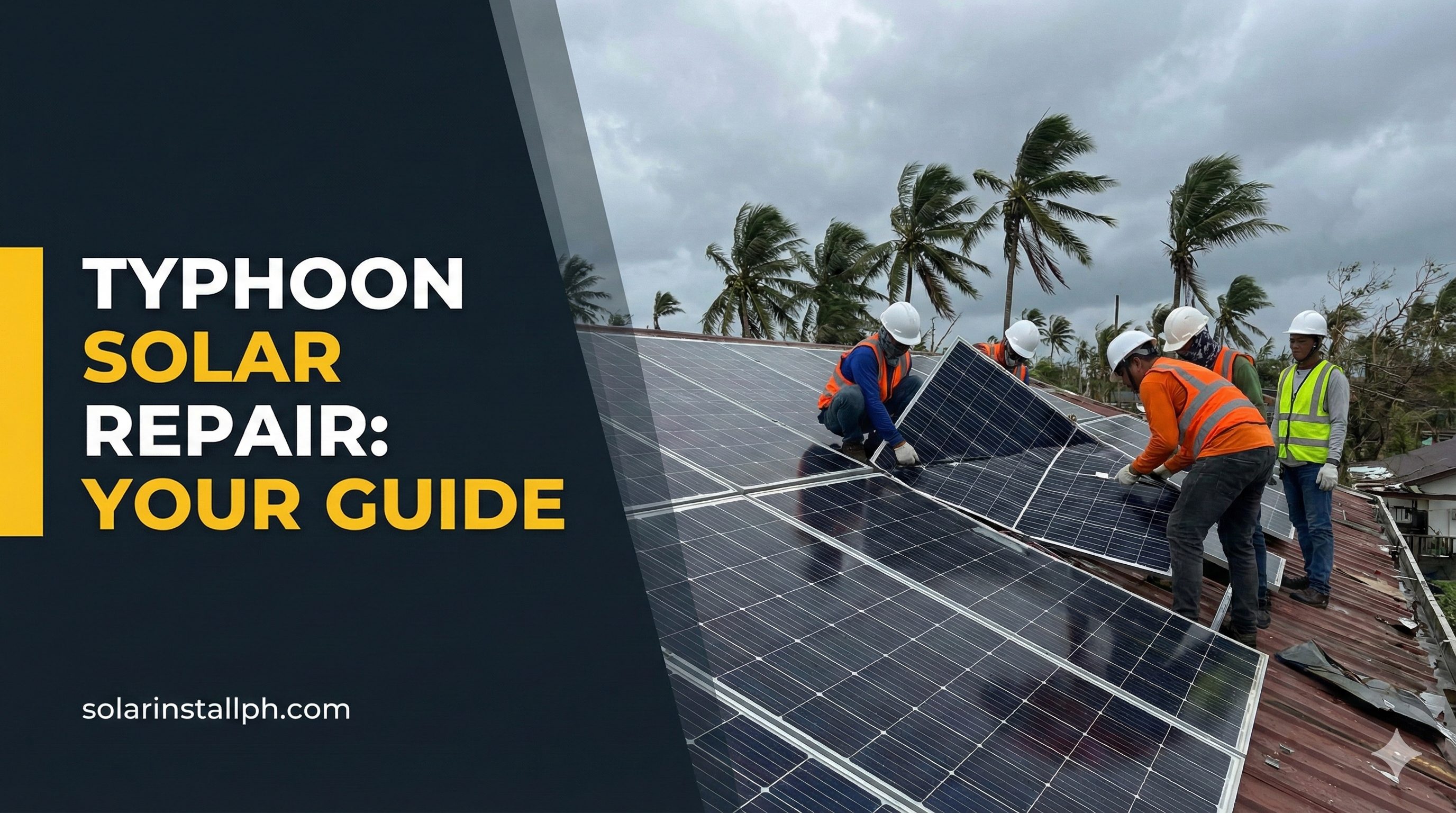
The morning after a typhoon is always the same. The wind stops, the rain slows to a drizzle, and the silence is deafening. Then, the anxiety sets in. You step outside, look up at your roof, and ask the question every solar owner in the Philippines fears: "Is my system still alive?"
Whether you just survived a Signal No. 4 storm or are preparing for the reality of living in the typhoon belt, you need to know that damage isn't always obvious. A panel might look fine from the ground but have micro-cracks that will kill your production in six months. An inverter might power on but have internal corrosion from salt spray that creates a fire hazard.
This is your practical, no-nonsense guide to assessing, repairing, and claiming insurance for your solar system after a disaster.
1. The "Do Not Touch" Rule (Safety First)
Before you grab a ladder, stop. Post-typhoon rooftops are death traps.
If your area is flooded or the roof is wet, do not climb up. Solar panels generate high-voltage DC electricity (up to 600V or 1000V) as soon as the sun hits them, even if the grid is down. If a wire insulation has been stripped by debris or a connector has pulled loose, the entire metal railing system could be electrified.
Immediate Isolation Protocol
Turn off the AC Breaker: This is usually labeled "PV System" or "Solar" in your main distribution panel.
Turn off the DC Disconnect: This is the switch (usually red or black) located near your inverter.
Inspect the Inverter from Afar: If your inverter is mounted outdoors and was exposed to horizontal rain, look for water inside the screen or condensation. If you suspect water ingress, do not attempt to turn it on. A wet inverter is a short circuit waiting to happen.
2. The Ground-Level Inspection
You don't need to be on the roof to spot the first signs of failure. Grab a pair of binoculars and scan your array from the ground. You are looking for:
Sagging Rails: This indicates the mounting feet have pulled out of the trusses.
Missing Clamps: Look for the silver or black clamps between panels. If they are gone, the panel is loose and vibrating.
Debris Impact: Coconuts, branches, or GI sheets from a neighbor’s roof often shatter the tempered glass.
Loose Wires: Cables hanging down and touching the roof surface are a ground fault risk.
If you see structural damage (bent rails or lifted panels), do not attempt a DIY fix. The tension on those bolts is unpredictable, and releasing one could cause the panel to slide off.
3. Navigating the Insurance Maze
In the Philippines, most standard fire insurance policies do not automatically cover solar panels against typhoons. You typically need a specific "Typhoon and Flood" rider, and the solar system must be declared as a separate improvement.
The 2% Reality
If you have coverage, be aware of the "participation fee" or deductible. In the Philippines, the standard deductible for Acts of Nature is 2% of the actual cash value of the damaged property.
If your system is insured for ₱300,000, your deductible is ₱6,000.
If the repair cost is only ₱5,000 (e.g., replacing two clamps), the insurance won't pay. It is only worth filing for major damage.
How to Document for a Claim
Insurance adjusters need proof.
Take Photos: Wide shots of the house showing the storm context, and close-ups of the specific damage (shattered glass, bent frames).
Save the Parts: Do not throw away broken panels until the adjuster sees them.
Get a Technical Report: You will need a formal damage assessment report from an installer.
For a deeper dive on what your policy likely covers (and excludes), read our guide to solar home insurance.
4. The Technical Diagnosis (Hidden Damage)
Visual inspection only catches 20% of the problems. The most dangerous damage is invisible.
Micro-Cracks
When wind gusts hit 200 kph, panels flex. This vibration causes the silicon cells inside the glass sandwich to crack. These "micro-cracks" are invisible to the naked eye but sever the electrical pathways.
Symptom: Your system works fine today, but output drops by 30% over the next year as the cracks expand into "hot spots".
The Test: Professional installers use Electroluminescence (EL) Imaging to "X-ray" the panels and see the cracks.
Isolation Resistance (IR) Test
If water entered your MC4 connectors or the inverter, your system has a "ground fault." The inverter will display an error (often "Isolation Low" or "Ground Fault").
The Fix: A technician uses a megohmmeter to test the insulation of the DC wires. Do not ignore this error; it usually means a wire is shorting to the roof.
To understand what a proper check-up looks like, review our professional solar maintenance checklist.
5. Repair vs. Replace: The Hard Truth
If a panel is cracked, it cannot be repaired. There is no "solar glue." It must be replaced.
The Matching Problem
You cannot just buy any panel to replace the broken one. You must match the Voltage (Voc) and Current (Imp) of the existing string.
If you put a new 550W panel (high current) in a string of old 300W panels (low current), the new panel will be "throttled" down to the performance of the old ones.
If the voltage difference is too high, you risk damaging the inverter.
If your original panel model is discontinued (which happens every 2 years), you might need to replace the entire string or use a separate microinverter for the new panel. For advice on selecting compatible hardware, consult our guide to top solar panels.
6. Finding a Real Pro (Not a Handyman)
Post-typhoon, "fly-by-night" repair crews appear out of nowhere. They will offer to "fix" your solar for cheap. Avoid them.
Solar repair requires an understanding of high-voltage DC series circuits.
A handyman might patch a leak with silicone but fail to torque the clamps correctly, leading to failure in the next storm.
Always hire a company with a track record. Check if they are on the list of DOE-accredited installers. A legitimate installer can also issue the technical report required by your insurance company.
7. Fortifying for the Next Storm
Once the repairs are done, don't just go back to "normal." Use this as an opportunity to upgrade your defenses.
Retorque Everything: We often find that panels survived the wind but the clamps loosened. Have the installer apply a torque wrench to every bolt.
Add Clamps: If your panels were held by only 4 clamps, ask to upgrade to 6 clamps or a "shared rail" system to increase rigidity.
Upgrade Rails: If your rails bent, replace them with Aluminum 6005-T5 (structural grade) instead of the softer 6063 alloy.
We detail these specific structural upgrades in our article on typhoon-resistant mounting strategies.
Conclusion
Recovering from a typhoon is exhausting, but getting your solar system back online is a priority. It provides the energy security you need when the grid is unstable.
Start with safety (isolate the system). Document everything for insurance. And when you repair, do not just patch the damage—reinforce it. In the Philippines, the question isn't if another typhoon is coming, but when. Your solar system needs to be ready.