
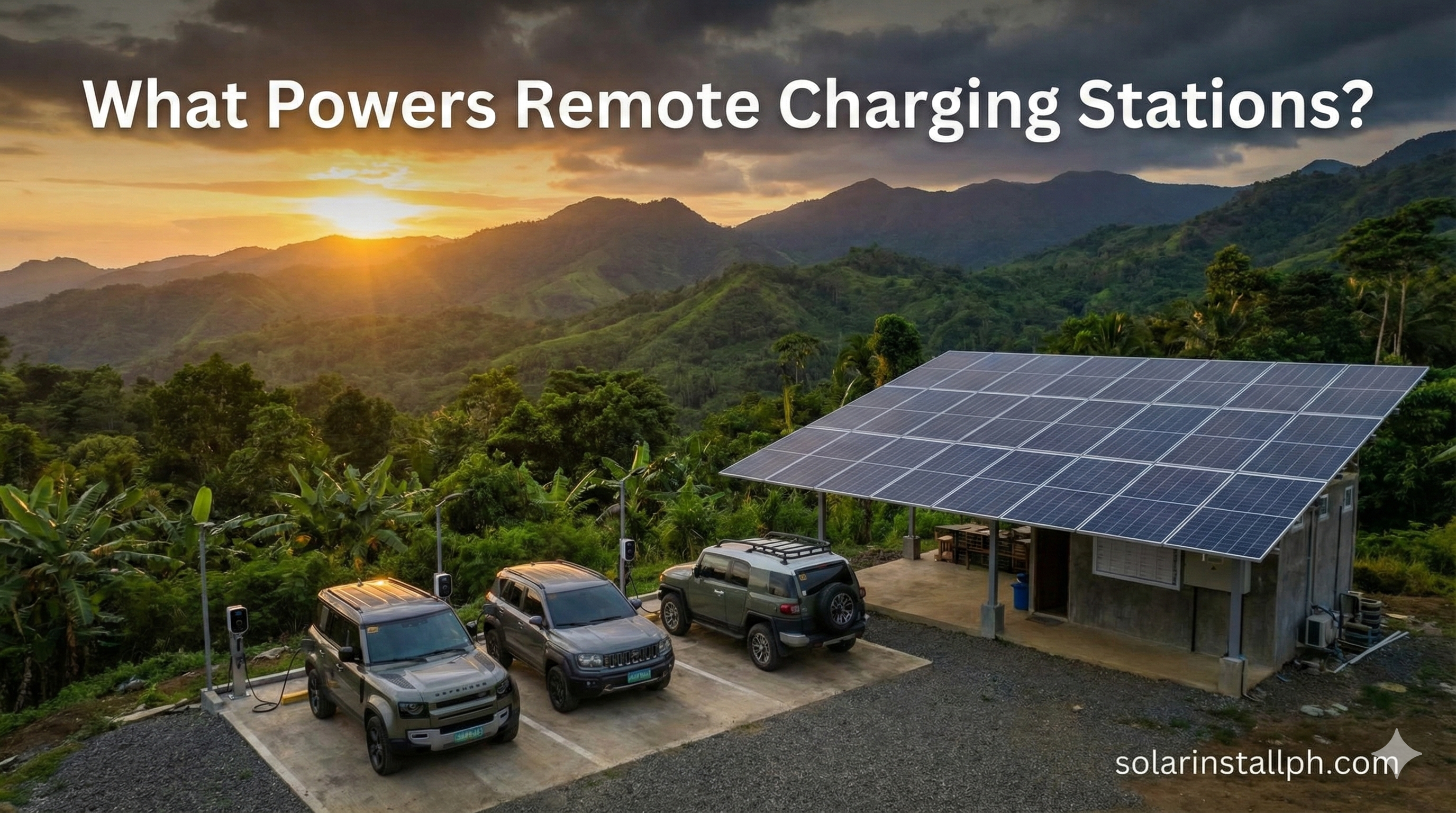
What Powers Remote Charging Stations?
The Electric Vehicle Industry Development Act (RA 11697) or EVIDA Law has officially put the Philippines on the EV map. We are seeing more BYD Dolphins, Nissan Leafs, and e-trikes on the road than ever before. But for anyone who has tried to drive an EV from Manila to Matnog, or operate an e-trike fleet in a remote Palawan municipality, one question looms larger than any tax incentive:
Where do I plug this thing in?
In Metro Manila, you find chargers in malls or condominiums. But in the provinces—where the grid is often unstable, expensive (think PHP 15-20/kWh in some missionary areas), or nonexistent—building a charging station isn't as simple as calling the local electric coop.
If you are a resort owner in Siargao, an LGU in Bicol, or a developer in a "missionary" area, you cannot rely on the grid to power your EV fleet. You have to build your own power plant.
Here is the engineering reality of what powers remote charging stations in the Philippines today.
1. The "Dirty" Secret: Diesel Generators
Let’s be blunt. Right now, a significant chunk of "remote" charging is actually powered by diesel.
In off-grid islands or areas at the tail-end of a distribution line, the voltage fluctuation is often too severe for sensitive EV chargers. To get a stable 230V, operators fire up a diesel genset.
This defeats the purpose of an EV. Charging a battery with a diesel engine is inefficient and expensive.
The Cost: Generating power from a small diesel genset costs PHP 25 to PHP 40 per kWh depending on fuel transport costs.
The Maintenance: Gensets are not designed to run at the high sustained loads that fast chargers demand.
However, for many early adopters, this was the only way. But in 2025, the math has changed. The "Solar Microgrid" is now the standard for remote EV infrastructure.
2. The Solar Microgrid Architecture
A true remote charging station is essentially a standalone off-grid solar system dedicated to transportation.
It is not as simple as connecting a solar panel to a car. Solar production is a bell curve (peaking at noon), while EV charging demand is sporadic and intense (often at night). You need a buffer.
The Components
PV Array (Solar Panels): You need a massive array. To charge a standard 60kWh EV battery in one day, you need roughly 15-20kW of solar panels, assuming 4-5 peak sun hours. This requires significant roof space or a ground mount.
Energy Storage (ESS): This is the heart of the system. The batteries store the solar energy harvested at noon so you can charge vehicles at 6:00 PM.
The Inverter/Charger: This converts the DC power from the panels/batteries into the clean AC power the vehicle accepts.
3. Storage is Non-Negotiable (and Lithium is King)
You cannot build a remote charging station with lead-acid batteries. The physics just doesn't work.
EV charging is a "high C-rate" application. It pulls a massive amount of current very quickly. Lead-acid batteries suffer from the "Peukert Effect"—the faster you discharge them, the less capacity they have. If you try to fast-charge a car using lead-acid batteries, the voltage will sag, and the system will trip.
You need Lithium Iron Phosphate (LiFePO4).
High Discharge: They can handle the surge current of a Level 2 charger (7kW or 11kW) without voltage sag.
Cycle Life: They last 10+ years, which is crucial for ROI.
Efficiency: You get 95%+ of the energy out that you put in.
When evaluating solar batteries in the Philippines, prioritize "high voltage" (HV) lithium systems for commercial charging stations. These operate at 200V-400V DC, which is more efficient for larger loads than the standard 48V residential systems.
4. The "Hybrid" Compromise
Pure solar is romantic, but in the Philippines, we have the rainy season. If you are running a commercial charging station, you cannot tell a customer, "Sorry, it's cloudy, come back tomorrow."
The most reliable remote stations use hybrid power sources.
Primary: Solar + Battery (provides 80-90% of the energy).
Backup: Diesel Generator (provides the remaining 10% during typhoons or heavy usage).
This setup allows you to downsize your expensive battery bank. Instead of sizing batteries for 5 days of autonomy (which is crazy expensive), you size them for 1 day. If the battery gets low, the generator automatically kicks in to finish the charge.
This approach keeps the commercial solar cost manageable while guaranteeing 100% uptime.
5. Charger Types: Level 2 vs. Level 3
If you are off-grid, forget about DC Fast Charging (Level 3) unless you have a budget of millions.
Level 3 (DCFC): These pump 50kW to 150kW of power. To support this off-grid, you would need a battery bank the size of a shipping container and an inverter setup that rivals a small factory.
Level 2 (AC): These deliver 7kW to 11kW. This is the sweet spot for resorts, hotels, and remote offices. It takes 4-8 hours to fill a car, which matches the "overnight stay" behavior of guests in remote areas.
For remote locations, Level 2 is the practical choice. It is gentler on your off-grid hardware and significantly cheaper to install.
6. The Economics: Solar vs. Grid vs. Diesel
Why bother with all this hardware? Because the alternatives are worse.
Grid Extension: Meralco or the local coop might charge you PHP 1-2 million just to run poles and wires to a remote site.
Diesel Running Costs: At PHP 80/liter (remote price), a diesel-charged EV is actually more expensive to run than a gas car.
Solar ROI: Once installed, the "fuel" is free. For a resort running e-trikes or guest transfers, the ROI usually hits around the 4-5 year mark when replacing diesel.
When comparing solar vs diesel for remote power, solar wins on operational expense (OPEX) every time, even if the upfront capital (CAPEX) is higher.
Conclusion: The "Gas Station" of the Future
We are seeing a shift in how infrastructure is built. In the past, you waited for the road and the power line to arrive before you built the business.
Today, with the EVIDA law pushing for adoption and solar technology maturing, you can build the infrastructure yourself. The Shell station at TPLEX and the solar-assisted charging at Subic are just the beginning.
For the remote Philippines, the future isn't a long extension cord from Manila. It is a decentralized network of solar-powered hubs, fueling the next generation of transport with the power of the sun.