
Why Bother Typhoon-Proofing Panels?
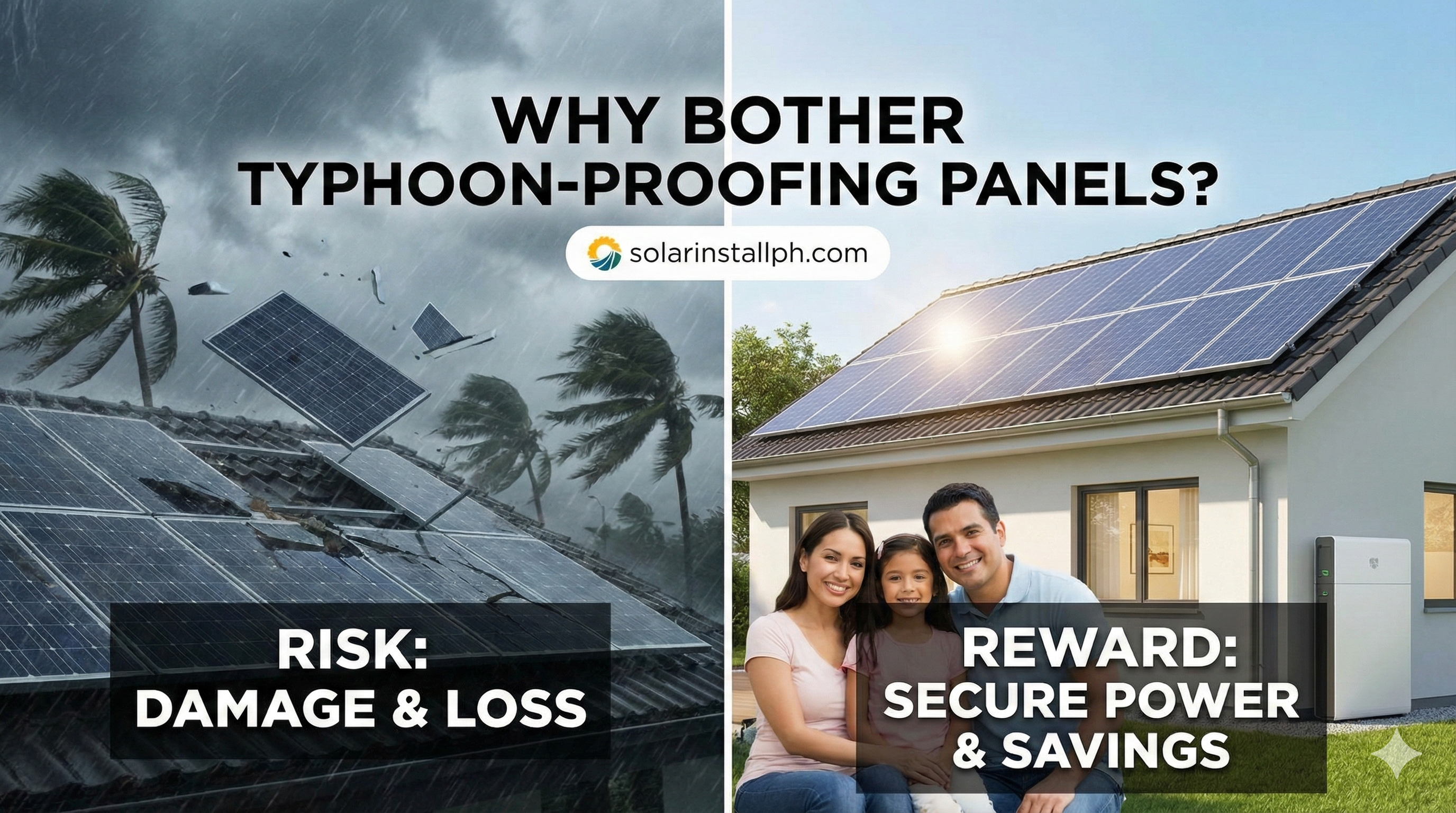
In the Philippines, buying solar is often an emotional rollercoaster. You feel the high of crushing your Meralco bill, followed immediately by the anxiety of the "ber" months. Every time PAGASA announces a Low Pressure Area (LPA) entering the Philippine Area of Responsibility, you find yourself looking up at your roof and wondering: “Is that thing going to fly?”
It is a valid fear. We live in the typhoon belt of the Pacific. We don’t just get rain; we get 250 kph wind gusts that can peel Galvanized Iron (GI) sheets off a house like a sardine can.
Yet, when we quote a "typhoon-proof" mounting system—which costs roughly 10–15% more than a standard setup—many homeowners hesitate. They ask, "Is it really necessary? My neighbor installed a standard kit, and it’s fine."
The answer is blunt: Your neighbor is lucky, not safe. In the high-stakes environment of Philippine solar, "standard" is often a synonym for "temporary." Here is why you should bother paying the premium for typhoon-proofing, and why it is the only way to protect your ROI.
1. The "Standard" Rating vs. Philippine Reality
Most generic solar mounting kits sold in the Philippines are imported with a standard wind load rating of 2400 Pascals (Pa). In plain English, this means the system is tested to withstand wind speeds of roughly 130 to 140 kph.
That sounds decent, right? It covers Signal No. 1 and Signal No. 2.
But the Philippines regularly experiences Signal No. 4 and No. 5 typhoons. Super Typhoon Odette (2021) and Super Typhoon Egay (2023) brought gusts exceeding 240 to 280 kph. At those speeds, the wind pressure on your panels jumps exponentially, often exceeding 5400 Pascals.
The "Sail Effect"
Solar panels are not painted onto your roof; they are mounted on rails with a gap underneath for airflow. During a typhoon, wind rushes into that gap, creating a massive uplift force. It tries to rip the panel up, not push it down.
Standard Install: Uses 4 clamps per panel on two rails. At 250 kph, the panel frame can flex, causing the glass to shatter, or the clamps can simply shear off.
Typhoon-Proof Install: Uses a 5400 Pa rated setup. This often involves a third rail (or shared rail matrix) and 6 clamps per panel to distribute the tension.
If you stick to the minimum standard, you are essentially gambling that a super typhoon won’t hit your specific barangay for the next 25 years. That is a bad bet. For a deeper look at the physics of wind loads, read our breakdown of typhoon-resistant mounting strategies.
2. The Cost of "Buying Twice"
There is a saying in construction: "If you think a professional is expensive, wait until you hire an amateur." The same applies to solar hardware.
Let’s look at the math for a typical 5kW residential system (approx. ₱300,000 value).
Standard Mounting Kit: ~₱20,000.
Typhoon-Rated Upgrade: ~₱35,000.
Difference: ₱15,000.
You are saving ₱15,000 upfront. But if a typhoon hits and you lose just two panels, the replacement cost—including labor, shipping, and the hassle of finding matching wattage—will easily exceed ₱25,000.
If the wind rips the entire array off, you aren't just replacing the solar system. You are likely replacing your roof, your gutters, and paying for the damage your flying panels caused to your neighbor’s car.
Typhoon-proofing is not an aesthetic upgrade; it is an insurance policy you pay once. It transforms your solar array from a fragile accessory into a structural asset. To understand how these costs fit into the bigger picture, review our guide on residential solar pricing.
3. Insurance Is Not a Magic Wand
"I don't need to over-engineer it; I have insurance."
This is a common objection. While we strongly advocate for insuring your system, relying on it as your only defense is a mistake. Insurance in the Philippines has friction.
The Deductible Reality
Most property insurance policies for "Acts of Nature" (Typhoon/Flood) carry a 2% deductible based on the total sum insured.
If your system is insured for ₱400,000, your deductible is ₱8,000.
If a storm damages a few clamps or cracks one panel, the repair cost might be below your deductible. You pay out of pocket.
The Claims Purgatory
After a major typhoon, insurance adjusters are swamped. It can take 3 to 6 months to process a claim and get paid. During that time, your system is offline. You are back to paying full price to Meralco.
Lost Savings: If your 5kW system saves you ₱8,000 a month, being offline for 4 months costs you ₱32,000.
That loss alone is double the cost of the typhoon-proofing upgrade you skipped. Insurance is for catastrophic total loss; engineering is for business continuity. Learn more about the nuances of policies in our solar home insurance guide.
4. Preventing "Micro-Cracks" (The Silent Killer)
Damage isn't always dramatic. Sometimes, the panels don't fly off the roof. They stay attached, and you think you survived unscathed.
However, standard mounting systems allow panels to flex and vibrate violently during high winds. This flexing causes micro-cracks in the silicon cells inside the glass laminate. You can't see them with the naked eye, but they sever the electrical pathways.
Six months later, you notice your production has dropped by 20%. The cracks have widened into "hot spots," creating burn marks on the backsheet and potentially risking a fire.
Typhoon-Proofing Fix: We use rigid mounting (thicker rails, more attachment points) to stiffen the array. This prevents the "wobble" that kills panels from the inside out.
Using high-quality panels helps, but even the best panel will crack if the mounting allows it to dance in the wind. Check our list of durable solar panel brands that feature reinforced frames.
5. Protecting Your Roof Structure
Solar panels are heavy (20–25kg each). A 5kW array adds nearly 250kg to your roof. When you add wind lift to that weight, you are stressing your roof trusses in ways they weren't designed for.
A proper typhoon-proofing service doesn't just look at the solar clips; it looks at the purlins and trusses underneath.
The Upgrade: We often install "L-feet" that drill directly into the structural truss, not just the thin GI sheet. In some cases, we add extra blocking (wood or steel) to reinforce the roof skeleton.
The Risk: If you bolt a strong solar system to a weak roof, the wind won't take the panels; it will take the roof with the panels attached.
This structural assessment is often skipped by budget installers who quote low to win the job. They use "umbrella nails" or rivets that pull out easily.
6. Energy Security When You Need It Most
The days following a super typhoon are dark. The grid is down. Gas stations have lines for kilometers. ATM machines are offline.
This is the moment your solar system should shine. If you have a hybrid setup with batteries, you become an energy oasis. You can power your fridge, charge your family’s phones, and keep the lights on.
But you can only do that if your panels are still on the roof.
If your system was destroyed because you saved ₱15,000 on mounting, you are sitting in the dark with everyone else, staring at a pile of broken glass in your yard. The value of having power immediately after a disaster—when utility crews might not reach you for weeks—is incalculable. It is about safety, communication, and comfort.
To ensure your system is ready for this role, regular check-ups are vital. Review our solar panel maintenance guide for pre-typhoon checklists.
Conclusion: Peace of Mind Has a Price
Typhoon-proofing is not a marketing gimmick. It is an acknowledgment of the Philippine environment. We live in a country where nature is hostile to infrastructure.
When you look at a solar quotation, do not just look at the Price Per Watt. Look at the Price Per Typhoon.
Does the quote include 6005-T5 aluminum rails?
Does it specify 5400 Pa wind load ratings?
Does the installer offer a workmanship warranty that explicitly covers mounting integrity?
Spending the extra 10% today means you sleep through the storm tomorrow, knowing your investment is secure. In the long run, the cheapest system is the one you only have to buy once.