
Ready for Wattage: 10 Residential Permit Tips
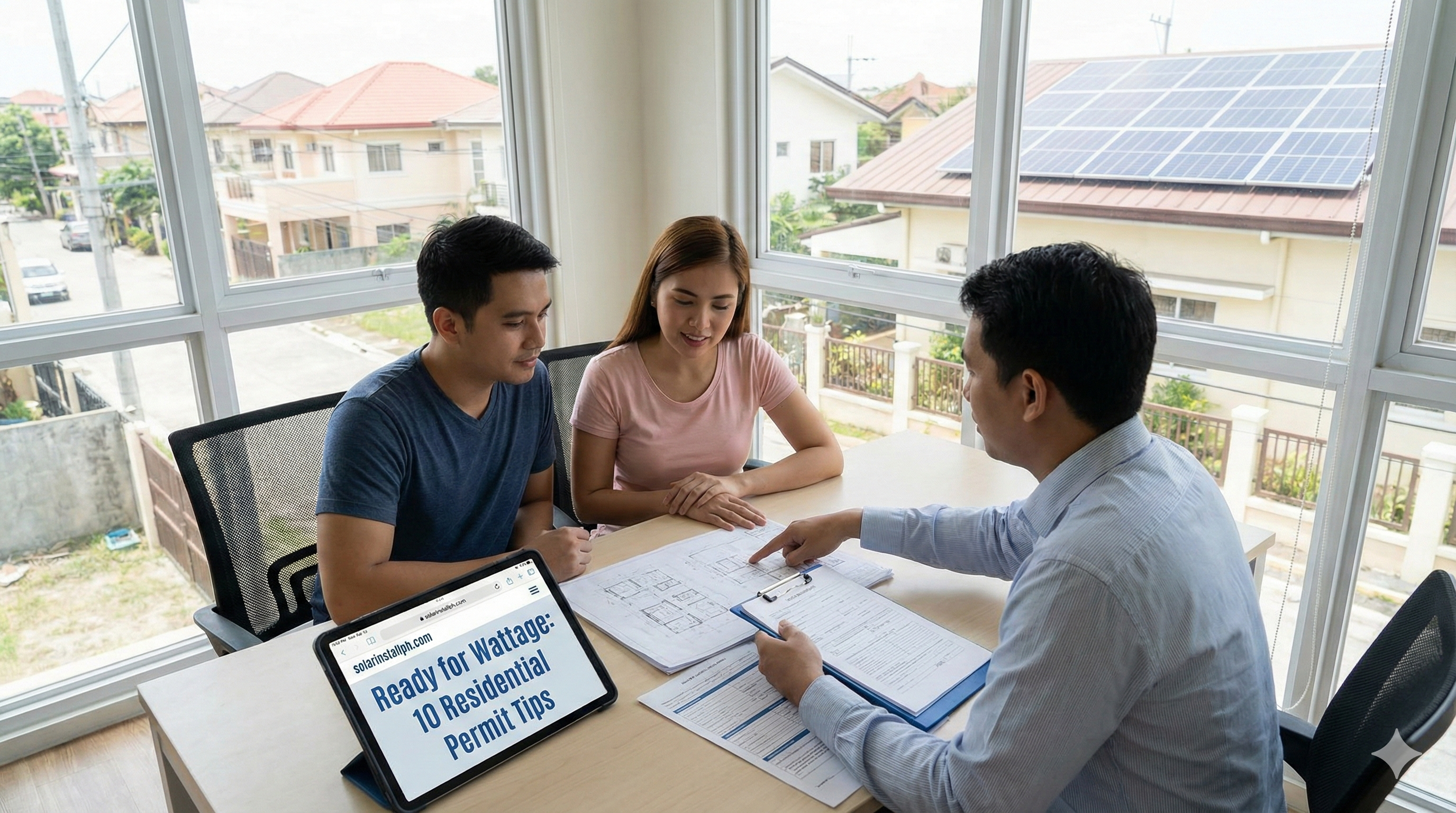
You’ve picked your panels. You’ve chosen an inverter. You’re ready to save thousands on your Meralco bill.
But before you flip the switch, you face the final boss of Philippine solar: The Permitting Process.
In the Philippines, installing a "grid-tie" solar system is not just a home improvement project; it is technically a power plant construction project. Whether you are in Metro Manila or a province served by an Electric Cooperative (EC), you are connecting a generator to the national grid.
This means paperwork. Lots of it.
Many homeowners are tempted to skip this step ("colorum" solar), but the risks—fire, disconnection, and voided insurance—are real. To help you navigate the bureaucracy without losing your mind, here are 10 insider tips for securing your residential solar permits in 2025.
1. The "Yellow Card" Dance
If you are in Meralco territory, you will hear about the "Yellow Card." This is often the source of the biggest confusion.
Here is the catch-22: The LGU (City Hall) often won’t give you a Certificate of Final Electrical Inspection (CFEI) until they see a Meralco approval. But Meralco won't give you final approval until they see the CFEI.
The Fix: Meralco issues a preliminary technical document (often called the "Yellow Card" or a technical evaluation form) after their initial site check. You take this specific document to your City Hall's Office of the Building Official (OBO) to prove that Meralco is aware of your project. Only then will the LGU release the CFEI, which you then bring back to Meralco.
2. "Zero Export" Still Needs a Permit
A common myth is: "I'm not selling power back to the utility, I'm just using it myself. So I don't need a permit, right?"
Wrong.
Even if you install a "Zero Export" device to prevent excess power from flowing to the grid, your system is still physically connected to their lines. If the grid goes down (brownout) and your inverter doesn't disconnect properly, you could electrocute a lineman fixing the wires nearby.
Utilities require all grid-connected systems to be registered and tested for "Anti-Islanding" safety, regardless of whether you export power or not. Read more about the nuances in our Zero Export overview.
3. The Barangay Clearance Comes First
Before you go to City Hall or the Utility, start locally. Most LGUs require a Barangay Clearance specifically for "Solar Installation" or "Renovation."
Some strict subdivisions (HOAs) also have their own aesthetic guidelines regarding reflective glare or roof visibility. Tip: Secure your HOA and Barangay clearances first. If your neighbor complains about glare after you install, the Barangay can legally force you to take the panels down.
4. You Cannot DIY the Electrical Plan
You might be an engineer, but unless you are a Professional Electrical Engineer (PEE) with a valid PRC license, you cannot sign your own plans.
Meralco and OBOs require a signed and sealed electrical plan that includes:
Single Line Diagram (SLD)
Load Schedule
Short Circuit Analysis
Don't try to draw this on a napkin. Most reputable installers include the PEE fees in their "turnkey" packages. If you are DIY-ing the install, be prepared to pay a PEE separately (usually ₱5,000–₱15,000 depending on complexity) just for the signature.
5. Prepare for the "Bill Deposit" Update
When you apply for Net Metering, the utility treats it as a "modification of service." This triggers a review of your account.
If your original electric meter was installed in 1995, your "Bill Deposit" (the security deposit you paid when you first connected) is likely based on 1995 rates. The utility will update this deposit to match your current average monthly consumption.
Warning: This can result in a sudden one-time charge of ₱10,000 to ₱30,000 on your next bill. This isn't a fee for solar; it's a deposit update that was overdue.
6. The Timeline is Not "Instant"
Filipino time applies to permitting.
Optimistic: 3 months
Realistic: 4–6 months
Pessimistic: 9+ months (common in areas with complex LGU requirements)
While you wait, you cannot legally turn on your system to export power. Some installers will leave the system in "Zero Export" mode while the permit is processing, but technically, even this requires a provisional approval. For a detailed breakdown of the steps, check our guide to the rooftop solar permitting process.
7. The Two-Meter Setup
Net Metering doesn't just mean "the meter spins backward." In the Philippines, it usually involves installing two meters:
Bi-directional Meter: Replaces your main meter. It counts Import (what you buy) and Export (what you sell).
REC Meter (Renewable Energy Certificate): A second meter usually placed near your inverter. It measures the total solar generation of your system.
You pay for the wiring and meter socket for this second meter. Ensure your installer leaves space on your wall for it!
8. Hiring a "Liaison" is Worth It
If you have a day job, do not try to process these permits yourself. You will spend days queuing at City Hall, only to be told the signatory is at a seminar.
Most turnkey solar installers have a dedicated "Liaison Officer." Their sole job is to sit at City Hall and wait for signatures. If your installer offers a "Permitting Package" for an extra ₱15,000–₱25,000, take it. The cost of your time (and frustration) is much higher.
9. Skipping Permits Voids Insurance
This is the scary part. If your house catches fire—even if the fire had nothing to do with the solar panels—your home insurance provider can deny your claim if they find an unpermitted electrical modification.
An unpermitted solar system is technically an "illegal connection." Don't risk your entire home equity to save a few months of paperwork. For a deeper dive into the risks, read our article on skipping LGU permits.
10. Understanding the "Distribution Impact Study" (DIS)
The DIS is a technical simulation the utility performs to see if their local transformer can handle your extra power.
If you are the first person in your barangay to get solar, you will pass easily.
If 20 of your neighbors already have solar, the local transformer might be "saturated."
In rare cases, the utility might require you to pay for a transformer upgrade (Asset Study) before you can connect. This is why applying early matters. You want to lock in your slot on the local transformer before your neighbors do.
Conclusion
Permitting is the least sexy part of solar, but it is the foundation of a safe, legal, and profitable system. A Net Metering agreement is the only way to get paid for the excess energy you produce. Without it, you are throwing free money away every time the sun shines while you are at work.
Next Steps
If you are still in the planning phase, ask your prospective installer one question: "Who handles the LGU and Meralco processing, and is the cost included in your quote?"
If they say "we let the homeowner handle that," walk away. You want a partner, not a box-pusher.
For more details on how to maximize your system once you are approved, read our full Meralco Net Metering guide.