
Sun Power: Island Nation Opportunities & Hurdles
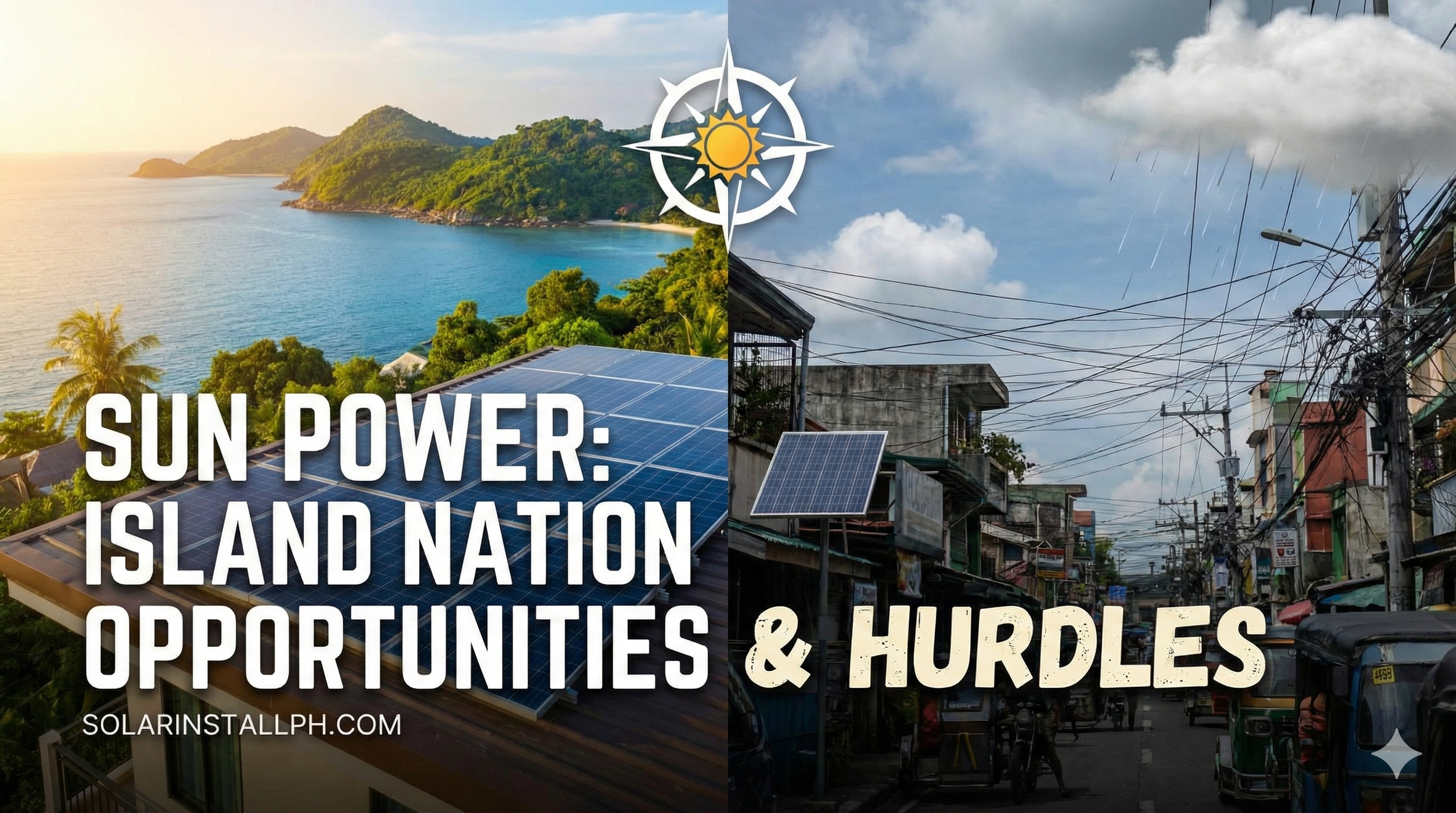
The Philippines is currently navigating one of the most aggressive energy transitions in Southeast Asia. For a country defined by high electricity rates and an archipelago of isolated grids, solar energy is no longer a luxury for the eco-conscious. It has become a financial necessity. However, scaling solar across 7,641 islands presents a unique set of technical and regulatory challenges that differ significantly from continental markets.
The Philippine Solar Reality in 2025
The economic driver for solar in the Philippines is simple: we have some of the highest power rates in the region, often exceeding ₱12 per kilowatt-hour for residential consumers. Combined with a tropical location that provides ample irradiance, the math for rooftop solar has never been more compelling. Most well-designed systems now see a realistic solar payback period of four to seven years, depending on the daytime load and the efficiency of the installation.
While the opportunity is vast, the hurdles are equally significant. We are dealing with a fragmented grid, frequent typhoons, and a complex permitting landscape that can vary from one local government unit (LGU) to another. To succeed with solar here, you have to look beyond the marketing and understand the structural realities of the Philippine market.
High Electricity Prices as a Catalyst
The primary motivation for most Filipino homeowners and businesses is cost reduction. Unlike other countries where subsidies drive adoption, the Philippine market is driven by "grid parity." This means the cost of generating your own solar power is now significantly lower than buying it from a distribution utility like Meralco or a local electric cooperative.
The Impact of RA 9513
The Renewable Energy Act of 2008 (RA 9513) remains the bedrock of the industry. It established the frameworks we use today, such as Net Metering, which allows participants to sell excess electricity back to the grid in exchange for bill credits. This policy has been instrumental in making residential solar adoption a viable financial investment rather than just a hobby.
Net Metering vs. Zero Export
For many, Net Metering is the gold standard. However, the application process can be lengthy, involving inspections from both the distribution utility and the Energy Regulatory Commission (ERC). Because of these hurdles, many installers now opt for "Zero Export" systems. These use smart meters to ensure no power flows back to the grid, avoiding the need for a Certificate of Compliance (COC) from the ERC, though this means you lose the ability to earn credits for excess generation.
Technical Hurdles in an Archipelago
The Philippines is not a single market but a collection of micro-markets. What works in Metro Manila might not be feasible in a remote part of Palawan or Sulu.
Grid Stability and Interconnectivity
In the main Luzon grid, solar can be easily integrated. However, on smaller islands, the grid is often powered by expensive diesel gen-sets. While solar can drastically reduce diesel consumption, these small grids are sensitive to "intermittency." If a cloud passes over a large solar array, the sudden drop in power can cause frequency drops and blackouts. This is why many island-based projects are now requiring integrated battery storage to smooth out the supply.
The Typhoon Factor
Any solar installation in the Philippines must be built to withstand the "Big One." We are hit by roughly 20 typhoons a year. A system that isn't engineered for high wind loads will not survive its 25-year expected lifespan. This involves more than just tightening bolts; it requires specific typhoon-resistant mounting solutions that account for roof type and orientation. Using substandard rails or failing to use enough roof attachments is a common mistake that leads to catastrophic failure during the typhoon season.
Navigating the Regulatory Landscape
One of the biggest hurdles for the average consumer is the "paperwork wall." Even if you have the funds to install a system, getting it legally connected to the grid is a multi-step process.
LGU Permits: You typically need a Building Permit and an Electrical Permit from your local City or Municipal Engineering Office.
Distribution Utility (DU) Approval: If you are in Metro Manila, Meralco has a specific process for Net Metering. This involves a distribution impact study to ensure your system won't mess up the local transformer.
ERC Certification: To officially get credits for your power, you need a COC.
Many fly-by-night installers skip these steps to lower their quotes. This puts the homeowner at risk of legal issues or, worse, having their power cut off by the utility for "back-feeding" without a permit. It is critical to verify installer credentials before signing any contracts to ensure they handle the permitting process correctly.
Opportunities for Small and Medium Enterprises (SMEs)
While residential solar is booming, the SME sector is where the most significant "island nation" opportunities lie. Cold storage facilities, rice mills, and small factories are plagued by high operating costs. For these businesses, a 50kW to 100kW rooftop system can be the difference between profit and loss.
The government has also introduced the Green Energy Option Program (GEOP). This allows large consumers (those with a monthly peak demand of 100kW and above) to choose their own renewable energy supplier instead of being forced to buy from their local franchise utility. This is a massive opportunity for businesses to lock in lower energy rates for the long term.
The Role of Technology: Inverters and Batteries
The hardware choice in the Philippines is often dictated by the reliability of the local grid.
Grid-Tied Systems: These are the most common in urban areas. They are cheap and efficient but they shut down during a brownout for safety reasons.
Hybrid Systems: These are becoming the standard for high-end residential and island resorts. They use batteries to provide backup power during outages. Understanding the difference between lead-acid and lithium batteries is vital here; while lead-acid is cheaper upfront, lithium-ion (specifically LiFePO4) is the only technology that truly survives the heat and deep-cycling requirements of the Philippine climate.
Off-Grid Systems: These are the only option for remote areas. They require careful sizing to ensure the lights don't go out after three days of rain.
Common Pitfalls and How to Avoid Them
The influx of demand has led to an influx of low-quality components and inexperienced labor. To avoid becoming a cautionary tale, watch out for these red flags:
Undersized Wiring and Poor DC Management
In the Philippines, heat is a constant. If an installer uses standard AC wires for DC solar runs, or fails to use proper conduits, the insulation will degrade rapidly. This is a leading cause of solar-related fires. Always ensure your installer uses dedicated solar cables and high-quality breakers.
Lack of Shading Analysis
Even a small shadow from a vent pipe or a nearby tree can significantly drop the output of a traditional string inverter system. In cramped urban areas like Quezon City or Cebu, a proper shading analysis is non-negotiable.
Warranty Ghosts
Many brands enter the Philippine market and vanish two years later. A "25-year warranty" is useless if the manufacturer has no local office or authorized service center to handle claims. Stick to Tier 1 brands that have a proven track record and local distribution partners.
The Future: Decentralized Energy
As we move toward 2030, the "Island Nation" hurdle will become its greatest opportunity. Microgrids—small, localized grids that combine solar, batteries, and backup generators—are the future for our provinces. We are seeing more "solar for social" initiatives where entire barangays are powered by a central solar array, reducing dependence on the national government's "missionary electrification" subsidies.
For the individual Filipino, the goal is "Energy Sovereignty." By generating your own power, you insulate yourself from the volatile prices of imported coal and gas.
Frequently Asked Questions
Is solar worth it if I have a small roof?
Yes, but you have to be more strategic. Higher efficiency panels (like N-Type or Bifacial) can generate more power in a smaller footprint. It’s about maximizing the "yield per square meter" rather than just looking at the total number of panels.
Do I still have to pay a monthly bill to Meralco?
If you are grid-tied, yes. You will still have a fixed monthly charge (system loss, metering charge, etc.). However, with a properly sized system and Net Metering, your consumption charge can effectively drop to zero, or you can even build up credits during the summer months to offset your bills during the rainy season.
What happens to the panels during a super typhoon?
If the mounting system is engineered correctly, the panels should stay attached. Most Tier 1 panels are rated for wind pressures of 2400 to 5400 Pascals. The weakness is usually not the panel itself, but the way the rails are anchored to your roof structure. Professional installers will use additional "feet" or attachments to distribute the load.
Conclusion
The Philippines is at a tipping point. The opportunities for solar to solve our energy crisis are immense, but they are gated by the need for technical rigor and a clear-eyed understanding of our local constraints. Whether you are a homeowner in Manila or a resort owner in Siargao, the path to solar success involves choosing quality hardware, insisting on legal permitting, and hiring installers who understand that in this country, the wind is just as important as the sun.