
Commercial PV Install: Maximize Savings
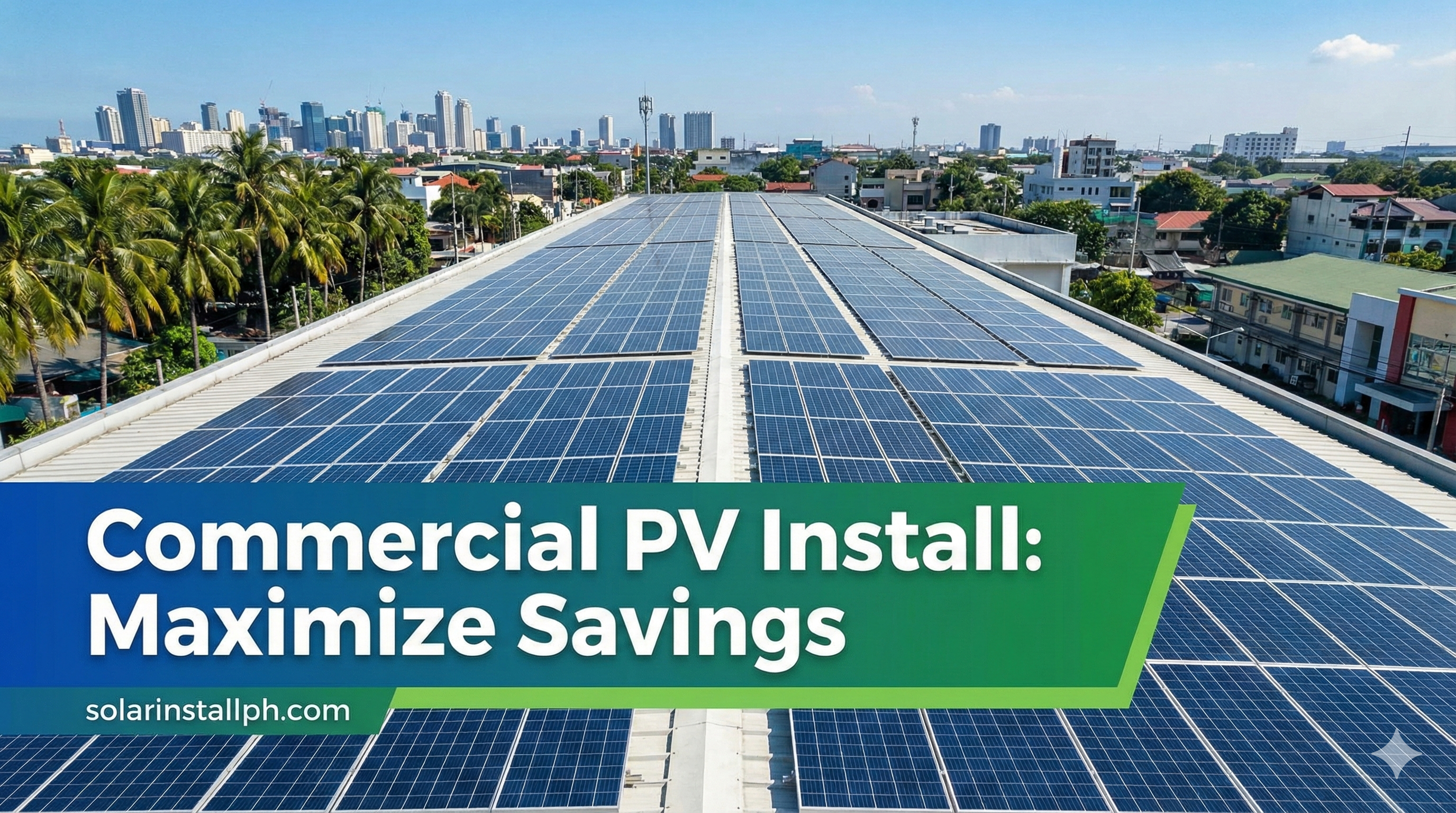
Running a business in the Philippines often feels like you are working just to pay Meralco. Whether you operate a manufacturing plant in Cavite, a BPO in Ortigas, or a cold storage facility in Davao, electricity is likely your second or third largest operating expense.
With commercial rates fluctuating wildly and the generation charge hitting new highs in 2025 due to fuel costs and currency depreciation, the old strategy of "just pay the bill" is no longer viable. It is a hemorrhage of capital.
For commercial entities, a Photovoltaic (PV) installation is not a CSR stunt or a "green initiative" for the annual report. It is a defensive financial instrument. It is a way to pre-purchase your next 25 years of electricity at a fraction of the current market rate.
However, commercial solar is not as simple as slapping panels on a warehouse roof. To truly maximize savings, you need to navigate a complex matrix of load profiling, tax incentives, and grid policies. Here is the practitioner’s guide to squeezing every peso out of your commercial PV install.
The New Math of Commercial Power
To understand the savings, you have to look at the "Levelized Cost of Energy" (LCOE).
If you buy power from the grid today, you are paying anywhere from ₱11.00 to ₱14.00 per kWh, depending on your voltage level and location. This rate is variable, inflationary, and exposed to foreign exchange risks.
When you install a commercial solar system, you are locking in a fixed cost. Based on current turnkey prices for commercial systems (roughly ₱35,000 to ₱45,000 per kWp depending on size), your LCOE over 25 years is approximately ₱3.50 to ₱4.50 per kWh.
The Delta: You are saving roughly ₱7.00 to ₱9.00 on every kilowatt-hour you generate and consume.
The Scale: For a facility consuming 50,000 kWh a month, offsetting just 50% of that usage translates to ₱175,000 to ₱225,000 in monthly savings. That is ₱2.1M to ₱2.7M annually—direct to your bottom line.
To get a more granular look at pricing tiers for different system sizes, review our breakdown of commercial solar costs.
1. Match the "Generation Curve" to the "Load Curve"
The biggest mistake we see in commercial solar is oversizing. In residential setups, we often rely on Net Metering to sell excess power. In commercial setups (especially those above 100kW), exporting power can be administratively complex.
The goal for maximum ROI is 100% Self-Consumption.
The "Daytime Operations" Advantage
If your business operates 8:00 AM to 5:00 PM (like an office or a garment factory), your consumption profile matches the sun almost perfectly.
Strategy: Size the system so that its peak production (at noon) is slightly below your base load.
Result: You consume every electron you produce. You never export to the grid. You replace the most expensive "Peak" power with your own cheap solar power.
The "24/7 Operations" Challenge
If you are a cold storage or a 24-hour call center, your load is flat.
Strategy: Solar will only attack your daytime load. You will still need grid power at night.
Optimization: This is where the Peak / Off-Peak (POP) program comes in (see below).
2. Leverage Meralco’s Peak / Off-Peak (POP) Program
Many business owners don't realize they can combine Solar with the grid's time-of-use rates for a "double discount."
Meralco and other large DUs offer POP rates where electricity is significantly cheaper at night (Off-Peak) and expensive during the day (Peak).
Peak Hours: 8:00 AM to 9:00 PM (Mondays to Saturdays).
Off-Peak Hours: 9:00 PM to 8:00 AM, and Sundays.
The Hybrid Financial Model
Install Solar: Use your PV system to massacre the "Peak" charges during the day (8 AM to 4 PM).
Switch to POP: Use the grid for the "Off-Peak" hours (9 PM to 8 AM) when rates can be as low as ₱3.55/kWh (generation charge).
By combining these two, you avoid paying the high grid rates during the day (using solar) and avoid paying the high cost of solar batteries for the night (using cheap grid power).
3. The 100kW Threshold: GEOP vs. Solar
If your facility has an average peak demand of 100kW or more, you have a powerful card to play: The Green Energy Option Program (GEOP).
This program allows you to fire your local Distribution Utility (as a supplier) and buy power directly from a Renewable Energy Supplier (RES) at a negotiated rate.
The Dilemma: Build or Buy?
Should you build a rooftop solar plant or just switch to GEOP?
The Hybrid Approach: Do both.
Why: Even with a GEOP contract, you still pay "wheeling charges" (transmission and distribution fees) to Meralco/DU for every kWh you import.
The Fix: Install a rooftop system to cover your daytime baseload (avoiding wheeling charges entirely for that portion). Use your GEOP contract to supply the remaining power and nighttime load at a lower, green rate.
This requires careful contract negotiation. For details on eligibility, consult our guide to the GEOP program.
4. Claim Your VAT Exemption (The 12% Grant)
In the Philippines, there are no direct cash grants, but there is a massive tax break that acts like one. Under the Renewable Energy Act and recent BIR clarifications, the sale of RE equipment and services by accredited suppliers is VAT Zero-Rated.
For a ₱5 Million commercial project, 12% VAT is ₱600,000. That is a significant chunk of capital.
How to Ensure You Get It
BOI Registration: Your installer/supplier must be registered with the Board of Investments (BOI).
Direct Billing: The invoice must clearly state zero-rated sales.
The Catch: If you buy from a non-accredited "importer" or a general contractor, they will charge you VAT, and you cannot claim it back easily.
Always verify your installer’s accreditation status. We explain the mechanics of this in our article on VAT zero-rating for RE.
5. The "Passive Cooling" Bonus
This is a hidden saving that doesn't appear on the inverter screen but appears on your bill.
Most warehouses and factories in the Philippines use GI Sheet (yero) roofing. These roofs absorb heat like a frying pan, radiating it down into your workspace. This forces your air conditioning or refrigeration units to work harder.
The Solar Shield: Solar panels act as a second roof. They absorb the sun's heat before it hits your metal roof.
The Data: Studies and local experience show a 3°C to 5°C drop in ceiling temperature under the array.
The Saving: For air-conditioned warehouses (like logistics centers or pharma factories), this reduction in thermal heat gain can lower the HVAC load by 15–20%.
6. Financing: Capex vs. Opex
Many CFOs hesitate to drop ₱5M to ₱20M in cash. Fortunately, the Philippine financial market in 2025 has matured.
Option A: Green Financing (Capex)
Banks like BPI, BDO, and Security Bank now offer dedicated "Sustainable Energy Finance" loans.
Pros: You own the asset. You get the depreciation benefits (tax shield). You keep 100% of the savings.
Cons: It sits on your balance sheet.
Option B: Solar Leasing / PPA (Opex)
For larger roofs (usually 500kW+), you might qualify for a Power Purchase Agreement (PPA).
Mechanism: A third-party investor installs the system on your roof at zero cost to you. They sell you the power it generates at a discount to the Meralco rate (e.g., if Meralco is ₱12, they sell at ₱9).
Pros: No cash out. Instant savings. O&M is handled by the provider.
Cons: Lower total savings compared to ownership. Long-term contract (15-20 years).
If you are debating between using your own cash or borrowing, run the numbers using our solar ROI guide.
7. Operational Intelligence: Monitoring is Money
A commercial solar system is a power plant. You cannot just "set it and forget it."
If one string of panels goes down due to a blown fuse, or if a localized shadow from a new billboard cuts production by 20%, you need to know immediately.
Smart Inverters: Ensure your system comes with granular monitoring (per string or per optimizer).
The O&M Contract: Do not skimp on cleaning. In dusty industrial zones (like near cement plants or highways), dirty panels lose 15–25% efficiency. A quarterly cleaning schedule is mandatory to protect your ROI.
For a checklist on keeping your commercial asset performing, read about solar panel maintenance.
8. Permitting: The "Own Use" Path
One of the biggest friction points in PH solar is the permitting process (DU and LGU).
For commercial facilities, if you design the system as "Zero Export" (meaning you never send power back to the grid), the permitting process with the Distribution Utility is often simplified or expedited compared to a Net Metering application.
The Device: You install a Smart Meter and a limiter that tells the inverters to throttle down if production exceeds consumption.
The Benefit: Faster deployment. You can be up and running in months, not years.
The Risk: You must ensure the limiter is robust. If you backfeed the grid without a permit, you risk disconnection and penalties.
Conclusion
The business case for commercial solar in the Philippines is irrefutable. We have the highest rates and the best sunlight.
But maximizing savings requires precision. It’s about sizing for self-consumption, layering grid programs like POP and GEOP, leveraging tax incentives, and treating the system as a critical financial asset.
Your roof is currently a liability—it leaks, it absorbs heat, and it requires maintenance. Turn it into your most performing asset.