
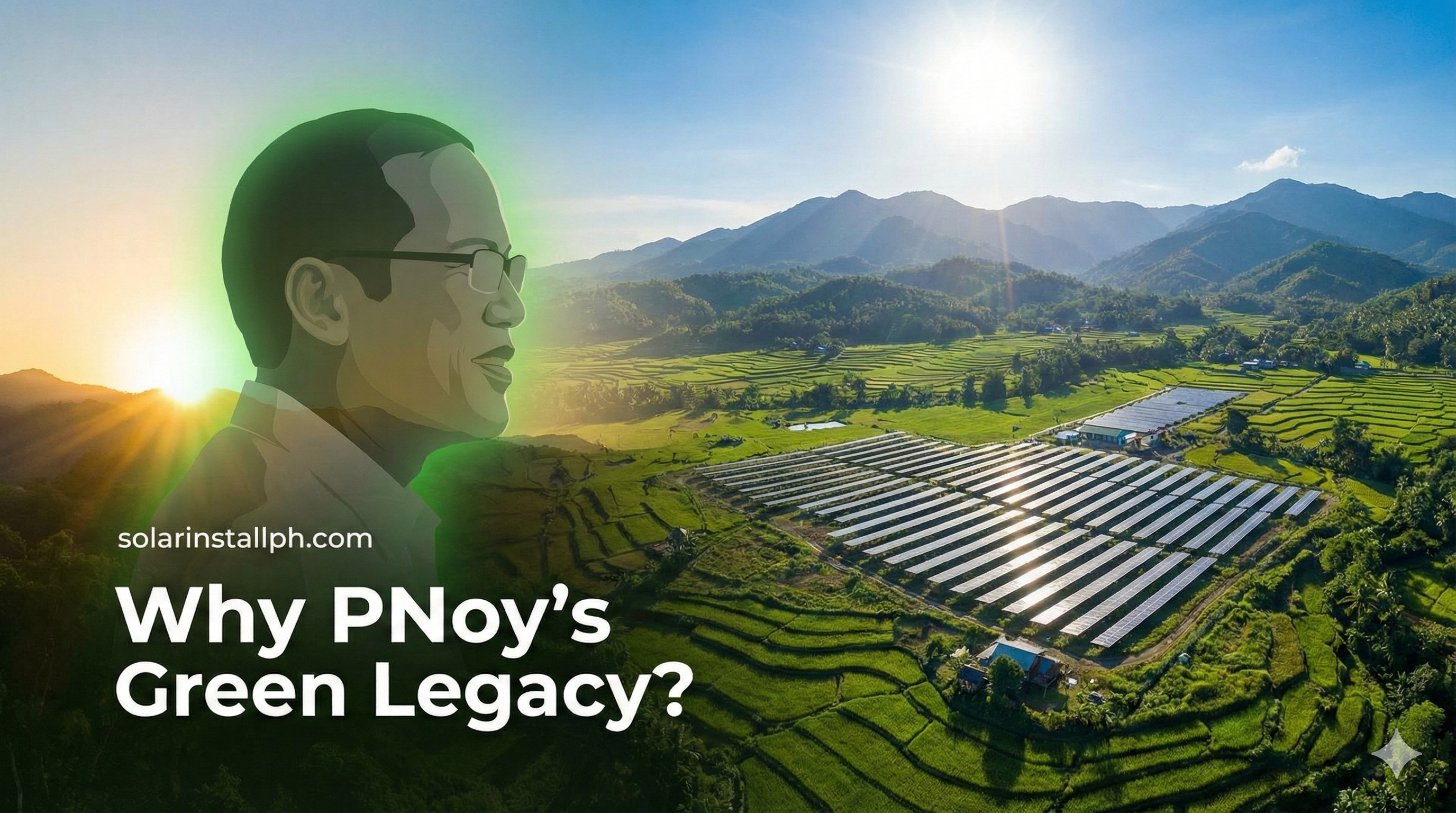
Why PNoy's Green Legacy?
The term "Green Legacy" is often associated with the administration of the late President Benigno "PNoy" Aquino III (2010–2016), a period that many energy experts and environmentalists identify as the true takeoff point for renewable energy in the Philippines. While the legal architecture for renewables was drafted just before his term, it was during the Aquino years that these abstract laws were transformed into operational solar farms, consumer-friendly net metering rules, and a long-term national roadmap.
For homeowners and business owners today, the "green legacy" of the 15th President isn't just a matter of history; it is the reason why installing solar panels is a viable, regulated, and financially sound decision in 2026.
The Foundation: Launching the NREP
In 2011, PNoy formally launched the National Renewable Energy Program (NREP). This was a massive undertaking that sought to triple the country’s renewable energy capacity to over 15,000 MW by 2030. Before this, solar was largely restricted to small-scale rural electrification projects. The NREP signaled to the world that the Philippines was open for large-scale, commercially financed clean energy investments.
One of the most significant shifts during this time was the focus on the solar payback factor. By creating a structured market for renewables, the administration helped drive down technology costs, making the transition from fossil fuels more attractive to the private sector.
Major Milestones: Making Solar History
PNoy’s term was marked by several "firsts" in the Philippine energy sector:
The First Large-Scale Solar Plant: In 2014, Aquino inaugurated the San Carlos Solar Energy Inc. (SaCaSol) in Negros Occidental. This 22 MW project was the country's first large-scale, government-commissioned solar power plant.
The 63.3 MW Calatagan Solar Farm: In March 2016, he led the switch-on ceremony for a massive solar farm in Batangas, which at the time was the largest established by a purely Filipino company.
The Feed-in Tariff (FIT) System: His administration implemented the FIT system, which provided guaranteed fixed rates for renewable energy developers. This policy was instrumental in luring billions of pesos in foreign and local investment into the Philippine grid.
These projects proved that the Philippine sun could do more than just power a few light bulbs; it could power entire industries.
Beyond Panels: Climate Resilience and Policy
The "Green Legacy" extended beyond energy production into environmental protection and climate diplomacy. PNoy was a vocal advocate for climate justice on the global stage, spearheading the Manila Call to Action on Climate Change in 2015 alongside French President François Hollande.
Domestically, the administration focused on building a safer, more transparent environment for sustainable development:
Project NOAH: Launched in 2012, this was the primary disaster risk reduction and management program, providing real-time weather data and hazard maps.
Republic Act 10174: This law created the People’s Survival Fund, allocating ₱1 billion annually for climate change adaptation projects in local communities.
Watershed Protection: Through Executive Order 206, the administration mandated the sustainable management of watersheds, recognizing that hydro and geothermal energy are dependent on these natural resources.
For modern solar adopters, these policies emphasize that a system must be built for resilience. Today, professional installers still prioritize high wind load solar designs to ensure that the infrastructure PNoy championed can survive the intensifying typhoons of the 2020s.
What This Means for You Today
If you are currently looking at rooftop solar permits or calculating your ROI, you are navigating a path blazed between 2010 and 2016. The standardization of the net metering application process and the involvement of agencies like the Department of Energy (DOE) as a "one-stop-shop" are direct evolutions of the "Daylight" strategy of transparency and efficiency from that era.
Moreover, the push for solar backup power has become a necessity as we strive to meet the ambitious energy mix targets first set out in the NREP.
FAQ
Did PNoy sign the Renewable Energy Act? No, RA 9513 was signed in late 2008 by his predecessor, but the Aquino administration was responsible for the crucial implementation, including the FIT system and the NREP.
What was the "Manila Call to Action"? It was a global appeal for nations to act swiftly against climate change, emphasizing the vulnerability of developing nations like the Philippines.
How did his administration help ordinary homeowners with solar? By institutionalizing net metering and encouraging DOE-accredited installers, the administration helped create a regulated market where homeowners could safely sell excess power back to the grid.
PNoy's Green Legacy is not just a collection of signed papers; it is the physical infrastructure and the policy confidence that continues to power the Philippines toward a sustainable future.