
7 Best: Farms' Typhoon Tech Gains
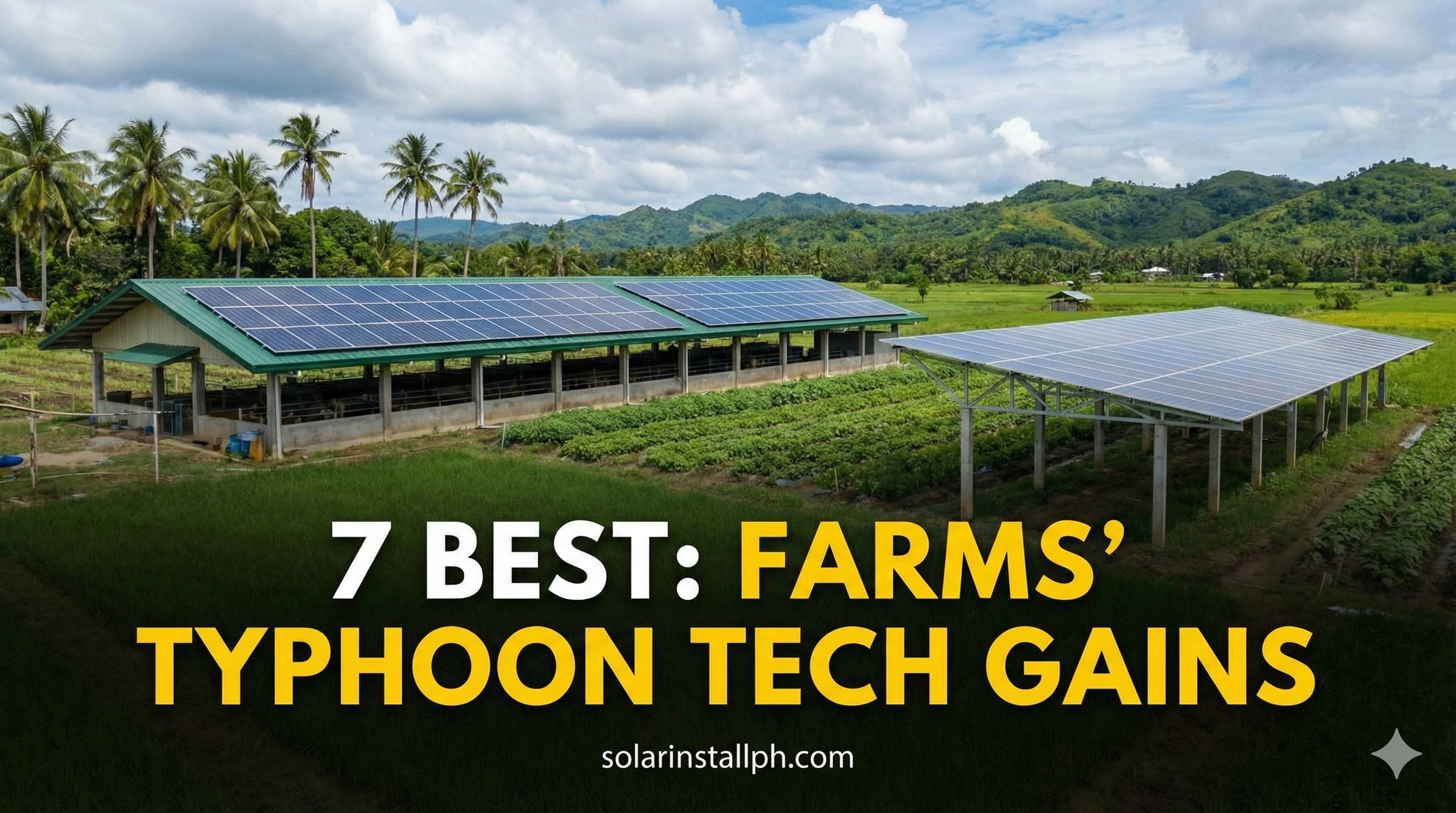
In the high-stakes world of utility-scale solar in the Philippines, the definition of "ROI" is shifting. It is no longer just Return on Investment; it is Return on Integrity.
After Super Typhoon Odette flattened ill-prepared solar farms in the Visayas in 2021, the industry woke up to a harsh reality: standard engineering does not survive Signal No. 4. The Philippines sits in the world's most active typhoon belt, and for solar farm developers, this means the battle is not against the sun—it’s against the wind.
Fortunately, the technology has evolved. We are seeing a shift from "preventing damage" to "intelligent survival." Here are the seven best technological gains that are helping Philippine solar farms stay standing when the 250 kph gusts hit.
1. The "Hail Stow" Tracker Strategy
For years, single-axis trackers (which follow the sun east to west) had a standard defensive posture called "flat stow." When the wind picked up, the panels would lay flat (0 degrees) to reduce drag.
The Failure: In the Philippines, flat stow proved disastrous. It created a phenomenon called dynamic galloping—the wind would catch the edge of the flat wing and rip it apart like a twisting bridge.
The Tech Gain: Modern farms are adopting High-Tilt Stow (often called Hail Stow or 75-degree Stow). Instead of laying flat, the panels lock at a steep angle (around 60°–75°). This forces the wind to flow over and under the array smoothly, pressing the structure firmly into the ground rather than lifting it. It stabilizes the torque tube and prevents the dreaded galloping effect.
2. Glass-Glass Bifacial Armor
The era of the plastic backsheet is ending for large-scale projects. In the past, panels had glass on the front and a polymer sheet on the back. During typhoons, flying debris (coconuts, branches, GI sheets) would puncture the backsheet, or the violent flexing would crack the silicon cells inside.
The Tech Gain: Developers are moving to Glass-Glass Bifacial Modules. These panels sandwich the solar cells between two layers of tempered glass.
Rigidity: The dual glass structure is far more rigid, reducing micro-cracking during heavy wind vibration.
Impact Resistance: The rear glass protects against projectiles hitting the back of the array.
Bonus: They generate power from the rear side (albedo), which is perfect for the white gravel often used in substations.
For a deeper look at why this technology is becoming the standard, read our guide on bifacial dual-glass modules.
3. Elastic Mooring for Floating Solar
Floating solar (floatovoltaics) is booming in Laguna de Bay and reservoirs in Cebu. However, water surfaces are not static. During a typhoon, waves can reach 2–3 meters, snapping rigid anchors and causing islands of panels to collide.
The Tech Gain: The new standard is Elastic Mooring Systems. Instead of rigid chains, these systems use heavy-duty elastic hawsers (similar to bungee cords for ships) that allow the solar island to rise and fall with the waves and drift slightly with the wind load without snapping.
Example: The floating solar project in the Malubog Reservoir utilizes an anchoring design specifically engineered to absorb wave energy rather than fight it.
Investors looking at water-based assets should review the specific risks involved in floating solar farms.
4. Digital Twins and Predictive Stow
In the past, a site manager had to manually hit the "emergency stop" button based on a text from PAGASA. Often, it was too late.
The Tech Gain: Tier 1 farms now utilize Digital Twins. This is a virtual replica of the solar farm running in the cloud.
How it works: Sensors on the farm feed real-time wind speed and direction data to the Digital Twin. The AI simulates the approaching storm front and calculates the exact moment to trigger "stow mode" for each block of the farm.
Benefit: It allows the farm to stay online longer (harvesting energy) and stow safely minutes before the critical wind speeds arrive, removing human error from the equation.
This level of sophistication is part of the new wave of advanced maintenance protocols required for modern assets.
5. Super-Coated Steel (Mg-Al-Zn)
Galvanized steel (zinc coating) has been the industry standard for mounting structures. However, in the Philippines, typhoons often bring salt spray tens of kilometers inland. Standard galvanization corrodes in 5–7 years, weakening the structure right before the next storm hits.
The Tech Gain: The shift to Magnesium-Aluminum-Zinc (Mg-Al-Zn) coatings (often branded as SuperDyma or ZAM).
Self-Healing: This alloy is "self-healing." If a scratch occurs during installation, the chemical composition migrates to cover the exposed steel, preventing rust.
Typhoon Durability: It is 5 to 10 times more resistant to salt corrosion than hot-dip galvanization. This ensures that the bolts and rails holding the panels are just as strong in Year 15 as they were in Year 1.
6. Aerodynamic Agrivoltaics
As the Philippines experiments with Agrivoltaics (farming crops under solar panels), wind load becomes tricky. Raising panels higher to allow tractors underneath creates a massive sail effect.
The Tech Gain: Porosity-Optimized Racking. Engineers are now using wind tunnel simulations to design racking systems with intentional "gaps" and specific tilt angles that allow wind to bleed through the array rather than hitting it like a solid wall.
Application: In projects like the new agrivoltaic site in Batangas, the spacing is calculated not just for sunlight for the crops, but to reduce the "drag coefficient" of the entire field.
This engineering ensures that investment in resilient infrastructure protects both the energy asset and the agricultural yield.
7. Independent Power for Control Systems
One of the ironies of solar farms is that they often lose internal power during a storm. If the grid goes down (blackout) and the farm disconnects, the tracker motors lose power. If they lose power, they cannot "stow" into the safety position.
The Tech Gain: Decentralized Battery Backups.
Instead of relying on grid power to move the trackers, modern systems equip every tracker row (or block) with its own small battery and solar panel.
Survival Mode: Even if Meralco's lines are down and the main substation is offline, the trackers have enough independent juice to move into the 75-degree safety position and stay there for days until the storm passes.
Conclusion
The "typhoon tax" on Philippine solar farms is real. It costs more to build here than in sunny, windless deserts. However, these seven technological gains are proving that the cost is worth it. By spending 10% more on elastic mooring, glass-glass modules, or Mg-Al-Zn steel, developers are saving 100% of their asset from destruction.
For developers and EPCs, the message is clear: You cannot fight the Philippine wind with brute force alone. You have to outsmart it.
Planning a large-scale project? Ensure your EPC understands these requirements by reviewing our guide on typhoon-resistant mounting structures.