
Cut Business Electric Bills: 10 Ways
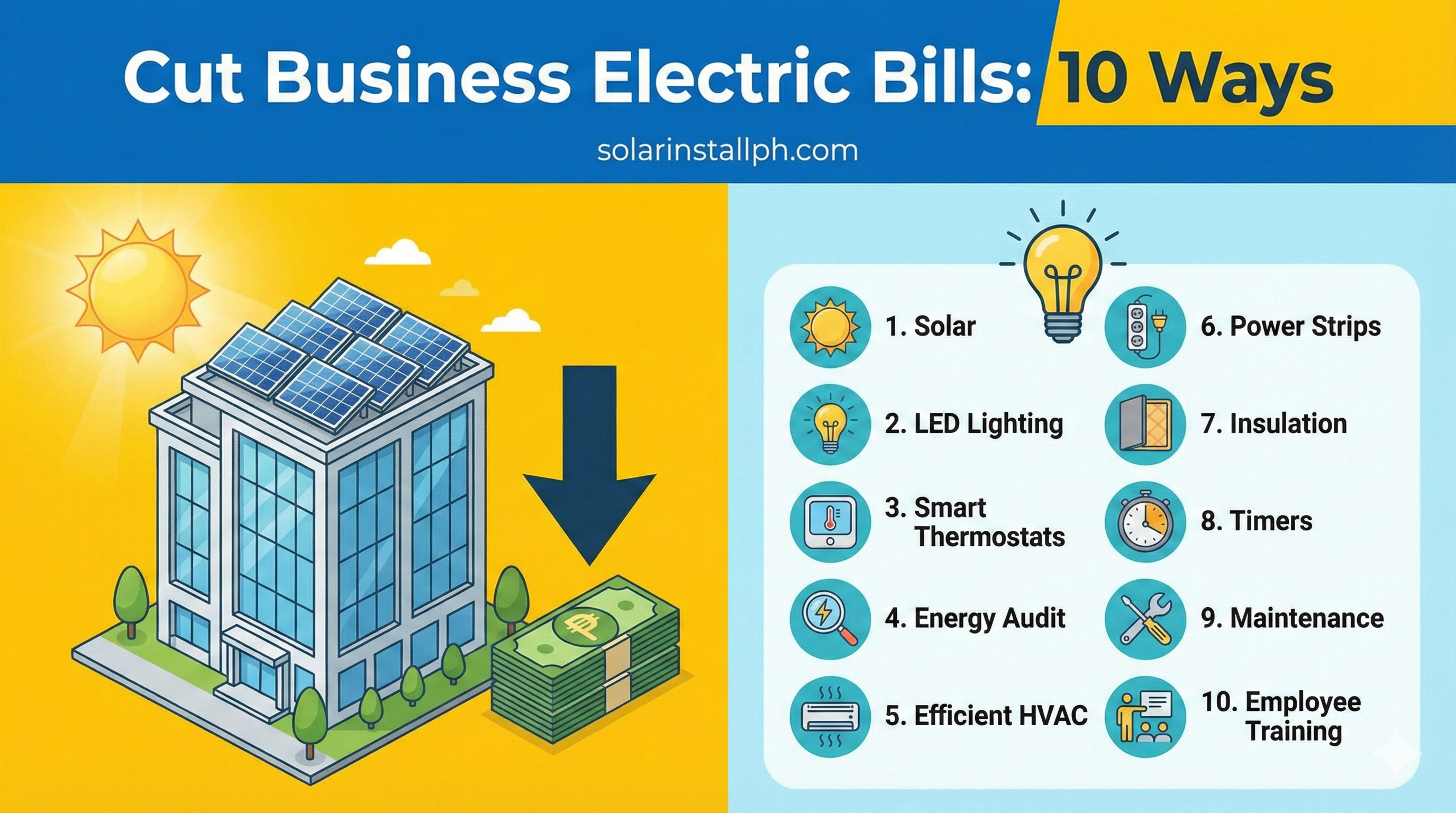
Running a business in the Philippines often feels like working just to pay Meralco. With commercial electricity rates hovering between ₱10 and ₱14 per kWh depending on your location and supplier, energy is likely your second biggest operational expense after payroll.
The tragedy is that most Philippine businesses bleed money through inefficiencies they can't see. An old aircon here, a poor power factor there, and a roof baking in the sun—it all adds up to thousands of wasted pesos every month.
Whether you run a small café in Quezon City or a manufacturing plant in Cavite, you don't have to accept these high bills as a fixed cost. Here are 10 practical ways to cut them down, ranked from behavioral fixes to major infrastructure upgrades.
1. Start with an Energy Audit
You cannot fix what you don’t measure. Most business owners only look at the "Total Amount Due" line. To cut costs, you need to know where the power is going.
Is it the servers running 24/7? The old chilling machine? Or the lights left on in the warehouse?
DIY Audit: Check your meter at opening and closing time. Calculate your "base load" (what you burn when the business is closed). If it's high, you have phantom loads.
Professional Audit: For larger facilities, a pro can install data loggers to find voltage imbalances or peak demand spikes.
To understand how a professional assessment works, read our guide on what a solar and energy audit entails.
2. The "Aircon Discipline" (50% of Your Bill)
In a tropical country, cooling typically accounts for 50% to 60% of a commercial electric bill.
The 24°C Rule: Set thermostats to 24°C or 25°C, not 18°C. Every degree lower increases consumption by ~6%. Your office doesn't need to be a freezer; it just needs to be non-humid.
Maintenance: A dirty filter restricts airflow, forcing the compressor to work harder. Clean filters monthly.
Inverter Upgrades: If you are still using non-inverter window or split types, replace them. The ROI on an inverter unit in a commercial setting (running 9+ hours a day) is often less than 12 months.
3. Power Factor Correction (The Hidden Penalty)
This is technical, but it saves serious money for industrial and medium-commercial users.
Power Factor (PF) is a measure of how efficiently you use incoming power. If you run many motors, pumps, or non-inverter ACs, your PF might drop below 85%.
The Meralco Penalty: If your PF is below 85%, Meralco charges a Guaranteed Minimum Billing Demand (GMBD) penalty.
The Fix: Install capacitor banks. These smooth out the flow of power.
The Bonus: If you raise your PF above 95%, you can actually get a discount on your bill.
4. Install "Self-Consumption" Solar
For businesses, solar is a no-brainer because your "peak consumption" (8 AM to 5 PM) matches the sun’s "peak production."
Unlike homes that need batteries for the night, a business can simply install a grid-tied system and use 100% of the power immediately. This offsets your most expensive daytime kWh rates.
ROI: Because you use the power instantly, you save the full retail rate (e.g., ₱12/kWh). Payback is typically 3–5 years.
Asset Value: A solar array is a depreciable asset that lowers your taxable income while cutting opex.
If you are wondering about the investment required, check our breakdown of commercial solar costs in the Philippines.
5. Switch to RCOA (For Big Consumers)
If your monthly average peak demand is 500kW or higher, you are considered a "Contestable Customer" under the Retail Competition and Open Access (RCOA) scheme.
This means you are no longer forced to buy from Meralco or your local coop. You can shop around and sign a contract with a Retail Electricity Supplier (RES) for a lower rate (e.g., ₱6–₱8 per kWh generation charge vs. the standard blended rate).
Note: The threshold is set to lower to 100kW by mid-2026, opening this option to many SMEs.
6. Maximize Tax Incentives
The Philippine government wants businesses to go green, and they have put money on the table to prove it.
BOI Incentives: Under the Renewable Energy Act (RA 9513) and recent amendments, businesses investing in renewable energy for their own use can apply for Income Tax Holidays (ITH) and duty-free importation of equipment.
Net Metering: If your system is under 100kW, you can sell excess power back to the grid.
For a detailed list of what you can claim, review our article on renewable energy incentives for Philippine businesses.
7. Passive Cooling and Insulation
Stop the heat before it enters. If your roof is uninsulated GI sheeting, your aircon is fighting the sun directly.
Roof Insulation: Install PE foam or glass wool insulation. It can drop indoor temperatures by 3–5°C.
Air Curtains: If you run a shop with high foot traffic (like a convenience store), install air curtains above the door. They create an invisible barrier that keeps cold air in and dust/heat out.
Window Tints: For office buildings with glass facades, UV-blocking tints reduce solar heat gain significantly.
8. Smart Lighting and Sensors
LEDs are standard now, but "Smart" is the next step.
Occupancy Sensors: Install these in restrooms, pantries, and meeting rooms. There is no reason for the CR lights to be on when no one is there.
De-lamping: In many warehouses, lighting is excessive. Remove every third bulb or disconnect unnecessary fixtures near windows where natural light is sufficient.
9. Shift Loads to "Off-Peak"
If you are on a Time-of-Use (TOU) rate (common for larger industrial partners), electricity is cheaper during "Off-Peak" hours (usually 9 PM to 8 AM) and Sundays.
Manufacturing: Schedule heavy machinery or batch processing for the night shift if possible.
Batteries: Charge forklifts or electric delivery vans at night.
10. The "Last Out" Protocol
Technology can't fix bad habits. If your staff leaves computers on standby or the AC running in an empty conference room, you are burning cash.
Assign a Marshal: Designate one person per shift to check that all non-essential equipment is off.
Smart Strips: Use power strips that cut power to peripherals (monitors, printers) when the main device (PC) is turned off.
Conclusion: It’s About ROI
Cutting electric bills is not just about "saving"; it is about increasing your bottom line. Every ₱10,000 saved on electricity is ₱10,000 of pure profit.
For most SMEs, the journey starts with the Aircon Discipline and ends with Solar. The payback period for these investments has never been shorter.
Small Office: Start with inverter ACs and LED upgrades.
Factory/Warehouse: Look into Power Factor correction and RCOA.
All Businesses: Assess your roof for solar potential.
Curious about the financial timeline? Read our analysis on office solar payback periods to see real-world numbers.
If you are still on the fence, consider the risks of doing nothing. Rates are volatile. Taking control of your power supply is one of the few ways to stabilize your operating costs in 2025. For more motivation, see our guide on why SMEs should switch to solar.