
Why Typhoon-Proof Your Off-Grid Energy?
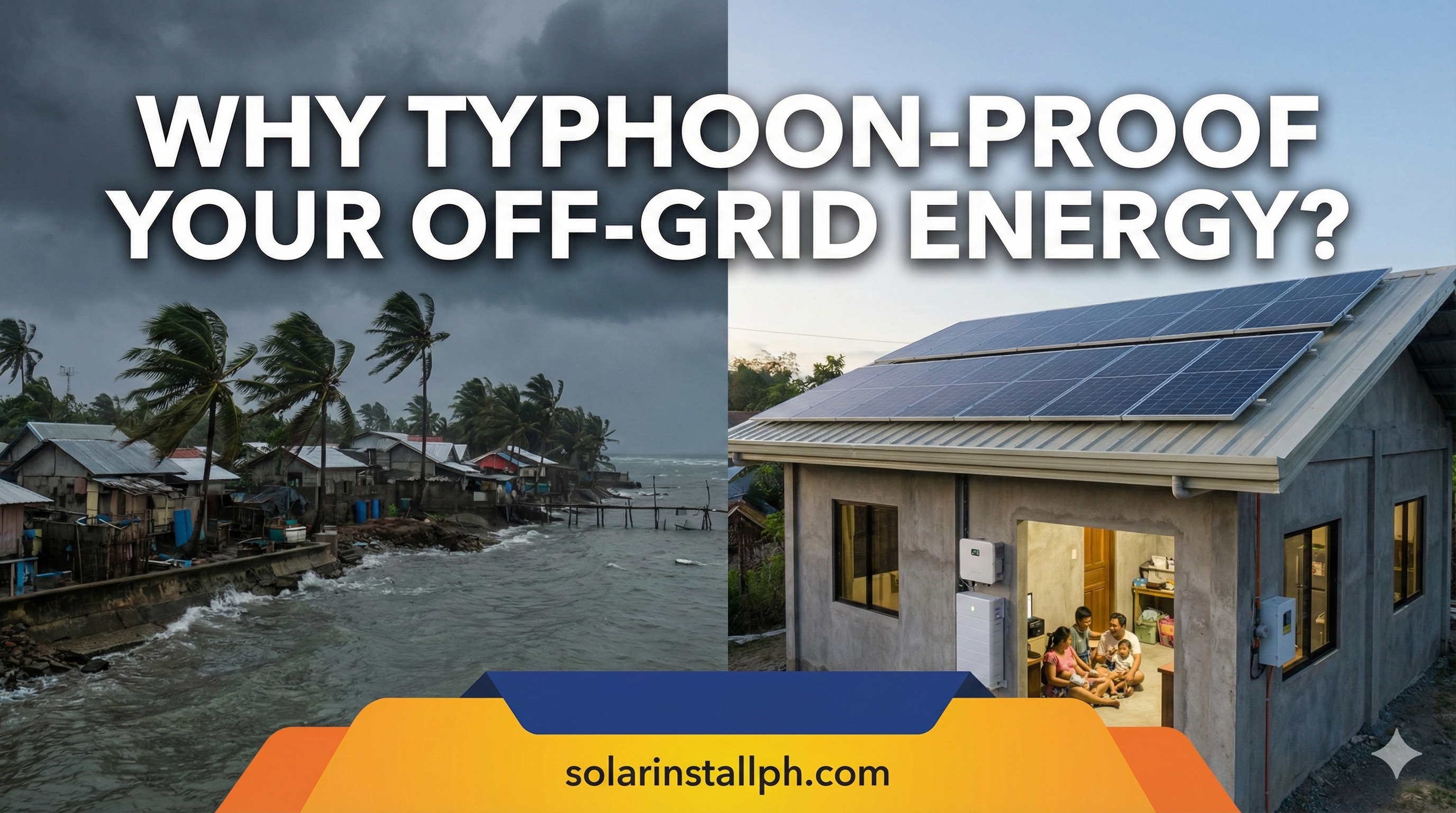
In the Philippines, the decision to go off-grid usually stems from two motivations: frustration with high electricity rates or fear of the next big blackout. Whether you are running a remote resort in Siargao, a farm in Bukidnon, or simply a backup system for your Metro Manila home, the logic is the same: you want independence.
But here is the brutal irony: the very event you are preparing for—the Super Typhoon that knocks out the grid for weeks—is the exact same event that will destroy your solar setup if you built it cheaply.
We saw this clearly after Typhoon Odette ravaged the Visayas in 2021. Thousands of homeowners who had installed "budget" off-grid systems found themselves in the dark alongside everyone else. Their panels were in the neighbor's yard, their inverters were fried by moisture, and their batteries were underwater.
Typhoon-proofing your off-grid energy is not an optional upgrade. It is the difference between having a survival asset and having a pile of expensive scrap metal. Here is why you need to harden your system against the Philippine climate, and how to do it.
The "Survival Paradox" of Cheap Solar
Many Filipinos enter the off-grid market looking for the lowest price per watt. They browse online marketplaces for "complete solar kits" that promise energy independence for ₱50,000. These kits often come with standard mounting rails, generic clamps, and basic lead-acid batteries.
This creates a "Survival Paradox." You buy the system to ensure you have power when the utility grid fails. But standard solar equipment is rated for "normal" weather—maybe 140 kph winds (Signal No. 1 or 2). When a Signal No. 4 typhoon hits, the utility grid will fail, but so will your standard solar system.
If your off-grid system cannot survive the storm that caused the blackout, it has failed its primary purpose. You haven't bought energy security; you've just bought a fair-weather hobby.
To avoid this, you must understand the specific components that fail under stress. Reviewing a comprehensive checklist of essential off-grid components is a good starting point to ensure you aren't missing critical protective gear like surge protection devices (SPDs) or proper racking.
Wind Load: The Force That Rips Roofs
The Philippines sits in the world’s most active typhoon belt. We don't just get rain; we get vertical wind gusts and massive pressure differentials.
Solar panels are essentially giant sails. A standard 500W panel is roughly 2 square meters. When wind hits your roof at 200 kph, it doesn't just push down; it creates a vacuum effect that pulls up. This "uplift" force can tear the panels right off the rails, or worse, rip the rails out of your roof trusses.
The 5400 Pascal Standard
Most budget panels and mounts are rated for 2400 Pascals (Pa) of pressure. That is fine for a sunny day in California. In the Philippines, you need hardware rated for 5400 Pa.
Clamp Failure: Standard clamps loosen under vibration. Typhoon-proof clamps use locking washers and are spaced closer together.
Rail Thickness: Thin aluminum rails bend and snap. You need reinforced 6005-T5 aluminum.
If you are unsure whether your current setup is built for this, read our detailed analysis on typhoon-resistant mounting strategies. It explains why "three rails" are often better than two.
Water and Salt: The Silent Destroyers
While wind gets the headlines, water does the long-term damage. This is especially true for off-grid systems, which rely heavily on batteries.
The Battery Bunker
In an on-grid system, if the inverter gets wet, you lose money. In an off-grid system, if the batteries get wet, you lose your entire power reserve.
Flood Risk: Many homeowners place heavy lead-acid or lithium batteries on the floor of a garage or bodega. In the Philippines, flash floods are common even in areas that don't usually flood. If water touches the terminals of your battery bank, it’s game over.
Humidity: Even without flooding, high humidity can corrode the Battery Management System (BMS) of modern lithium units.
You must elevate your battery bank at least 1 meter off the ground and ensure the enclosure is IP-rated against moisture. Choosing the right chemistry is also vital; Lithium Iron Phosphate (LiFePO4) is generally more robust than older types, but only if the casing is sealed properly. Compare the options in our guide to solar batteries in the Philippines to see which brands offer better environmental protection.
The DIY Trap
The "Do-It-Yourself" culture is strong in the off-grid community. It makes sense—if you are building a system for a remote farm, you want to know how to fix it. However, DIY installations often skip the boring structural work.
We see DIYers using:
Standard J-bolts hooked onto GI sheets (instead of drilling into the purlin).
Regular house wire (THHN) exposed to the sun (instead of UV-resistant PV cable).
Undersized breakers that melt under continuous load.
These shortcuts work fine for 11 months of the year. But during a typhoon, they become liabilities. A loose wire can arc and start a fire in the middle of a storm when the fire department cannot reach you.
If you are determined to build it yourself, you must be brutally honest about your skills. There are severe risks involved. We discuss these candidly in our article on the limits of DIY solar, which highlights where you should draw the line between "handyman work" and "professional engineering."
Maintenance: The Pre-Storm Ritual
Even a professionally installed, typhoon-proof system will degrade over time. The constant thermal expansion and contraction (hot days, cool nights) loosen bolts. Salt spray corrodes grounding wires.
Typhoon-proofing is not a one-time purchase; it is a maintenance discipline. Before the rainy season begins (usually May/June), you should perform a "torque audit."
Check every mid-clamp and end-clamp. If they can be turned by hand, your panels are loose.
Inspect the grounding. If the copper wire has turned green and brittle, replace it. A good ground protects your inverter from lightning surges, which are frequent during typhoons.
Trim the trees. The best mounting system in the world cannot protect your panels from a falling mahogany branch.
For a step-by-step guide on what to look for, consult our resource on solar panel maintenance.
The Economics of "Doing It Twice"
The most compelling argument for typhoon-proofing is financial.
Let’s say you want a 3kW off-grid system.
Option A (Budget): ₱150,000. Uses standard rails, thin wires, and cheap batteries.
Option B (Typhoon-Proof): ₱220,000. Uses reinforced racking, surge protection, elevated battery racking, and premium cables.
You save ₱70,000 with Option A. But when a typhoon hits:
Option A suffers panel damage (cracked cells from vibration) or total loss (blown off roof). You spend another ₱150,000 to replace it, plus the cost of diesel for your generator while you wait for parts. Total cost: ₱300,000+.
Option B survives. You might lose a day of generation due to clouds, but the hardware is intact. Total cost: ₱220,000.
In the Philippines, buying cheap often means buying twice.
Conclusion
Off-grid solar is the ultimate form of energy security, but it demands respect for the environment it operates in. You are not just fighting the utility company's rates; you are fighting physics.
By investing in stronger mounting, better battery protection, and rigorous maintenance, you ensure that your home remains a sanctuary of light and power when the rest of the province goes dark. Do not wait for the wind to howl before you check your bolts. Build it right today, so you can sleep through the storm tomorrow.