
Off-Grid Inverter Sizing Philippines: A Collection
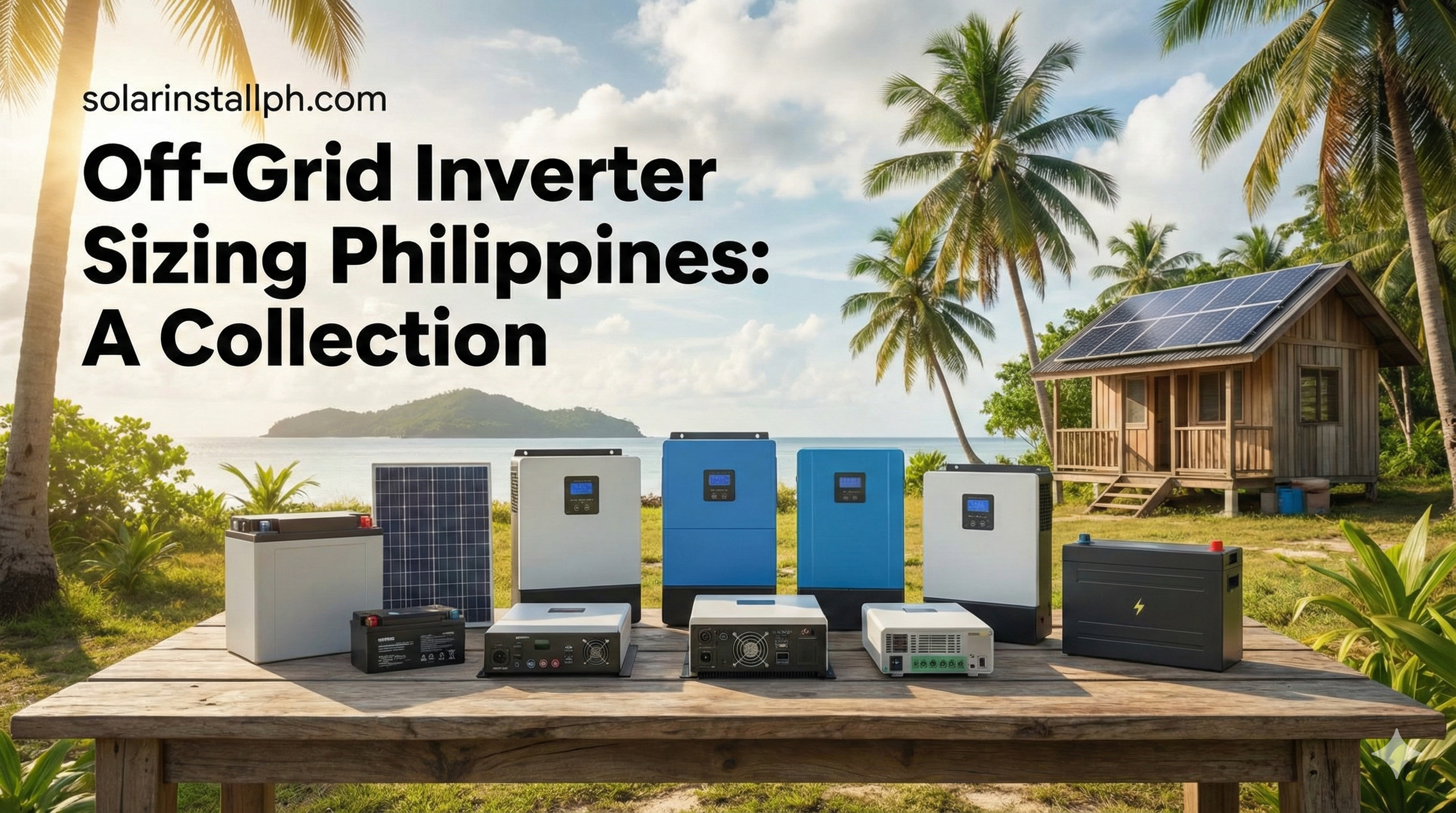
In the Philippines, "Off-Grid" used to mean a small hut in the mountains with a single light bulb. Today, it means something entirely different. It means subdivisions in Cavite ensuring their work-from-home setup survives a scheduled Meralco maintenance. It means farms in Batangas running submersible pumps without waiting for the coop to fix a downed line.
But off-grid solar is unforgiving. Unlike grid-tie systems where the utility covers your mistakes, an off-grid inverter that is too small will simply shut down—usually when you need it most.
Sizing an off-grid inverter is not just about adding up watts. It is about understanding "surge," managing system voltage, and choosing the right architecture. Here is a collection of the most critical sizing rules and strategies for Philippine homes in 2025.
1. The "Continuous vs. Surge" Rule
The most common mistake Filipino DIYers make is buying an inverter based on the label wattage of their appliances.
You might look at your refrigerator and see "150 Watts" on the back sticker. You think, "Great, a 500W inverter can run three of these!"
Wrong.
Compressor-based appliances (refrigerators, air conditioners, water pumps) have a Surge Power (or starting current) that is 3 to 5 times their running wattage. A 150W ref might need 750W for a split second just to wake up. If your inverter cannot handle that spike, it will trip its overload protection immediately.
The Sizing Formula
To find your minimum inverter size, use this two-step calculation:
Total Running Watts: Sum of all lights, fans, TV, and Wi-Fi that will be on simultaneously.
Surge Requirement: Take your largest motor-driven appliance (usually the ref or water pump) and multiply its rated watts by 3. Add this to the running watts of everything else.
Example:
5 LED Lights (50W) + 2 Electric Fans (120W) + Wi-Fi (10W) = 180W Running.
Inverter Ref (150W Running). Surge = 150W x 3 = 450W.
Minimum Inverter Size: 180W + 450W = 630W.
Safety Margin: In practice, we round up significantly. For the load above, a 1kW or 1.5kW inverter is the practical choice to prevent overheating in our tropical climate.
2. Low Frequency vs. High Frequency: The "Pump" Decision
Not all inverters are built the same. When browsing shops in Raon or online, you will see two main types. Your choice depends entirely on what you are powering.
High Frequency (Transformerless)
These are the lightweight, sleek boxes (often white or modern-looking).
Best For: Electronics, lights, TVs, computers, and inverter-type aircons.
Pros: Cheaper, lighter, more efficient at low loads.
Cons: Terrible at handling massive surges. If you try to start a 1HP non-inverter water pump, you might fry the MOSFETs (internal switches).
Low Frequency (Transformer-Based)
These are the heavy, ugly metal boxes with a massive copper transformer inside.
Best For: "Inductive loads" like deep well pumps, heavy-duty power tools, and older non-inverter air conditioners.
Pros: Built like a tank. Can handle surges up to 300% of its rating for several seconds.
Cons: Heavy, expensive, and has higher standby power consumption (it eats battery even when doing nothing).
The Verdict: For most modern Filipino homes full of "Inverter" appliances (inverter ref, inverter AC), a High Frequency unit is fine. If you run a farm with a deep well pump, you must use a Low Frequency inverter.
For more on selecting components for specific needs, check our off-grid solar guide.
3. The System Voltage Hierarchy (12V vs. 24V vs. 48V)
You cannot separate inverter sizing from battery voltage. As you go up in inverter wattage, you must go up in DC voltage to keep your system safe and efficient.
Here is the standard "Voltage Hierarchy" for Philippine setups:
12V System: reliable only up to 1,000W.
Why? pulling 2,000W at 12V requires massive cables (almost as thick as your thumb) to prevent fire. It is inefficient and dangerous for whole-home use.
24V System: The "Sweet Spot" for 1kW to 3kW.
Use Case: Small sari-sari stores, tiny homes, or backup for lights/fans/ref only.
48V System: The Standard for 3.5kW to 10kW+.
Use Case: Standard family homes running aircons. 48V keeps the amps low, allowing you to use standard, affordable wire sizes and reducing heat loss.
Rule of Thumb: If you plan to run an air conditioner, do not even look at 12V or 24V inverters. Go straight to 48V.
See how these voltages impact your battery choices in our comparison of solar battery capacities.
4. The "Brownout-Proof" Sizing Strategy
In the Philippines, many "off-grid" inverters are actually installed as Hybrid backups in grid-connected homes. The goal is to survive a brownout.
When sizing for backup, you don't need to power the whole house. You only need to power your Critical Loads.
The 5kW Standard
A 5kW 48V Inverter has become the default "standard" for Filipino middle-class homes.
It provides enough power to run 1 window-type inverter aircon (1HP), a refrigerator, lights, TV, and internet simultaneously.
It has enough headroom to start the ref compressor without lights flickering.
If you are on a tight budget, you might be tempted by a 3kW unit. Be warned: a 3kW unit will struggle if someone accidentally turns on a microwave or a hair dryer while the aircon is running. The price difference between 3kW and 5kW is often small enough that 5kW is the safer long-term investment.
5. Standby Consumption: The Silent Battery Killer
Every inverter uses power just to stay "on." This is called No-Load Power Consumption.
Cheap Off-Grid Inverters: Can consume 50W–80W just idling. Over a 12-hour night, that’s nearly 1kWh of battery drained—enough to run a small aircon for an hour!.
Premium Inverters: Often consume <15W in "Eco Mode."
When sizing your battery bank, you must account for this "ghost load." If your inverter burns 50W constantly, you need to add an extra solar panel just to feed the inverter itself.
To see how this affects your total costs, review our breakdown of solar system lifespan.
6. Temperature Derating (The Philippine Factor)
Most inverters are rated at a standard temperature of 25°C.
The Philippines is rarely 25°C. Inside a concrete garage or unventilated shed at noon, temperatures can hit 35°C or 40°C.
As heat rises, electronics become less efficient. An inverter rated for 5,000W might only be able to safely deliver 4,000W when the ambient temperature is 40°C.
Sizing Tip: Never plan to run your inverter at 100% load continuously. Aim for 70-80% load max. This buffer accounts for our tropical heat and ensures your equipment lasts longer than its warranty.
Summary: The Quick Sizing Collection
If you want a cheat sheet for 2025, here are the common "packages" that work for specific Filipino lifestyles:
Setup Profile | Inverter Size | System Voltage | Inverter Type |
"Camping / Emergency" (Lights, Phone, 1 Fan) | 500W - 1kW | 12V | High Freq |
"Baryo Basic" (Lights, TV, Karaoke, Ref) | 2kW - 3kW | 24V | High Freq |
"Farm / Deep Well" (Submersible Pump 1HP) | 3kW - 5kW | 48V | Low Freq |
"City Backup" (Aircon, Ref, Wi-Fi, PC) | 5kW - 6kW | 48V | High Freq |
"Big House" (Multiple ACs, Water Heater) | 8kW - 12kW | 48V | High Freq |
Choosing the right inverter is the difference between a peaceful night's sleep and waking up in a sweat because the breaker tripped.
For those ready to install, make sure you also consider the physical mounting. Check our guide on solar mounting for typhoon resistance to ensure your panels stay on the roof while your inverter keeps the lights on.
And if you're looking for specific brands that handle these loads well, visit our list of top solar inverters for 2025.