
Filipino Utilities: Power Shift Challenges?
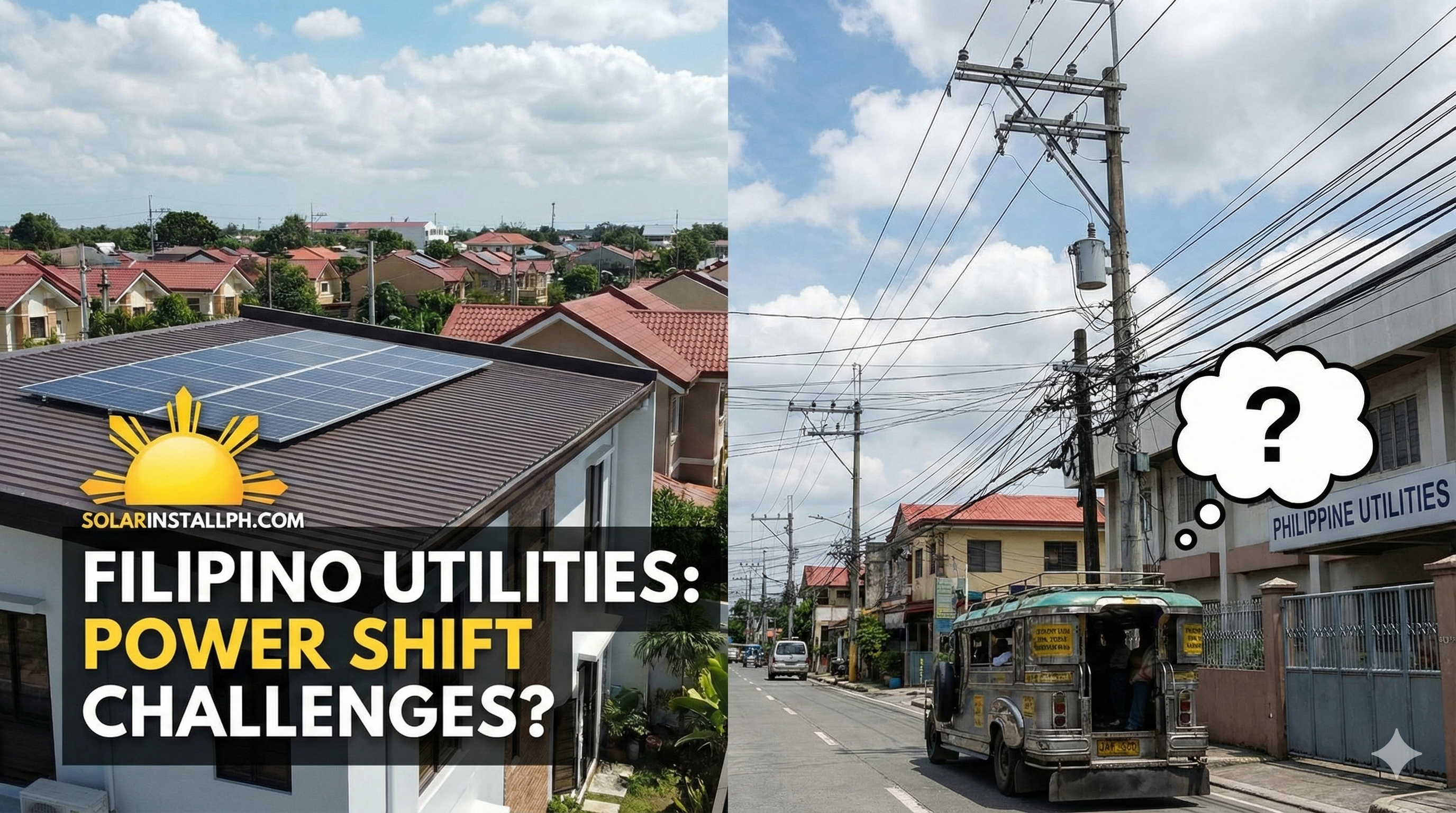
If you have tried to apply for Net Metering in late 2025, you might have noticed a shift in tone from your electric company. A few years ago, solar applicants were treated as novelties. Today, you are viewed as a "grid variable"—a mini power plant that complicates their math.
The Philippines is undergoing a massive "Power Shift." We are moving from a centralized model (where a few big coal plants feed everyone) to a decentralized one (where thousands of homes feed the grid).
While this is great for your wallet and the planet, it is a logistical nightmare for the utilities. Meralco, NGCP, and provincial electric cooperatives are struggling to adapt their 20th-century infrastructure to 21st-century prosumers.
Here is a look at the real "Power Shift Challenges" facing Filipino utilities in 2025, and what they mean for your solar application.
1. The "Duck Curve" Has Landed
For years, energy experts warned about the "Duck Curve"—a phenomenon where the grid gets flooded with solar power at noon (when demand is low), followed by a steep ramp-up in demand at 6:00 PM (when solar vanishes).
In 2025, this is no longer a theory; it is a daily headache for the National Grid Corporation of the Philippines (NGCP).
The Problem: At 12:00 PM, thousands of homes are exporting excess power. This drops the "net load" on the grid significantly.
The Shock: At 5:00 PM, the sun sets, and everyone turns on their lights and appliances. The grid suddenly loses gigawatts of solar supply and has to instantly fire up diesel or gas peaker plants to fill the void.
This rapid fluctuation stresses the transmission lines and transformers. For the utility, it increases the risk of frequency imbalances, which can trigger the "Red Alerts" we have seen frequently this year.
2. The "Saturation" of Local Circuits
This is the most common reason for Net Metering denials or delays in 2025.
Your local neighborhood transformer has a limit. In the past, it only had to worry about delivering power. Now, it has to worry about receiving it.
If you live in a wealthy subdivision where 40% of your neighbors already have solar, your local transformer might be "saturated." It cannot physically handle any more backflow current without risking an explosion or voltage swell.
What this means for you:
Distribution Impact Studies (DIS) are becoming stricter. Utilities are now modeling worst-case scenarios before approving new connections.
You might be asked to pay for a transformer upgrade (costing Php 50,000+) just to connect your 5kW system.
Check our guide on grid-tie capacity limits to understand if your area might be at risk.
3. The Revenue Death Spiral
Let’s be blunt: Utilities lose money when you go solar.
Under the Net Metering scheme, they not only sell you less power, but they also have to pay you for your exports. With the new 2025 ERC rules allowing for indefinite banking of credits, homeowners are wiping out even more of their bills.
The Fear: As more affluent customers (who typically pay the highest bills) leave the grid or net meter to zero, the utility is left with fewer paying customers to support the fixed costs of maintaining the poles and wires.
The Reaction: This financial pressure is why some electric cooperatives (ECs) drag their feet on processing applications. They lack the technical and financial buffer of a giant like Meralco.
If you are dealing with a slow-moving coop, read our article on challenges with Net Metering to navigate their specific hurdles.
4. The Data Gap: "Blind" Grids
A major challenge is that many Philippine utilities are flying blind.
While Meralco has rolled out smart meters in Metro Manila, many provincial utilities still rely on analog technology. They don't know exactly how much solar is being pumped into their lines at any given second until a fuse blows.
Shadow Solar: Many homeowners install "Zero Export" systems without informing the utility. While these don't export, they still mess with the utility's load forecasting.
The Fix: Utilities are rushing to install Advanced Metering Infrastructure (AMI), but it is expensive and takes time. This is why they demand expensive "REC Meters" or specific bidirectional meters—they need the data to keep the grid stable.
5. The Policy vs. Reality Disconnect
The Department of Energy (DOE) and Energy Regulatory Commission (ERC) have passed aggressive policies to encourage solar, such as the streamlined Certificate of Compliance (COC) process.
However, the utilities and Local Government Units (LGUs) are the gatekeepers.
The disconnect: The ERC says "process this in 20 days." The LGU says "we need to inspect your 20-year-old building permit first."
The result: A backlog of applications. As of late 2025, thousands of homeowners are technically ready to turn on their systems but are stuck in administrative limbo.
If you are stuck in this phase, see our primer on DOE and ERC solar policies to know your rights and what you can legally demand.
Conclusion: How to Cope
The "Power Shift" is messy, but it is inevitable. The utilities are not villains; they are massive ships trying to turn in a tight harbor. They are upgrading transformers, digitizing grids, and retraining engineers as fast as they can.
For the Homeowner:
Be Patient: The days of 2-week approvals are gone. Budget for 3-4 months of processing.
Be Transparent: Do not install "guerrilla solar" (connecting without permission). It endangers linemen and destabilizes the grid you rely on.
Consider Batteries: The ultimate solution to grid constraints is to keep your power. By storing your excess instead of exporting it, you bypass the saturation issue entirely.
Next Step: If you want to help the grid (and yourself), look into Meralco's net metering guide to ensure your application is "utility-friendly" from Day 1. Or, if the grid in your area is hopeless, explore zero export solutions to start saving immediately without waiting for the new meter.