
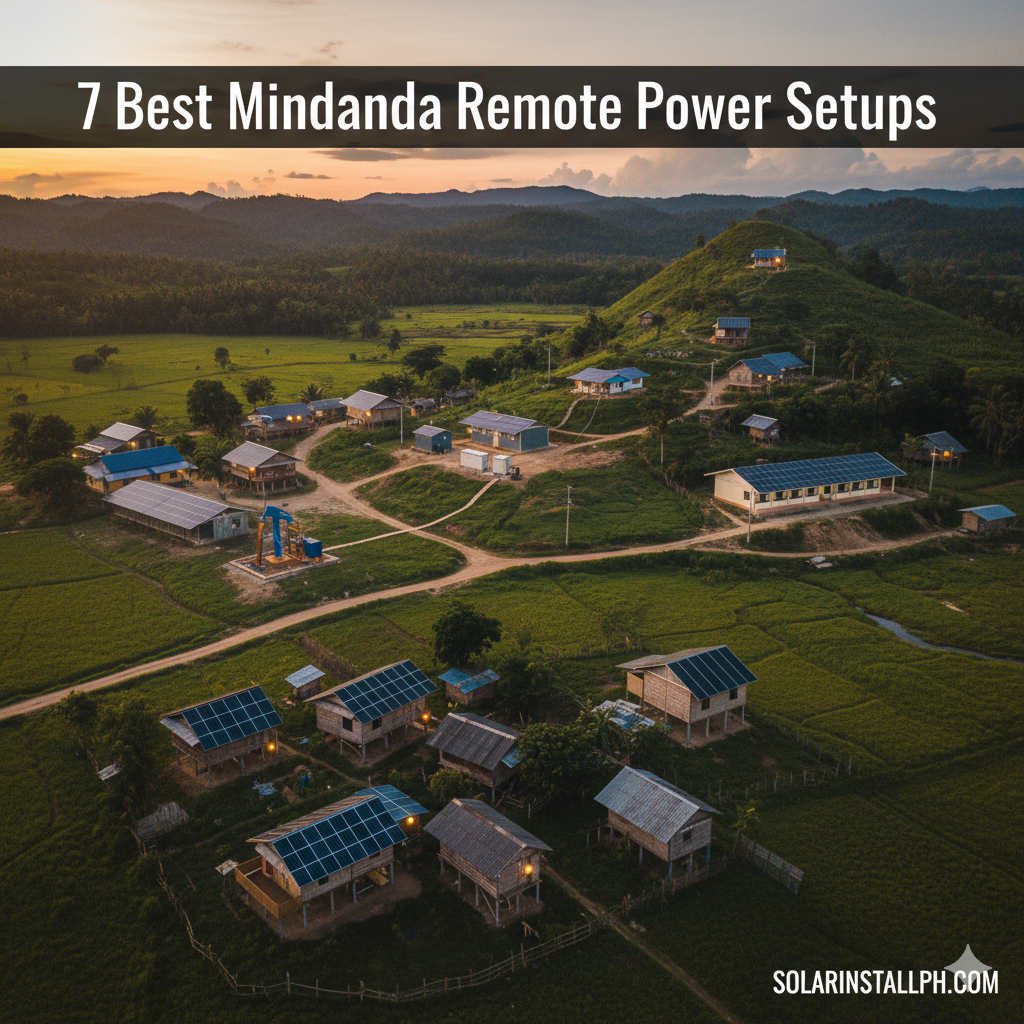
7 Best Mindanao Remote Power Setups
Mindanao is currently at the center of the largest rural electrification push in Philippine history. With the National Electrification Administration (NEA) allocating over ₱2.5 billion specifically for Mindanao’s Geographically Isolated and Disadvantaged Areas (GIDA) in 2025 and 2026, the region is rapidly moving away from its historic reliance on expensive, dirty diesel.
For homeowners, farm owners, and community leaders in remote provinces like Bukidnon, Sulu, or Davao del Sur, the question is no longer about grid availability—it is about which off-grid configuration offers the best resilience. Here are the 7 best remote power setups tailored for the unique challenges of the Mindanao landscape.
1. The "Sitio Starter" Solar Home System (SHS)
This is the most common entry-point for off-grid families in GIDA areas. Through the Solar PV Mainstreaming Program, the government is deploying tens of thousands of these units to reach "last-mile" households.
Configuration: A 50W to 100W panel paired with a small 12V lithium control box.
Capability: Powers 3–4 LED bulbs, a transistor radio, and mobile phone charging for a family of five.
Best For: Conflict-affected or geographically isolated sitios where transporting heavy equipment is impossible.
2. Productive Use "Agri-Solar" Systems
Mindanao’s agricultural heartland is leveraging solar to move up the value chain. In regions like Kalamansig, solar-powered post-harvest facilities are now used to process raw coffee beans into finished powder.
Configuration: 5kW to 10kW ground-mounted arrays with industrial-grade inverters.
Capability: Runs machinery for corn shelling, coffee roasting, or solar-drying equipment.
Best For: Farming cooperatives in Bukidnon and South Cotabato that need to lower operational costs and increase selling prices.
3. Solar-Powered Level 3 Water Pumps
Access to clean water is a primary challenge in rural Mindanao. Solar-powered pumps are replacing manual hauling and expensive diesel pumps in remote barangays.
Configuration: Direct-drive DC pumps powered by a dedicated solar array (no batteries needed if used for daytime reservoir filling).
Capability: Pumps water from deep wells to communal tanks for entire villages.
Best For: Upland communities where water-borne diseases and labor for water hauling are prevalent.
4. Resilient Coastal Solar-Diesel Hybrids
For island provinces like Camiguin, Sulu, and Tawi-Tawi, pure solar isn't always enough due to seasonal cloud cover. The National Power Corporation (NPC) and private developers are now pushing for hybridization.
Configuration: A large-scale solar array (50kW+) integrated with an existing diesel generator and a significant battery bank.
Capability: Provides 24/7 power to an entire island barangay, using solar during the day and saving diesel for rainy days or peak night loads.
Best For: Island municipalities where fuel logistics are difficult and expensive. For these setups, calculating the correct solar battery capacity is the difference between constant power and a dark night.
5. Residential Off-Grid "Estate" Systems
For retirees building homes in the mountains of Davao or Misamis Oriental, a high-capacity off-grid solar system is now a standard requirement. These users expect urban comforts in a remote setting.
Configuration: 3kW to 8kW of Tier-1 solar panels with a 10kWh to 20kWh Lithium Iron Phosphate (LiFePO4) battery bank.
Capability: Powers a modern home including a refrigerator, television, multiple fans, and even a high-efficiency inverter air conditioner.
Best For: Sustainable homesteads and eco-resorts that want to skip the "coal phase" of energy entirely.
6. Portable "Cloudgrid" Kits for Disaster Relief
Mindanao is prone to both seismic activity and severe weather. Portable solar kits, such as the "Solar Cloudgrid" units deployed in Surigao, provide immediate power when traditional infrastructure fails.
Configuration: All-in-one portable power stations with foldable or rigid 100W panels.
Capability: Emergency lighting and vital communication (mobile phones/radios) during post-disaster recovery.
Best For: Disaster-prone coastal areas and mobile health clinics that need to move power where it’s needed most.
7. Solar-Powered Educational "Smart-Centers"
In 2025, the NEA reported energizing dozens of "last-mile" public schools in Mindanao using renewable storage solutions. This allows remote students to access the same digital tools as their urban peers.
Configuration: 2kW to 5kW systems optimized for daytime use with moderate battery backup.
Capability: Runs computers, digital projectors, and Starlink satellite internet terminals for rural classrooms.
Best For: Public schools in remote mountain barangays that are far from electric cooperative lines.
Critical Factors for Mindanao Installs
Building a power system in Mindanao is different from building one in Metro Manila. You must account for three specific regional realities:
Typhoon and Wind Load Resilience
While Southern Mindanao is often outside the traditional typhoon belt, Northern Mindanao and the Caraga region face increasing storm intensity. Every remote setup must prioritize typhoon-resistant mounting systems. Using standard aluminum rails without proper wind-load certification can result in panels being ripped off during a Signal No. 3 storm.
Salt Air and Corrosion
Coastal installations in the Zamboanga Peninsula or the Sulu Archipelago must deal with high-salinity environments. All mounting hardware should be stainless steel or anodized aluminum, and electronics must be housed in NEMA-rated enclosures to prevent salt-mist from corroding inverter circuit boards.
Sizing and Budgeting
A common mistake in Mindanao is undersizing a system to save on upfront costs. In a remote area, the cost of a repair technician traveling to your site can exceed the cost of the hardware itself. It is often cheaper to invest in a higher residential solar cost upfront for better quality components than to deal with a failure 50 kilometers from the nearest city.
For those concerned about long-term reliability in the face of local grid instability, having a dedicated solar backup power strategy ensures that even if a local cooperative line goes down, your essential loads remain running.
Conclusion
Mindanao’s move toward decentralized, renewable power is not just about environmentalism—it is about economic survival. From solar-powered coffee processing in the south to hybrid microgrids on the islands of the west, these seven setups represent the best of what is currently possible in 2026. By choosing the right configuration for your specific load and local environment, you can secure reliable, low-cost power regardless of how far you are from the main grid.