
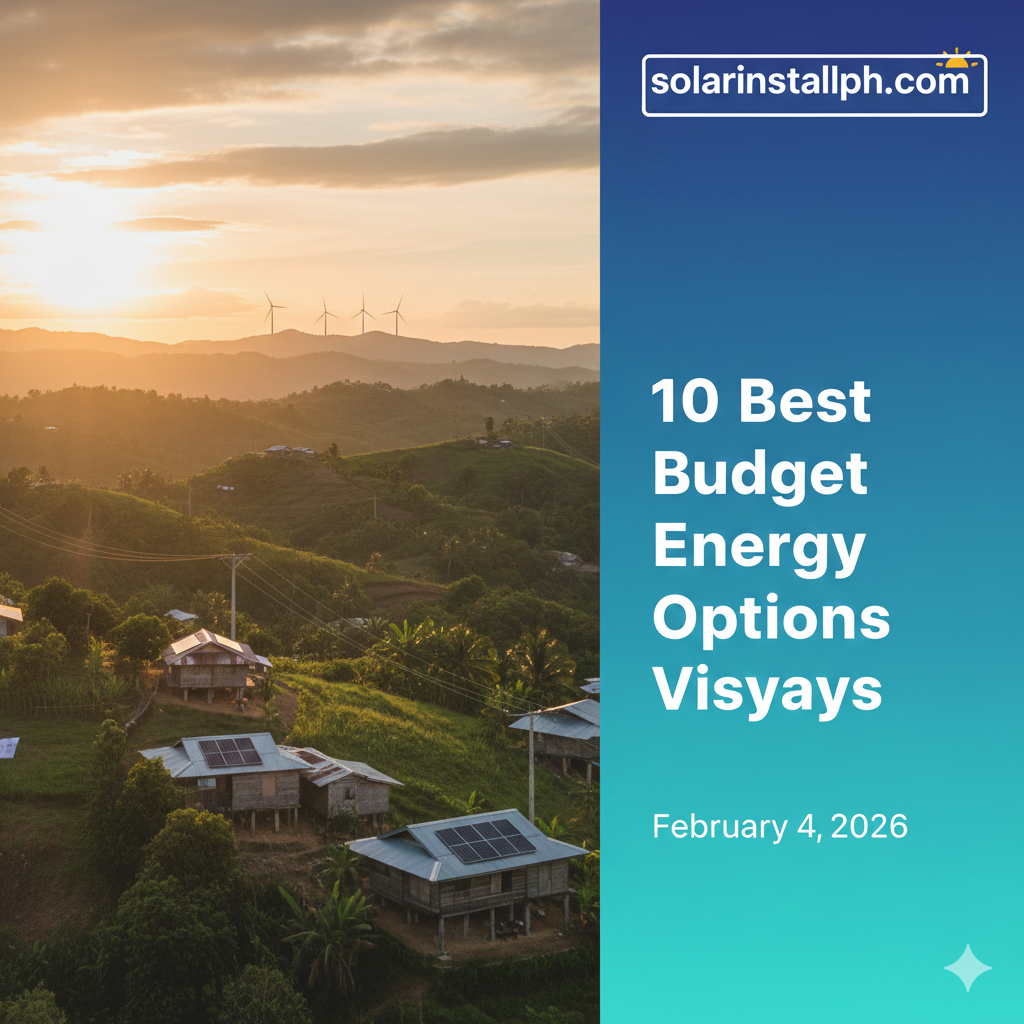
10 Best Budget Energy Options Visayas
The Visayas region is currently facing a dual energy reality. On one hand, it boasts some of the world’s most significant geothermal resources, particularly in Leyte and Negros. On the other hand, electricity rates remain a major concern for the average household. In early 2026, residential rates in the Visayan Electric (VECO) franchise area settled around ₱12.51 per kWh, while consumers in parts of Iloilo saw rates climbing toward ₱14 per kWh due to thin power supply margins and high spot market prices.
For residents of Cebu, Iloilo, Bacolod, and the surrounding islands, finding budget-friendly energy options is no longer just about environmentalism; it is about economic survival. Here are the 10 best budget energy options and strategies currently available in the Visayas to help you manage costs and secure your power supply.
1. Grid-Tied Solar (Net Metering)
For homeowners in urban centers like Cebu City or Bacolod, grid-tied solar remains the most effective long-term budget option. By installing a system that feeds excess power back into the utility grid, you can earn credits that offset your nighttime consumption.
While the residential solar cost for a 3kWp system typically starts around ₱150,000, the ROI in the Visayas is often faster than in other regions because of the high local generation charges. Many homeowners find their monthly bills reduced by 40% to 60%, making this a prime choice for long-term savings.
2. Zero-Export Solar Systems
If you want the benefits of solar without the administrative hurdle of the solar COC (Certificate of Compliance) or the waiting time for a bi-directional meter, a zero-export system is the budget-friendly shortcut. These systems use a "smart limiter" to ensure that no electricity flows back to the grid. This is an ideal solution for small businesses in Iloilo or Cebu that operate primarily during daylight hours and want immediate bill reduction with minimal red tape.
3. Solar Street Lights for Perimeter Security
Instead of wiring traditional outdoor lights to your main meter, many Visayan households are switching to standalone solar street lights. These are especially popular in coastal areas of Negros and Bohol where salt air can corrode traditional wiring.
Modern solar street lights are now integrated with motion sensors and Lithium Iron Phosphate (LiFePO4) batteries, providing 10–12 hours of illumination for a one-time purchase price of ₱3,000 to ₱7,000. This is a "zero-operating-cost" solution for home security.
4. Portable Power Stations for Brownout Protection
The Visayas grid is prone to "Yellow Alerts" during the peak summer months of April and May. For many, a full battery backup system is too expensive. The budget alternative is the portable power station.
These units can be charged via a standard wall outlet or a small solar blanket. A 500Wh unit can keep your fans, Wi-Fi, and phones running for several hours during a scheduled rotational brownout. It is a cost-effective insurance policy for those who work from home in the tri-cities of Cebu, Mandaue, and Lapu-Lapu.
5. High-Efficiency LED Retrofitting
The simplest "green" boost to your budget is a total shift to high-efficiency LEDs. The Department of Energy (DOE) Visayas Field Office recently launched campaigns urging a 10% reduction in household consumption through simple retrofits.
Replacing old 40W fluorescent tubes with 18W LEDs can save a typical 100kWh household nearly ₱150 per month. In the context of the Visayas, where rates are volatile, reducing your base load is the first step toward energy independence.
6. Solar-Powered Water Pumps for Agri-Residential Use
For residents in rural areas of Panay or Samar who rely on deep wells, electricity for water pumping can be a hidden drain on the budget. Small-scale solar-powered water pumps allow households to haul water for gardens and livestock without adding a single peso to their electric cooperative bill.
These kits often bypass the need for expensive inverters by using DC-powered pumps that connect directly to one or two solar panels.
7. Passive Cooling and Natural Ventilation
Visayan architecture, specifically the traditional Bahay na Bato style, was built for energy efficiency. Modern homeowners can adopt "budget energy" by using reflective roof paints and increasing attic insulation.
Lowering the temperature of your home by just 2 to 3 degrees Celsius can reduce air conditioning runtime by 15% to 20%. In a region where peak sunlight hours are intense, managing thermal gain is just as important as generating power.
8. Time-of-Use (TOU) Management
While not yet universal for all residential consumers, many electric cooperatives in the Visayas are moving toward Time-of-Use pricing for larger residential loads. By shifting heavy tasks like laundry, ironing, or dishwashing to "off-peak" hours (usually late at night or early morning), users can take advantage of lower generation rates. Check with your local cooperative—such as ILECO, CEBECO, or BOHECO—to see if a TOU program is available for your meter type.
9. DIY Solar "Mainstreaming" Kits
For the ultimate budget-conscious user, 100W to 200W "mainstreaming" kits are becoming popular. These are small, standalone systems designed to power just 2-3 bulbs and a phone charger. These are highly effective for coastal communities or mountain barangays where the grid is unreliable. While they won't run a refrigerator, they provide the "best budget" entry point for those wanting to test solar technology before committing to a full rooftop installation.
10. Community-Based Renewable Energy (CBRE)
Keep an eye on local government initiatives. Under the Energy Efficiency and Conservation (EE&C) Act, several LGUs in Negros Occidental and Cebu are piloting community solar projects. Residents can sometimes "subscribe" to a portion of a community solar array, receiving credits on their bills without having to install panels on their own roofs. This is a burgeoning option for renters and condo dwellers who are typically excluded from traditional solar benefits.
Evaluating Your Options
When choosing a budget energy strategy in the Visayas, consider the "avoided cost." If your local cooperative charges ₱13/kWh, every watt you save or generate yourself is worth more than it would be in a lower-rate region.
Quick Comparison Table
Option | Upfront Cost | Monthly Savings | Complexity |
LED Retrofit | Low (₱2,000+) | 10–15% | Very Low |
Solar Street Lights | Low (₱3,000+) | ₱50–₱100/light | Low |
Portable Power Station | Mid (₱15,000+) | N/A (Backup) | Low |
Zero-Export Solar | High (₱100k+) | 30–50% | Medium |
Grid-Tied Solar | High (₱150k+) | 50–70% | High (Permits) |
Common Mistakes to Avoid
Buying "Unlabeled" Appliances: Always look for the DOE Energy Label (Yellow Label). A cheaper non-inverter appliance might save you ₱5,000 at the store but cost you ₱20,000 extra in electricity over its lifetime.
Skipping Local Permits: Even for budget systems, safety is paramount. In cities like Cebu, skipping the proper solar site prep or LGU electrical permits can lead to fines or system failure during typhoons.
Ignoring Maintenance: Salt air is the enemy of energy systems in the Visayas. Ensure your solar panels are cleaned regularly and your mounting hardware is made of stainless steel or high-grade aluminum to prevent rust.
FAQ
Which Visayan city has the cheapest electricity?
Rates vary monthly. Historically, Negros and Panay have benefited from local RE sources, but transmission bottlenecks often push rates up. Always check your latest bill's "Generation Charge" for the most accurate data.
Can I run an aircon on a budget solar kit?
Usually, no. A 100W or 200W kit is for lights and gadgets. To run a typical 1.0 HP inverter aircon, you need at least a 1.5kWp to 2kWp professionally installed rooftop system.
Is solar worth it if I rent my house in Cebu?
Yes, but look for portable options. A portable power station or small "plug-and-play" kits are better for renters than permanent rooftop installations.
Conclusion
The Visayas region is at the forefront of the Philippine energy transition. While the grid faces challenges, the abundance of geothermal, solar, and wind potential makes it the ideal place to adopt decentralized energy. By starting small with LEDs and solar lights, and moving toward rooftop solar when the budget allows, Visayan households can take control of their utility costs and contribute to a greener future.